
A field director starts the morning with three spreadsheets open, a voter file downloaded from a data provider, and a canvassing list assembled by someone who won’t be available after lunch. One file uses full street names, another abbreviates them, and a third contains records that have already been contacted. By afternoon, volunteers are standing outside the wrong homes, turf assignments overlap, and headquarters can’t tell whether a missing result reflects a failed shift or a failed upload.
That isn’t a minor administrative inconvenience. Campaign data management determines whether voter intelligence reaches the right person, in the right geography, at the right moment. A reliable operation treats data as a living field system, not a file that gets purchased, cleaned once, and forgotten.
The Hidden Cost of Fragmented Voter Files
The familiar failure begins with a harmless request: “Export the latest list.” A staff member downloads a CSV, opens it in a spreadsheet, removes a few columns, changes the headers, and sends it to the person responsible for turf. That person discovers duplicate addresses, missing apartment numbers, inconsistent precinct labels, and records that don’t match the canvassing application’s existing voter IDs.
The list still looks complete. That appearance creates the danger.
A campaign can have thousands of rows and still lack a dependable field plan. Duplicate records inflate the apparent universe. Stale addresses send volunteers to doors that no longer belong to the intended voter. A precinct mismatch can place a perfectly valid voter outside the district being targeted. None of those problems necessarily appears as an obvious system error. They surface as wasted volunteer time, confused residents, incomplete surveys, and reports that staff can’t confidently interpret.
Practical rule: A list isn’t operationally ready because it opened successfully. It’s ready when the campaign can explain where each record came from, how it was matched, and which geography controls its assignment.
Where manual handoffs break
Fragmentation usually creates several versions of the truth:
- The vendor file: A broad source containing voter records, history, geography, and available attributes.
- The campaign spreadsheet: A manually filtered copy with local notes and staff edits.
- The turf file: A subset shaped for routes, often with renamed fields or removed identifiers.
- The field app: The version volunteers see, which may lag behind every other copy.
- The reporting sheet: A separate artifact used to summarize completed contacts.
Each handoff introduces a decision. Someone chooses which row to keep, which address format to accept, and whether a near-match represents the same person. Those decisions often happen under deadline pressure, without a change log or record-level ownership. When a volunteer reports an unexpected result, the field director may not know which version produced the assignment.
A practical voter list management workflow reduces that uncertainty by treating ingestion, matching, geographic assignment, field activity, and reporting as connected operations. The value isn’t limited to fewer spreadsheet tasks. It gives staff a way to trace a field result back to the record and workflow that generated it.
Why the costs stay hidden
Fragmented systems don’t always fail loudly. They fail through small losses that accumulate across a shift:
- A canvasser walks past a duplicate door because another volunteer already received the same address.
- A route includes a property outside the target boundary.
- A survey response gets attached to a stale record.
- A coordinator manually reconciles completion totals instead of redeploying a team.
- A manager delays a decision because the dashboard and the field app disagree.
The campaign may describe each event as a volunteer issue or a mapping issue. The underlying problem is usually pipeline design. The system allows records to move without preserving identity, geography, status, and provenance together.
Continuous workflows solve a different problem than one-time list building. They establish rules for importing new records, resolving matches, recording changes, assigning turf, and synchronizing field activity. That structure lets the field team spend its time talking to voters rather than proving which spreadsheet is current.
Evolution of the Modern Voter Database
A field director can still lose hours to a simple question: which voter file is current? One team exports a CSV after canvassing, another edits a copy for phone outreach, and a third imports the results into a reporting system. Each handoff creates another chance to lose a match, overwrite a status, or separate a voter response from the record it belongs to.
Campaign databases grew more complex as voter contact moved beyond isolated lists. Identification, persuasion, and turnout operations began sharing records, responses, geographic information, and digital engagement. The database became an operating layer for field decisions, not just a directory of names.
A major milestone came during the Obama-era expansion of campaign analytics. A widely discussed example involved a campaign using commercial database software to combine a large Democratic voter file with online interaction data, as described in an account of the evolution from canvassing lists to predictive campaign databases. The operational change mattered more than the software itself. Campaign staff could connect voter history, survey responses, and digital activity instead of maintaining separate lists that required manual reconciliation.
State-level election efforts showed the same shift through structured call-center research. Teams contacted voters for short interviews and conducted longer interviews to build predictive profiles and issue models. The practical lesson remains clear: modeling depends on consistent identifiers, disciplined collection, and a workflow that can turn a response into a field action without repeated CSV exports.
From contact list to managed operating system
A contemporary voter database may combine:
- State and national voter files
- Public records and survey responses
- Social media data collected lawfully and appropriately
- Third-party voter data
- Canvassing outcomes and volunteer observations
- Geographic boundaries, precincts, and turf definitions
The number of records does not determine the system’s value. Each record needs a stable identity, a current location, a clear source, and a defined status. Staff should be able to distinguish an imported voter from a matched voter, a contacted voter, and a record that requires review.
That distinction becomes difficult when every team exports its own file. A unified, API-driven canvassing workflow can pass status changes, survey outcomes, assignments, and contact history between connected systems while preserving the record’s identity. Staff spend less time comparing column headers and more time deciding where to send people next.
Maintenance is a campaign function
The practical benchmark is ongoing maintenance. During an active campaign, teams should perform at least a light cleanup every month, then conduct a deeper pass at milestones such as filing deadlines, early vote, and Election Day. The voter list maintenance guidance treats list quality as a continuing discipline rather than a one-time preparation task.
A light cleanup can check duplicate records, failed matches, incomplete addresses, invalid statuses, and recent field updates. A deeper pass should revisit the assumptions behind targeting and routing. If staff wait until a major push to clean the file, questionable records have already shaped planning, volunteer training, and turf preparation.
The database should support a closed operational loop:
- Ingest: Bring in source records while retaining source information.
- Resolve: Match records to existing identities and flag uncertain matches.
- Enrich: Add lawful survey, contact, and geographic information.
- Activate: Assign records to persuasion, identification, or turnout work.
- Capture: Record field outcomes in the same operational system.
- Review: Use new results to correct records and refine assignments.
That loop turns campaign data management into a maintained operating process. It limits the hidden labor of fragmented files and gives field, organizing, and analytics teams a shared record of what happened.
Building a Reliable Ingestion and Geocoding Pipeline
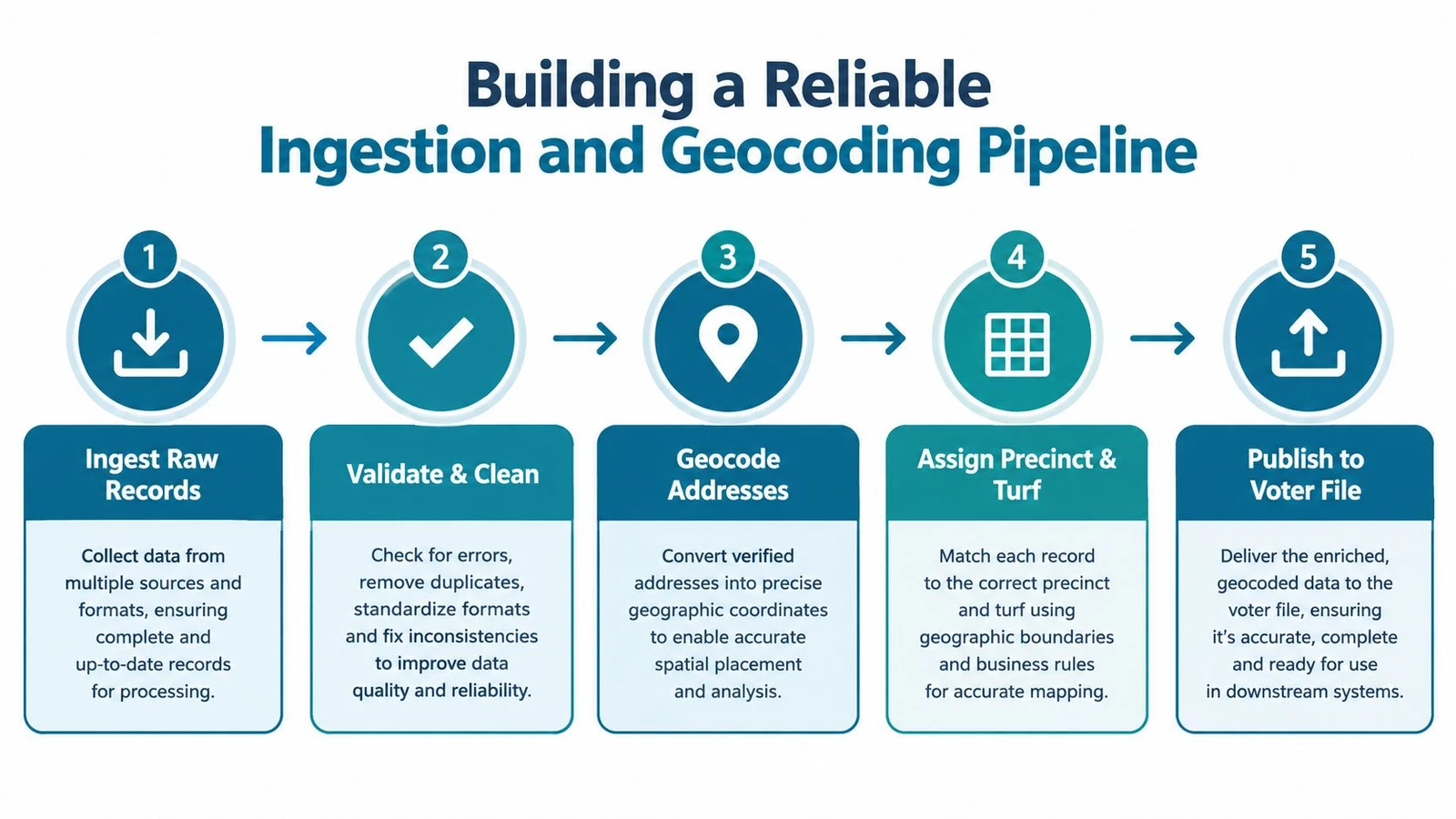
A canvassing route can fail before a volunteer reaches the first door. A voter record may have the wrong precinct, an incomplete unit number, or coordinates outside the campaign’s target boundary. The name can be correct while the assignment is wrong. Each error consumes staff review time, volunteer hours, and sometimes a full turf shift.
Geography is the control point between a voter record and a field assignment. The ingestion pipeline should validate records before it creates routes. Accepting a file only confirms that the system received it. It does not confirm that the data is usable.
Start with raw records
Keep the first version of every import intact. Preserve the original file, source label, import time, and identifiers supplied by the source. Staff can create a normalized working version, but they should not overwrite the raw material. Without that separation, later corrections become difficult because no one can tell which changes came from the source and which came from internal cleaning.
A reliable intake process standardizes field names and data types before matching begins. Street numbers, unit identifiers, postal codes, precinct labels, contact statuses, and voter IDs should follow a defined schema. The schema can stay simple. It needs enough consistency for automatic validation, error reporting, and repeatable imports.
A field operation may receive CSV, JSON, or Excel records. Each format should pass through the same matching, validation, and geographic checks. A dedicated voter file upload workflow can apply those checks at import, reducing the manual work required to prepare each file.
The file format matters less than the controls around it. Staff need an import log, clear rejection reasons, and a way to correct failed records without rebuilding the entire upload.
Deduplicate before routing
Deduplication requires more than searching for identical names. Names vary, households share addresses, and source files often contain typographical differences. Matching logic should use the strongest available combination of identifiers, then send uncertain cases to a review queue instead of merging them automatically.
Useful checks include:
- Stable identifiers: Prefer voter or source IDs when they remain reliable.
- Address combinations: Compare normalized street number, street name, unit, locality, and postal information.
- Household review: Keep separate voters at one address unless the available data supports a legitimate merge.
- Status history: Preserve previous contact outcomes instead of replacing them with a new import.
- Conflict flags: Escalate records with contradictory geography or identity fields.
A bad deduplication rule can create more work than it removes. Merging two voters may erase meaningful contact history. Retaining every duplicate may send multiple teams to one address or inflate the apparent size of a turf. The right process makes uncertainty visible and gives staff a controlled way to resolve it.
Geocode with traceability
Election GIS guidance recommends a consistent geocoding strategy, automated validation against multiple geospatial reference sources, and record-level lineage or metadata for each residence. The Election Assistance Commission guidance on voter list maintenance describes comparing geocoded addresses with precinct data to improve assignment accuracy and identify outliers.
Apply that guidance through practical safeguards:
- Normalize the address before geocoding.
- Store returned coordinates and match status.
- Record the reference source that supported the match.
- Compare each point with precinct, district, and campaign polygons.
- Flag points outside an expected boundary.
- Keep the original address beside the normalized version.
- Require review before a low-confidence match enters a route.
The metadata matters as much as the map point. If a route looks wrong, staff need to determine whether the cause was an incomplete address, an ambiguous geocode, an outdated boundary, or a later manual edit. Without that history, troubleshooting becomes guesswork and the same error can reappear in every export.
Publish only validated geography
A route generator should use the validated voter layer, not the raw upload. After records pass identity and geographic checks, the system can assign precincts, turfs, and walkable routes. Custom polygons can represent a campaign boundary that does not align neatly with a standard precinct, while preserving the relationship between the voter, the polygon, and the final assignment.
The operational trade-off is speed versus silent error. An import that skips validation appears fast until volunteers find incorrect routes in the field. A controlled pipeline adds review points, but it keeps questionable records from spreading into turf plans, assignments, and downstream reporting.
Replacing Manual Exports with Integrated Data Workflows
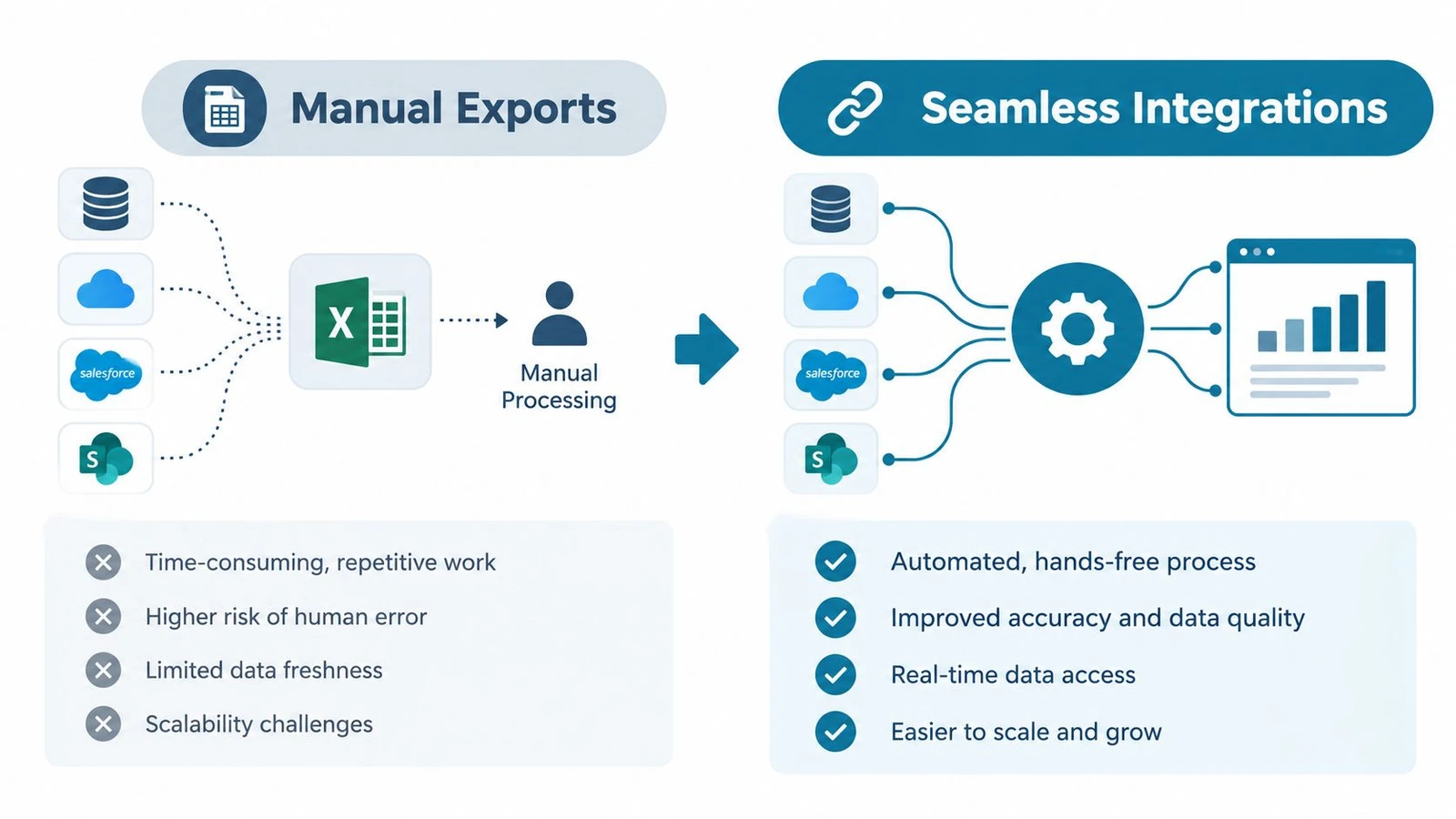
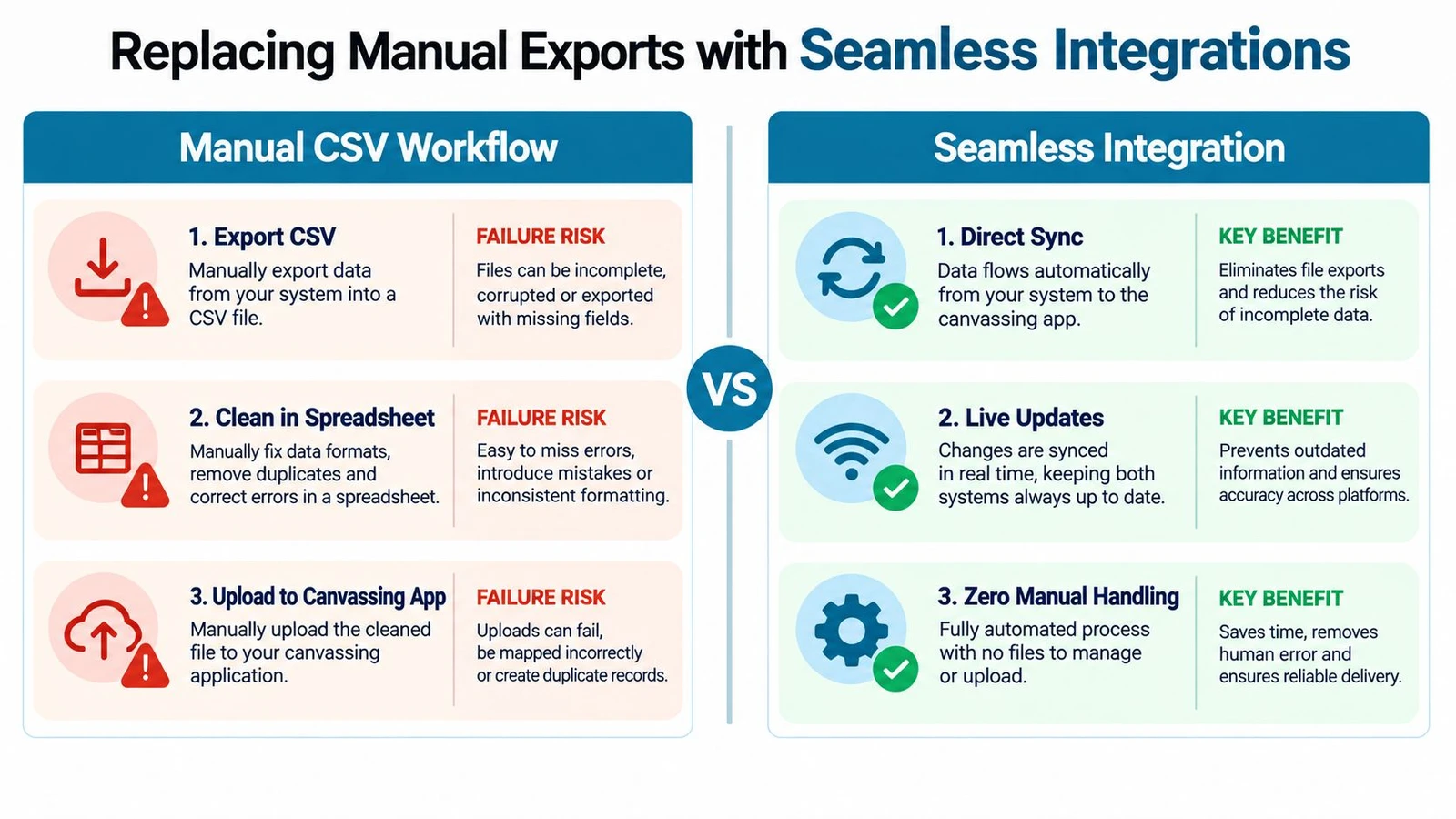
A field director can lose a morning to a simple targeting change. Someone exports a list, opens the CSV, removes records, adjusts columns, uploads the file, checks the mapping, and then discovers that yesterday’s contact results did not carry over. The work appears routine, but every handoff creates operational cost: staff time, version confusion, and another opportunity to damage the working dataset.
An API-driven connection assigns those steps to defined rules. The campaign sets filters, identifiers, update behavior, and failure handling once. The system then moves approved records into field operations without relying on one administrator’s memory of which spreadsheet is current.
Manual export versus connected workflow
The important difference is not only convenience. It is where the campaign pays for each update cycle and how much risk each handoff introduces.
| Manual handoff | Integrated operation | Operational cost |
|---|---|---|
| Staff export a broad file and filter it locally | Filters for state, race, party, and history run at the source | Repeated file preparation and local version risk |
| Spreadsheet edits change the working copy | Matching and field mapping follow defined rules | Manual changes can create inconsistent fields |
| A new upload can overwrite current statuses | Sync rules preserve operational history | Reconciliation is required after each replacement |
| Turf is cut after several disconnected steps | Approved records move into route generation | Delays between targeting and field assignment |
| Staff reconcile reports from multiple versions | Field activity returns to a shared operational view | Reporting time shifts from analysis to cleanup |
The table makes the trade-off visible. Manual work may seem flexible because staff can edit anything in a spreadsheet. That flexibility also makes the process difficult to audit. A connected workflow limits uncontrolled changes, then records what was accepted, rejected, added, or updated.
Automation still requires governance. The campaign must define permissions, field meanings, retention rules, and a review process for failed records. A connection only applies the rules it receives. If those rules are vague, the system can repeat a bad decision consistently.
A practical integration pattern
A targeted voter data service can return records using campaign-selected filters, including per-record pricing, state and race criteria, party information, and voter history. The integration transfers those records into the canvassing environment, where matching and geocoding prepare them for turf assignment.
The workflow removes several fragile actions:
- Downloading a new file after every targeting change
- Renaming columns by hand
- Removing records in a local spreadsheet
- Uploading a revised copy into a separate application
- Checking whether the latest import replaced prior field results
The field director remains responsible for deciding whom the campaign should contact. The system handles the repetitive transfer of that decision into operational tools, leaving staff more time to review targeting and field performance.
Teams assessing a broader architecture can also review Doczen operational data sync for a practical perspective on keeping operational records aligned across connected systems. The same principle applies to campaign data management. Synchronization should run as a maintained operating process, with ownership and failure handling, rather than as a file transfer someone performs when a deadline arrives.
What automation does not solve
An API connection cannot repair ambiguous targeting criteria or poor source data. If the campaign selects an overly broad universe, the integration moves the wrong records efficiently. If staff change field definitions without documenting them, automated updates can produce consistent confusion across every downstream view.
A workable control set includes:
- Define which system owns identity, geography, contact status, and survey results.
- Set rules for additions, changes, and removals.
- Log failed matches and rejected records.
- Test a small sample before activating a new filter.
- Give field staff visibility into list freshness and record status.
The goal is to reserve human judgment for targeting, messaging, and field decisions. Repetitive file handling should follow documented rules, produce an audit trail, and fail visibly when the source data does not meet those rules.
Navigating Privacy and Compliance in Field Apps
A canvassing app doesn’t collect neutral administrative information. It may hold voter contact outcomes, issue responses, household notes, volunteer identities, location information, and internal assessments. Treating that material as ordinary spreadsheet content creates legal and reputational exposure.
The assumption that “the campaign owns the list” is too simple. The campaign may have permission to use one field for one purpose without having a defensible basis to retain every note indefinitely, share every field with every partner, or reuse contact information in another jurisdiction.
An Open Rights Group report on voter privacy and election canvassing apps raises a public-interest concern that voter-contact application data can be shared with data brokers for commercial benefit. That risk changes the operational question. Staff need to ask not only whether an app can store notes, but also who can access those notes, how reuse is controlled, and what happens when the campaign no longer needs them.
Minimize before securing
Security controls matter, but the safest sensitive field is often the one the campaign never collects. A survey should capture the information required for the stated purpose, not every detail a volunteer might find interesting. Free-text notes need especially careful boundaries because a volunteer can enter health information, family circumstances, or allegations that the campaign has no reason to retain.
A workable policy should define:
- Permitted fields: What canvassers may record.
- Restricted content: What must never appear in free text.
- Access roles: Which staff can view, edit, export, or delete records.
- Retention periods: How long each class of data remains necessary.
- Export controls: When a download is allowed and who approves it.
- Incident handling: How the campaign reports and investigates exposure.
Consent and notice should be understandable to the people being contacted. Volunteers also need clear instructions. A field worker who doesn’t know the boundary between a useful contact outcome and an intrusive personal note can undermine an otherwise strong privacy program.
Build an audit trail
A compliant workflow needs more than a privacy statement. It should show what happened to a record. Audit logs can identify imports, edits, exports, access events, and deletions. Record lineage can connect a field observation to the user and campaign activity that created it.
Privacy regulation also affects measurement. A 2026 industry analysis says GDPR, CCPA, browser restrictions, and mobile privacy rules removed 30–40% of previously trackable conversions, while only 32% of marketers trust their data and 87% say data-driven marketing is critical, according to the documented 2026 marketing analytics analysis. These figures concern marketing data broadly, not election canvassing specifically, but they illustrate the same governance pressure: campaigns can’t assume that every observable signal is available, accurate, or lawful to retain.
Technical teams that need a practical framework for automating privacy controls for CTOs can use that resource to think through access, monitoring, and policy enforcement. For campaign staff, the takeaway is more direct. Privacy must be built into the data workflow before volunteers collect information, not added after an incident.
Unifying Offline Capture with Real-Time Analytics
Fieldwork happens where connectivity is inconsistent. A volunteer may lose service between apartment buildings, in a rural area, or while moving through a dense neighborhood. If the app requires a live connection for every form submission, the campaign forces the volunteer to choose between delaying the conversation and writing sensitive information somewhere else.
Offline-first capture gives the volunteer a local working queue, contact forms, route information, and a secure way to record outcomes without continuous service. The system then synchronizes changes when connectivity returns. That design only works if the campaign has defined conflict rules, local encryption, identity controls, and a clear status for records waiting to sync.

Separate capture from availability
An offline result can be valid even when it isn’t immediately visible at headquarters. The system should distinguish among:
- Captured on the device
- Queued for synchronization
- Accepted by the central system
- Rejected for a data or identity conflict
- Available for reporting and reassignment
Without those states, managers may interpret a temporary connectivity gap as a failed contact. Volunteers may also resubmit the same result when they don’t know whether the first attempt succeeded, creating duplicates.
Synchronization needs an explicit conflict policy. If two devices update the same record, the system might preserve both events, prefer the most recent authorized change, or send the conflict to staff review. The correct choice depends on the field model, but silent overwriting is rarely acceptable.
Turn live visibility into same-day action
A dashboard earns its place when it changes a decision before the shift ends. A field director should be able to see which routes have started, which teams are moving slowly, where completion is concentrated, and which assignments remain untouched. Those signals can support practical interventions:
- Reassign a volunteer from a completed route to an uncovered turf.
- Send a trained canvasser to a complicated apartment building.
- Adjust the evening target when a neighborhood is taking longer than expected.
- Ask a coordinator to investigate devices with unsynchronized results.
- Preserve a high-priority route for a team with the right training.
This is the operational value of connecting offline mobile collection to real-time analytics. The campaign doesn’t need every record to appear instantly. It needs trustworthy visibility into what has been captured, what is pending, and what action remains possible.
A field director comparing platforms should examine why live canvassing data matters in 2026, particularly the relationship between route completion, team activity, and same-day reporting. A dashboard that only produces an end-of-day report is a historical record. A dashboard that exposes actionable gaps while volunteers are still in the field is an operating instrument.
Scaling Data Operations for Election Day
A local race and a congressional contest may use different targeting plans, volunteer structures, and reporting demands, but both need the same foundation. Records must remain identifiable, geography must remain accurate, field activity must return to the central system, and staff must know which information is current.
Scale exposes weak processes quickly. More users create more opportunities for duplicate edits. More turf increases the cost of a boundary error. More frequent updates make manual exports harder to reconcile. A campaign doesn’t solve those pressures by adding another spreadsheet or giving every coordinator unrestricted access.
A scalable operating checklist
Before a major field push, campaign managers should verify:
- Source control: Every active list has a documented origin and owner.
- Matching rules: New records are matched consistently, with uncertain cases flagged.
- Geographic validation: Addresses are checked against the relevant precinct, district, or campaign boundary.
- Turf logic: Routes are balanced for the actual walking environment, not just divided by row count.
- Offline behavior: Devices can capture work without continuous connectivity and show sync status clearly.
- Permissions: Volunteers, coordinators, analysts, and administrators receive different levels of access.
- Reporting definitions: Completion, contact, refusal, persuasion, and turnout statuses mean the same thing across teams.
- Integration resilience: Failed syncs, rejected records, and API interruptions have visible queues and recovery procedures.
Tiered plans, expanded logins, and custom API access can support larger teams when those capabilities match the campaign’s operating model. They shouldn’t be treated as substitutes for clean ownership and documented rules. A large account with unclear data responsibilities produces confusion at a larger scale.
The most durable campaigns treat data maintenance as part of field leadership. Staff schedule cleanup, review exceptions, test new imports, and audit permissions alongside volunteer recruitment and route planning. That discipline protects Election Day operations because the team isn’t discovering its data model during the busiest phase of the campaign.
Campaign data management works when it stays close to the people using the information. A voter file becomes an operational asset only when ingestion, geography, contact capture, privacy, synchronization, and reporting function as one dependable loop.
Campaign teams that are still moving voter lists through manual exports can replace those handoffs with a connected canvassing workflow, offline capture, automatic matching, route planning, and live field reporting through doornoc. Review the current pipeline, identify the handoff that creates the most rework, and visit the platform to build a cleaner path from voter data to action.
Looking for a tool to run this? doornoc’s canvassing software bundles voter data, automatic turf cutting, the mobile app, and live reporting in one platform.