
82% of political professionals say political technology is necessary, but only 42% are satisfied with the tools they already use. That gap matters because GOTV software is supposed to improve field execution, not just organize a contact list.
| Capability area | What weak software does | What effective software needs |
|---|---|---|
| Route planning | Creates uneven turf and wastes volunteer time | Builds balanced, walkable routes |
| Offline fieldwork | Fails when connectivity drops | Stores contacts locally and syncs later |
| Voter data handling | Forces manual imports and cleanup | Matches and geocodes records automatically |
| Field visibility | Leaves managers guessing | Shows live progress and completion status |
| Volunteer privacy | Exposes too much voter data | Limits access by role and device |
The GOTV Software Satisfaction Gap
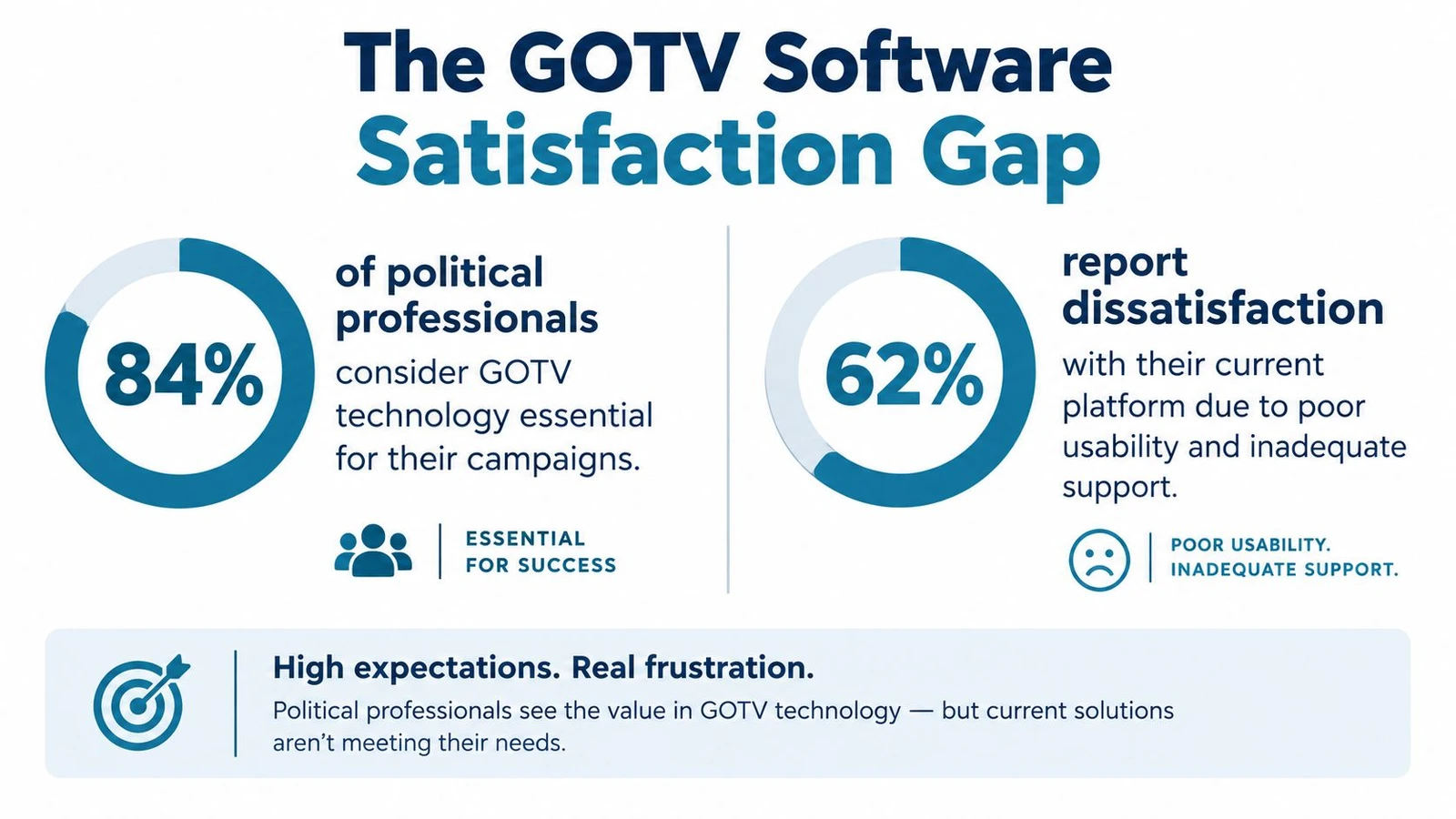
82% of political professionals say political technology is necessary, but only 42% are satisfied with the tools they already use. The gap matters because GOTV software is supposed to improve field execution, not just store contacts. A separate survey also found that improved voter outreach or engagement ranked at 53%, followed by data and analytics at 48% and cost or budget efficiency at 43% (2024 Post-Election Political Professional Survey). The pattern is clear. Campaigns have accepted software as a requirement, but many still do not trust it to support field operations cleanly.
What satisfaction depends on
The useful question is whether a platform handles the messy parts of a field program, route creation, live updates, volunteer assignments, and contact history without slowing people down. A system can be installed across a campaign and still fail at the moments that matter, especially when dozens of volunteers work the same turf at once.
That is why the satisfaction gap should be read as an operations warning. Campaigns often end up with software that covers one slice of the job, then forces staff to patch the rest with spreadsheets, exports, and manual follow-up. The result is predictable, field teams lose time, managers lose visibility, and data quality slips.
Practical rule: if a platform makes a field director reconcile contact records after every shift, it is not reducing workload, it is moving the workload around.
The internal logic is simple. If campaigns already see technology as necessary, then dissatisfaction usually means the software is underperforming in usability, coordination, or support. The selection standard should therefore be operational reliability, not feature count. A useful starting point is the working definition of what GOTV covers in practice, especially when teams need the software to fit live canvassing rather than abstract planning.
From Field Experiments to Digital Platforms
The reason GOTV software matters is rooted in field evidence, not marketing. A landmark randomized field experiment conducted before the November 1998 U.S. election found that personal canvassing increased turnout, direct mail had a smaller effect, and telephone contact produced no statistically meaningful effect. A later synthesis cited in the evidence base places personal canvassing at roughly 8.7% turnout increase, compared with about 0.06% for direct mail (Cambridge APSR field experiment).
Why the software layer exists
That finding created the logic for modern canvassing systems. If face-to-face contact is the highest-value field method in the evidence base, then the software should protect the quality of that contact by helping teams organize routes, assign volunteers, and record outcomes accurately. The goal is not to replace the human interaction, it is to make sure the interaction happens at scale with less waste.
The historical arc is visible in the way field programs now operate. Manual turf cutting gave way to digital route generation. Paper sheets gave way to offline mobile logging. Post-canvass guesswork gave way to dashboards and completion tracking. The software layer became valuable because it preserves the core intervention, personal contact, while reducing the friction that used to limit how many doors a team could reach in a day.
Operational takeaway: technology adds value when it shortens the distance between a voter list and a completed conversation.
A later body of GOTV research expanded the empirical base substantially. One review notes that Green and Gerber’s 2015 meta-analysis included 187 U.S. field experiments, and another large randomized study involved 22,500 precincts and 17.1 million citizens (large-scale GOTV evidence). That scale matters because it explains why campaign software now has to support measurement, not just mobilization.
The best way to read that history is as a shift from intuition to accountability. The more campaigns learned about what works, the more they needed systems that could document who was contacted, when, by whom, and with what result. The software is not the strategy. It is the operational wrapper that makes the strategy repeatable. For a practical field comparison, door knocking and phone banking behave very differently in real campaigns, which is exactly why software must preserve channel-specific contact data.
Core Features of Effective GOTV Software
The strongest GOTV software tends to do three things well, it builds sensible routes, it keeps voter data clean, and it survives weak connectivity in the field. Everything else is secondary if those functions break during canvass day. A campaign can live with a plain interface, but it can’t live with lost interactions or broken turf.
Routing and turf generation
Route generation should do more than sort addresses. It should produce walkable turf that respects real geography, keeps volunteer effort balanced, and minimizes dead time between doors. Software that ignores road layout, natural barriers, or route length forces canvassers to burn time on avoidable backtracking, which lowers the number of meaningful conversations a shift can support.
The better test is simple. Can a field lead cut turf quickly, distribute it fairly, and understand at a glance whether a route is too dense, too sparse, or too scattered? If not, the routing layer is just a map.
Voter matching and data intake
Data intake matters because field teams are rarely working from perfectly formatted lists. A good platform should accept uploads without turning staff into data clerks, then match and geocode records with minimal manual correction. When campaigns can import a list and send it directly into turf planning, the operation stays focused on voter contact instead of file cleanup.
If the campaign team spends a full morning fixing list formatting, the platform is competing with the field plan instead of supporting it.
Offline capture and live visibility
Offline-first design is not a convenience feature. It is a field requirement. Volunteer teams move through neighborhoods with inconsistent service, and canvassers still need to log conversations, dispositions, and notes while disconnected. Once the device reconnects, the software should sync cleanly without overwriting the day’s work.
Live dashboards matter for the same reason. Field directors need to know which routes are finished, where teams are lagging, and which turf can be reassigned before the day ends. That is how a manager adjusts tactics mid-shift rather than after the opportunity has passed.
For teams comparing workflow support across operational software, a useful parallel comes from AI agents for customer support, where the core issue is also continuity between front-line work and centralized tracking. The channel is different, but the operational principle is the same, software earns trust when it keeps live work visible without burdening the user.
Selecting Software for Your Campaign Size
Campaign size changes the software test. A neighborhood race, a citywide ballot initiative, and a statewide turnout program do not need the same configuration, even if they all want better door contact. The right selection process starts with the shape of the field operation, not the product brochure.
Small campaigns
Small teams should optimize for quick setup, clear navigation, and low overhead. The software needs to help a limited staff launch fast, load a contact list without friction, and get volunteers into the field with minimal training. If the platform requires a long setup cycle, a small campaign will feel that delay immediately because there is no spare operations staff to absorb it.
The decision filter is practical. Can a manager create turf quickly, brief volunteers in minutes, and review completed contacts without opening multiple systems? If the answer is no, the tool is too heavy for a small field program.
Larger campaigns
Larger operations need different safeguards. They need stronger analytics, more structured access controls, and more confidence that data will stay synchronized across teams, shifts, and geographies. A campaign that manages many volunteers cannot rely on memory or informal check-ins, it needs a system that records completed work cleanly and supports reuse across field offices.
The scale question also affects support. As the campaign grows, onboarding quality, troubleshooting speed, and interoperability matter more than feature lists. Procurement should focus on four friction points: time from campaign setup to first completed route, synchronization reliability in low-connectivity areas, accuracy of voter matching and geocoding, and manager satisfaction with live reporting. A useful benchmark is the time from setup to first completed route. If a field office cannot cut and assign turf within its first shift, the tool is already behind the field plan.
For teams comparing operational fit across systems, sales prospecting tools compared can be a useful analogy, because both environments depend on routing, record quality, and clear handoffs. The campaign context is different, but the selection logic is similar.
A platform such as doornoc fits into this decision only as one example of a field tool that combines route planning, offline capture, and live reporting. The broader point is that campaigns should buy for operational fit, not abstract flexibility.
Privacy and Security in Volunteer-Based Tools
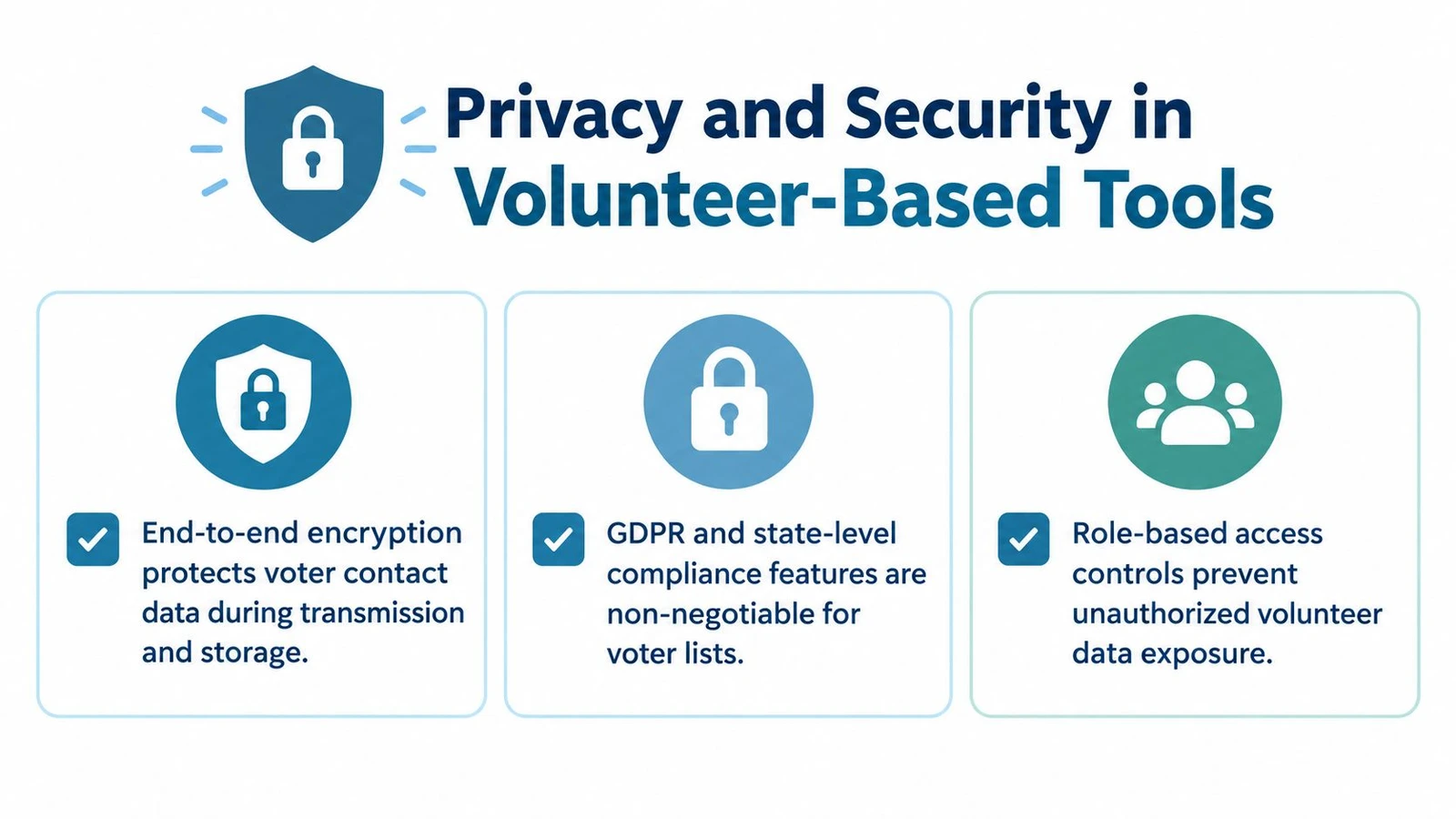
The privacy risk in GOTV software rises as the volunteer count rises. When campaigns let temporary users handle voter records on personal devices, the problem is access discipline as much as cyber hygiene. Field teams need enough data to do the job, but not so much that a casual volunteer can see more than necessary.
What governance should look like
A workable privacy model starts with least-privilege access. Volunteers should only see the turf, contact fields, and notes they need for their assignment. If a campaign lets every user browse the full voter file, it has created an exposure problem before the first door is knocked.
Device control matters just as much. Encryption, remote logout, offline-cache expiration, and secure offboarding should be standard because volunteers leave, phones are lost, and devices are shared. Comparable guidance on Waymap on protecting transit visitor data makes the same point about limiting what temporary users can access. Privacy research has warned that canvassing apps can expose substantial personal information to users who may have little or no privacy training, and that mobile data can move directly from field activity into central databases (privacy research).
Security standard: the safest voter record is the one a volunteer never had permission to open in the first place.
AI-assisted canvassing adds a different risk. The issue is not whether automation can draft prompts or organize outreach, it is whether a campaign can govern how those prompts are reviewed, disclosed, and stored. Human review should sit between machine-generated suggestions and voter-facing use, and every generated prompt should be logged with its reviewer and disclosure status before it reaches a voter.
Campaign managers should also care about compliance language. The ICO treats targeted face-to-face political campaigning as subject to data-protection rules much like direct political outreach. That means field operations cannot treat privacy as an afterthought. A campaign that handles consent, opt-out capture, retention limits, and volunteer offboarding poorly is taking an organizational risk, not just a technical one.
For a closer look at how workflow design shapes privacy controls, campaign data management is useful. That distinction matters when hundreds of volunteers are logging contacts across many devices.
Real-World Use Cases and Recommendations
A rapid-response campaign lives or dies on visibility. When field staff can see route completion and live activity, they can shift volunteers away from stalled turf and into the neighborhoods that still need coverage. The key advantage is not speed for its own sake, it’s the ability to correct the day while it is still happening.
A long-term grassroots program faces a different problem. Rural or low-connectivity areas make offline capture essential, because volunteers still need to record conversations even when service drops. The useful software is the platform that lets that data sync later without forcing re-entry, which keeps the program from losing institutional memory at the edge of coverage.

A short vendor checklist
- Route quality: Does the platform produce walkable turf that matches real geography?
- Offline reliability: Does it keep logging intact when the signal drops?
- Data visibility: Can managers see progress without asking volunteers for manual updates?
- Access control: Can the team limit what temporary users can see and edit?
- Volunteer usability: Does setup stay simple enough for first-time canvassers?
For campaigns that want a single operational stack, doornoc is one option that combines route planning, offline data collection, and live field reporting with voter data services. The more important lesson, though, is that the software should reduce friction between the list, the route, and the completed conversation.
For campaigns that want a cleaner field operation, doornoc brings route planning, offline canvassing, and live reporting into one workflow. Visit doornoc to see how a campaign can organize GOTV work around real field conditions instead of forcing volunteers to adapt to clumsy software.
Looking for a tool to run this? doornoc’s canvassing software bundles voter data, automatic turf cutting, the mobile app, and live reporting in one platform.