

Political consultants are outside specialists who advise on strategy, research, messaging, media and field work, and campaigns usually hire them one function at a time rather than as a full team.
But who’s accountable when an outside adviser recommends where a candidate should spend campaign money? That question matters more than whether the consultant can produce a polished advertisement. A useful consultant connects evidence to decisions, while a well-run campaign keeps approval authority, financial control and access to its own information.
What Political Consultants Do Across a Campaign
A political consultant helps a campaign understand voters, set strategy, communicate messages and identify and mobilize supporters. The work is divided into specialties because running research, producing advertising and supervising canvassers require different skills.
The political consultant hiring guide distinguishes general strategists from specialist firms handling polling, mail, digital communications and field operations. Hiring strategic coordination doesn’t require buying an entire outside operation.
Consultant roles and what each delivers
| Role | Core work | Typical output |
|---|---|---|
| General strategist | Campaign plan, budget, message and vendor oversight | Plan, budget, message and vendor schedule |
| Pollster | Benchmark, tracking and message-testing surveys | Topline results and crosstabs |
| Mail firm | Design, printing and distribution of direct-mail pieces | Mail pieces and mailing schedule |
| Digital firm | Paid social, search, streaming video, programmatic ads, email or SMS | Ad flights and performance reports |
| Field firm | Canvassing, voter registration, get-out-the-vote work, canvasser recruitment and training, turf cutting | Walk lists, knock reports and turnout tallies |
| Opposition researcher | Research on rivals’ records, votes and public statements | Documented research memo with supporting records |
| Fundraising consultant | Donor solicitation, finance events and reporting support | Solicitation plan, event schedule and fundraising reports |
The general strategist connects these assignments. That means developing a campaign plan, reconciling the budget with fundraising capacity, maintaining a consistent message and checking that vendors deliver work when the campaign needs it.
A strategist should resolve conflicts between departments, not just forward their proposals. If a mail recommendation would consume money reserved for field staffing, someone must explain the trade-off and present a decision for campaign approval.
Specialists need defined assignments
A pollster’s assignment should specify benchmark surveys, tracking surveys or message-testing surveys, rather than an undefined promise to provide voter insights. Likewise, a field contract should distinguish managing paid canvassers from merely supplying lists and reports.
Opposition research and fundraising deserve separate scopes even when the general consultant provides them. A research memo needs traceable documents; a finance program needs a solicitation process and usable reporting, not just optimistic revenue expectations.
Practical rule: A campaign needs a named owner of strategy and budget before it needs a longer vendor list.
The strongest hiring decision starts with the work the existing team can’t execute reliably. Specialists should fill those gaps, not duplicate capable staff or leave the candidate managing disconnected contractors.
How Consultants Turn Research Into a Campaign Plan
A general consultant works more like a general contractor than a painter. The job is to interpret the blueprint, sequence the trades and inspect the work, not merely make the finished campaign look appealing.
Academic histories identify polling, communication and supporter identification as enduring foundations of political consulting. Illustrative scenarios in Oxford Academic’s account of the profession contrast a $10 million gubernatorial campaign, with numerous specialists, against a $50,000 local campaign, with a manager, volunteers, a poll and direct mail. These are illustrations of organizational scale, not recommended spending benchmarks.
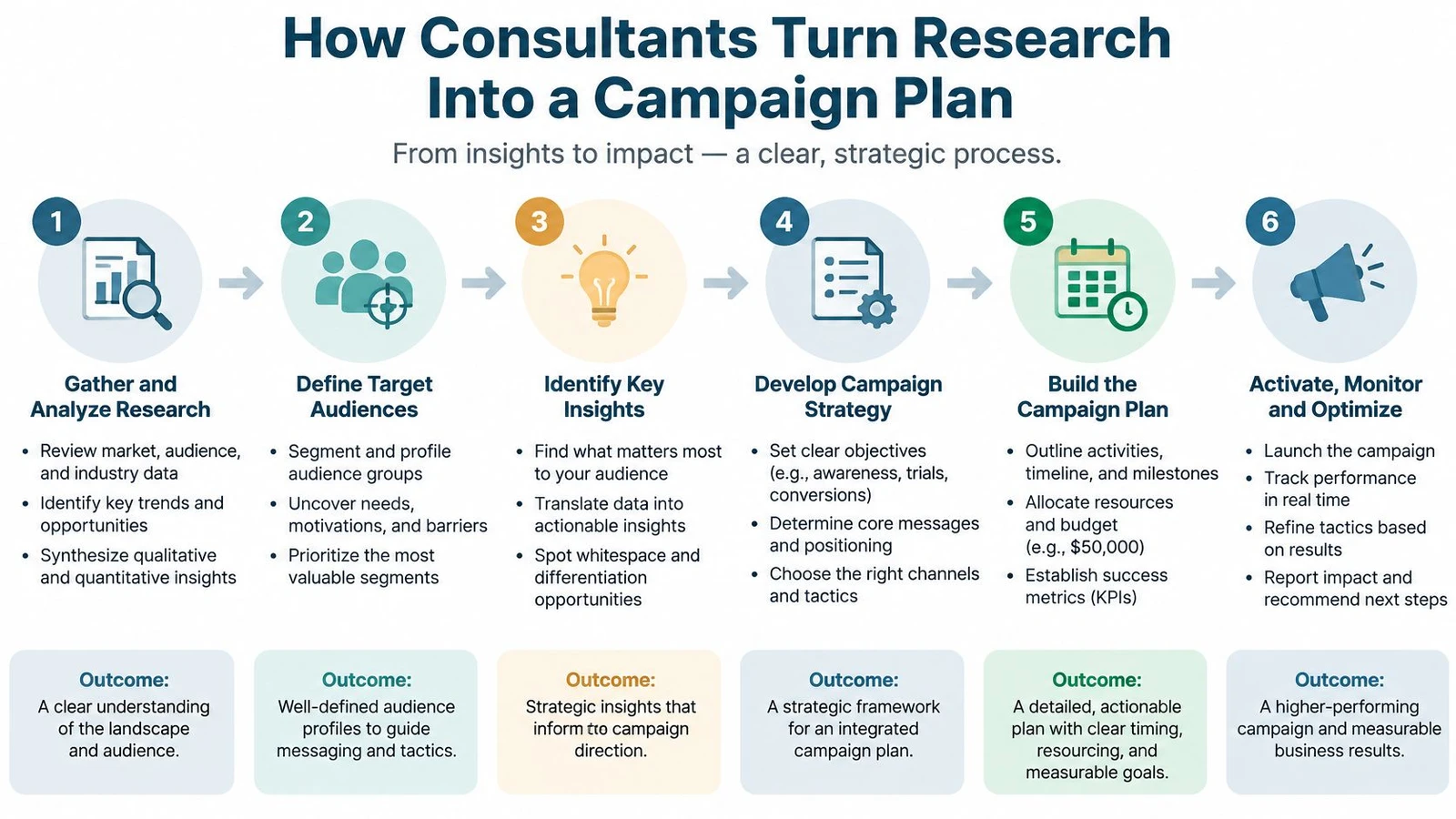
From evidence to operating decisions
- Research the electorate. Review election history, geography, candidate recognition and available opinion research. Decide which unknowns could materially change the campaign’s approach before commissioning additional work.
- Segment voters by need. Separate audiences requiring persuasion, supporter identification or turnout contact. The decision is which demographic label fits and what kind of intervention each group needs.
- Write the core message. Establish the candidate’s reason for running and the credible contrast with opponents. Choose what the campaign will emphasize and what it won’t chase.
- Pick channels. Match the audience and task to doors, mail, advertising or direct digital contact. Reject channels the team can’t operate or measure competently.
- Set timing. Work backward from voting opportunities and production deadlines. Decide when voters must receive information for it to remain useful.
- Allocate budget. Fund the essential operating program before optional additions. Identify what gets reduced if fundraising falls short.
- Decide how results will be measured. Assign an outcome, reporting owner and review point to each activity. Define what evidence would justify continuing, revising or stopping it.
The process below illustrates the connection between research and coordinated execution.
Keep the working plan compact
A campaign can build a one-page plan map with columns for audience, objective, message, channel, timing, budget owner and outcome. Each row should describe an executable assignment rather than a broad aspiration such as increasing awareness.
For a starting structure, Bulby’s guide to campaign strategy can help organize planning discussions. The campaign still needs to replace generic objectives with local decisions, named owners and realistic constraints.
The test is operational clarity: staff should know what happens next, who authorizes it and what would cause the plan to change.
Polling, Messaging and Targeting Decisions
A benchmark survey sets the campaign’s starting point before major spending. Tracking surveys measure movement during the race, while message tests compare arguments. Each should inform a specific decision, such as whether to change a message or shift resources.
Consultants adapt communications to a candidate’s strengths, weaknesses and perceived vulnerabilities. Shaping a message does not, by itself, show it works. A peer-reviewed study of negative campaigning and consultant influence examined links between consultants and negative campaigning, but found no convincing evidence that personalized messages produced a strong electoral advantage.
Test the decision, not just the wording
Use a pretest to separate a real difference in response to an argument from a difference caused by question wording.

Where feasible, use pretests and randomized experiments. Compare treatment and control groups on outcomes tied to the program’s objective, such as favorability, turnout intention, volunteer conversion, donations or validated turnout.
Impressions show that an ad was delivered. Clicks can help diagnose its performance, but neither measure alone shows whether voters became more likely to support the candidate.
Inspect the targeting chain
Scrutinize every handoff in the targeting process:
- Data source: Check completeness, update timing and whether records represent the intended electorate.
- Segment or model: Separate observed behavior from inferred preferences. Past participation does not establish a voter’s current intentions.
- Message: Confirm that the argument addresses a plausible concern without treating a demographic group as politically uniform.
- Channel: Consider who can be reached. An available address or digital match does not establish attention.
- Field action: Record whether a canvasser reached the intended person and had a meaningful conversation.
- Outcome measurement: Distinguish failed delivery from an ineffective argument, and uncertain responses from confirmed support.
Filtering a voter file by party, election history, district or precinct, and age creates a contact universe, not a full portrait of political interest. Staff should examine who was excluded and why. This guide to voter-data filtering strategies can help frame that review before a filtered list drives spending.
Consultants also advise which opposition findings to use as campaign contrasts and which fundraising appeals to use to finance the program. The campaign should identify who approves those recommendations and spending decisions, then record the approval authority and review criteria in writing.
Why this voter? Why this message? What evidence would show it worked?
How Media, Mail, Digital and Field Work Differ
Media consulting covers placement decisions, production coordination and tracking advertising flights. Consultants must match creative work to the audience and buying schedule rather than assume that producing an advertisement completes the assignment.
The shift from broad messaging toward narrowcasting is described in Oxford Academic’s analysis of consulting and campaign communication. Targeted delivery allows different groups to receive different communications, but it also requires tighter control of audience definitions and message consistency.
Match the channel to the job
Mail firms design, print and distribute pieces according to the contact calendar. Campaign approval should cover the audience, factual claims, production proof and delivery schedule before the printer receives authorization.
Digital firms manage paid social, search, streaming video, programmatic advertising and email or SMS. Each channel needs an audience definition, frequency rules and an appropriate objective; a single blended performance report can conceal weak delivery or wasteful repetition.
Field work requires the most visible operating discipline. A field firm may recruit and train paid canvassers, divide territory, maintain contact records and report results, while the campaign chooses whether volunteers, paid workers or an internal field director will run the program.
Make doorstep reporting useful
Before canvassers start, the field lead needs clear assignments, consistent outcome definitions and a process for checking incomplete routes. A reported knock, an answered door and a substantive conversation are different events and shouldn’t be combined into a flattering activity total.
For an in-house operation, canvassing software can help a campaign choose voters, cut turf, record door outcomes and report canvass activity. It doesn’t replace decisions about targeting, scripts, staffing or the overall campaign plan.
The field director should review unsuccessful contact patterns as well as completed work. Repeated unanswered doors may call for different contact timing rather than more assignments to the same inaccessible households.
A practical channel review should record:
- Internal ownership: Which staff member can run each channel and review its output.
- Outside requirement: Which production or operational task requires specialist capacity.
- Handoff: What information moves between the campaign, vendor and reporting owner.
- Stop condition: What delivery failure or budget constraint triggers a pause.
That exercise prevents a common mistake: buying more communication capacity than the campaign can supervise.
When a Local Race Needs a Consultant and What It Costs
A city council candidate with a dependable volunteer canvass and a limited mail program may need only a defined mail project, not an ongoing strategy retainer. Hire outside help only when the team has a specific capacity gap and a clear reason the proposed work cannot be handled internally.
Consultants may charge a monthly retainer for ongoing strategy, a fixed project fee for a poll, mail program or digital flight, or hourly fees for defined research work. Some agreements also include markups on media purchases or printed mail. A retainer buys continuing availability and specified responsibilities; a project fee covers a stated deliverable. A spending-based markup can raise the consultant’s compensation as the campaign buys more distribution, so clarify how fees are calculated.
Typical local race budget shares by function
The local campaign budget guide gives these approximate allocations for council, mayoral or state-house campaigns:
| Function | Typical share of budget |
|---|---|
| Field | 25% to 40% |
| Mail and texting | 20% to 35% |
| Digital advertising | 10% to 20% |
| Staff and consultants | 10% to 20% |
| Polling and research | 0% to 5% |
Treat these as planning ranges, not amounts to spend at every category’s upper limit. Reconcile the choices into one budget, and specify whether production and management charges are included in channel spending or listed separately.
Before comparing quotes, separate professional fees, production, distribution, data and reimbursable expenses. A low management fee can sit alongside a costly total program; a larger project quote may already include work another firm bills separately.
The need for outside help depends on the campaign’s actual workload. A small local race may have a volunteer team capable of covering its territory, while a campaign across dispersed communities may need specialist support for mail or digital advertising. In either case, the fee should correspond to a defined gap, not to the opponent’s staffing choices.
The guide to the cost of running for local office provides additional budgeting context. Each quote should state what the campaign receives and which expenses remain outside the fee.
Buying discipline: Compare the total program cost, not merely the consultant’s headline fee.
Review invoices by service type, then compare the proposed expense with the campaign’s budget and the work staff would otherwise handle internally. Do not approve an undifferentiated consulting charge without a clear account of what it covers.
Campaign Manager vs Consultant and What to Put in Writing
The campaign manager runs daily operations, supervises staff and manages the candidate’s calendar, usually reporting to the candidate. The consultant advises on strategy, research and messaging and may oversee vendors, but that role doesn’t automatically confer spending authority.
A clear political campaign manager role helps keep execution separate from outside advice. Small campaigns may combine responsibilities, but combining jobs shouldn’t erase accountability.
Advice can become control
A consultant who controls research interpretation, targeting recommendations and advertising purchases can become an informal operating chief. Deseret’s examination of political consultants and ethical advice highlights the influence advisers can exert over a candidate’s time, energy and money.
The risk isn’t dishonesty alone. Staff may stop challenging recommendations because the consultant holds the information needed to evaluate them, or because questioning the strategy also means questioning the person managing its execution.
When results disappoint, a campaign then struggles to distinguish a bad recommendation from poor implementation or a candidate’s refusal to follow the plan. A written decision record should capture the recommendation, supporting rationale, approver and actual execution.
Terms to confirm before hiring a consultant
| Term | What to ask for | Why it matters |
|---|---|---|
| Scope of work | Named deliverables, dates and hours | Prevents open-ended advice with no output |
| Budget authority | Who approves each spending line and the spending cap | Keeps spending decisions with the campaign |
| Data ownership | Campaign ownership of campaign-controlled voter files and contact results, subject to underlying licenses | Protects access after the contract ends |
| Other clients | Written disclosure of other campaigns and shared vendors | Reveals conflicts of interest |
| Approval rights | Campaign signoff on messages, ads and mail before release | Keeps control of the candidate’s voice |
| Performance measures | Named metrics and a review date | Helps distinguish strategy problems from execution failures |
Data provisions need particular care. A consultant can’t transfer ownership that a voter-file license doesn’t permit, so the agreement should distinguish licensed records, campaign-created contact results, account access and export rights.
Compensation disclosures should identify vendor relationships, rebates or markups that could affect recommendations. A campaign should also require an exit handoff covering work in progress, source files, outstanding obligations and usable reports.
Candidate approval should be documented before a recommendation becomes a purchase order.
Performance measures won’t prove that a consultant caused an election result. They can establish whether promised work was delivered, whether intended voters were reached and whether the campaign responded sensibly to evidence.
Before signing, the campaign should confirm in a one-page authority sheet who approves spending, who controls access to voter information and which measures determine whether the engagement continues. The candidate retains final authority, the manager owns assigned execution and the consultant answers for contracted recommendations and deliverables.
Frequently Asked Questions
How much do political consultants cost?
A retainer quote should list the fee and the work it covers, including research, creative development, revisions, distribution and any markups. Consultants may also price research or communications work by project or hour. Compare the full scope and cost, not just the headline fee.
Do political consultants work for more than one candidate?
Some do, particularly on separate races. Before hiring, ask for written disclosure of other clients and shared vendors, plus a process for updating the campaign if a new engagement creates a conflict or limits the consultant’s availability.
Do independent groups face special deadlines?
Yes. The FEC requires 48-hour reporting for qualifying independent expenditures of $10,000 or more made up to the twentieth day before an election (FEC reporting rules for independent expenditures). Its coordinated-communications guidance also addresses safeguards against prohibited information flows. Consultants managing independent spending need compliance oversight and a release calendar that preserves appropriate separation from candidate activity.
Do political consultants handle opposition research and fundraising too?
Some offer these services, but a general strategy contract does not necessarily include them. Specify who verifies research claims, who manages donor follow-up and what records the campaign receives when the work ends.
doornoc supports the door-to-door side of a campaign, from selecting voters and cutting turf to recording knock outcomes and reporting results. doornoc can help campaigns manage these field operations internally.