
A filing deadline is four days away, the printer needs a final count, and a blank document is waiting where a political fundraising letter should be. The candidate wants urgency, the treasurer wants legal wording, and donors want proof that money already raised did useful work. Copying a generic appeal solves none of those problems. A stronger letter names the race, the authorized committee, a lawful amount, a verifiable use of funds, and one clear reply method. The three samples that follow cover launch, deadline, and thank-you messages, with the rule behind each line kept visible.
Pick the Right Letter Type for Your Goal
A political fundraising letter has three distinct jobs. A launch letter introduces a candidate who hasn’t yet built a donor base. A deadline letter closes a named gap before a real reporting, filing, or match date. A thank-you letter confirms a gift, explains how support is used, and keeps the donor engaged without turning gratitude into another hard ask.
| Letter type | When to send | Main goal | Must include |
|---|---|---|---|
| Launch | Within the first two weeks after announcing | Build a first donor base | Candidate name, race, reason to give now, amount ladder, committee name |
| Deadline | 3 to 7 days before a real reporting or match deadline | Close a specific gap | Exact deadline, goal, amount still needed, what the gap pays for |
| Thank-you | Within 48 hours after receiving the gift | Confirm the gift and keep the donor | Donor name, gift amount, how support is used, next step without a hard ask |
Choose from the calendar and donor file, not habit. There’s no point sending a launch appeal when voting has nearly ended, and a deadline letter without a verifiable date trains donors to ignore the next one. Layout matters too, since a crowded page can bury the ask, and Steeve Elgui’s campaign design portfolio offers useful examples of hierarchy and spacing.
A letter is one channel, not the whole program. Campaigns planning broader activity can compare mail with other political fundraising ideas that win campaigns in 2026 and with grassroots fundraising ideas that win campaigns in 2026. The launch, deadline, and thank-you samples appear in the sections devoted to each job.
Set Suggested Amounts Within Legal Limits
Every rung on an ask ladder needs a legal ceiling behind it. For federal races, the Federal Election Commission contribution limits for 2025-2026 set the figures below: an individual may give a candidate up to $3,500 per election and national party committees up to $44,300 per calendar year in total, while a national party committee’s special accounts may receive up to $132,900 per account per year and no source may give more than $100 in cash.
Federal contribution limits for 2025-2026
| Contribution type | 2025-2026 federal limit | Effect on your ask |
|---|---|---|
| Individual to a candidate | Up to $3,500 per election | Primary and general amounts are asked for separately |
| Individual to national party committees | Up to $44,300 per calendar year in total | Combined across all national party committees |
| Contribution to a national party special account | Up to $132,900 per account per year | Each special account counts separately |
| Cash from one source | No more than $100 | Keep cash out of the reply options; check state rules for your race |
Those ceilings don’t mean every recipient should see the maximum. Source restrictions, prior giving, and election designation can lower the lawful amount for a particular donor.
Build the ladder
Start with a base amount most of the list can afford, add a stretch amount for committed donors, and leave an open field. A federal prospect letter might offer $25, $50, $100, $250, and other, while reserving $250 prominence for a segment already giving near that level. For a smaller local list, fewer choices keep the reply device readable and the recommended amount obvious: test a three-option ladder against a five-option ladder on the next mailing and keep whichever pulls more checks.
Wording must match the election. “For the primary election” is accurate when the contribution counts toward that limit. “Your gift covers the whole cycle” isn’t accurate when primary and general limits are separate. “The legal maximum” belongs in a letter only when the campaign has confirmed that the recipient hasn’t already given toward that election and that no source prohibition applies.
Practical rule: Never let design lock in amounts before the treasurer confirms the election, limit, and committee name on the final proof.
Federal figures govern federal races only. A county school board letter answers to state or county limits, which must be confirmed before printing. Before release, check three items: each amount sits under the applicable limit, the authorized committee is named correctly, and the relevant state or federal rule has been verified for the exact race.
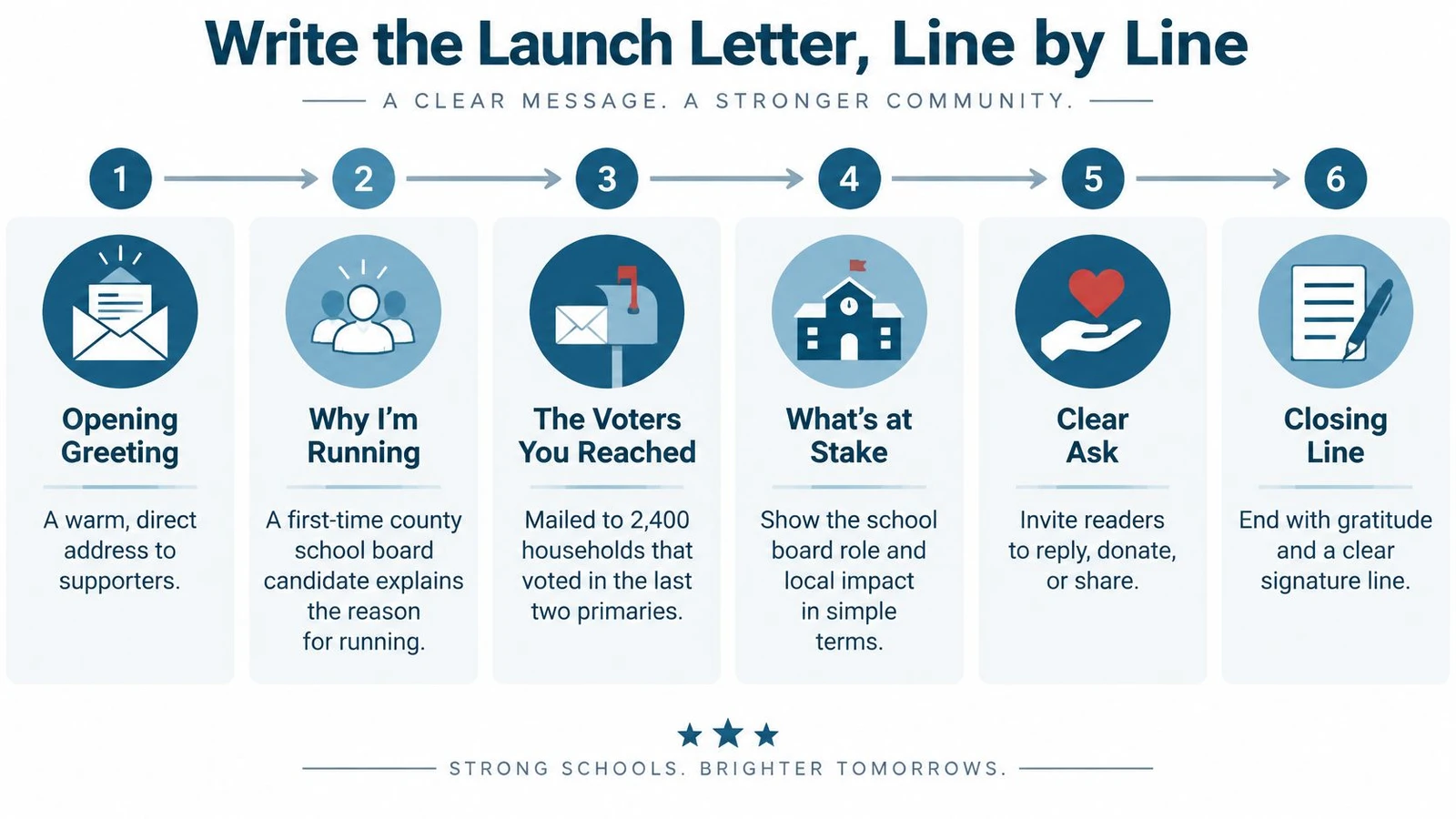
Write the Launch Letter, Line by Line
The sample below suits a first-time county school board candidate mailing 2,400 households that voted in the last two primaries. Bracketed fields require local facts, and the state or county contribution limit must be checked before the amounts are printed.
Dear [Donor name],
[Candidate name] is running for [County] School Board, District [number]. The board votes on the proposed school budget on [date], and families at [School name] still don’t have a clear answer on class sizes for next year.
The commitment is specific: publish the budget in plain language before the vote and hold a public question session in every district school area. Early contributions will pay for printing, postage, and voter contact before the [reporting date] filing deadline.
Please contribute $25, $50, $100, or another amount to [Authorized committee name] by [date]. Give at [donation link] or return the enclosed reply form.
Thank you for considering support for a local campaign built on clear budgets and direct answers.
Sincerely, [Candidate name]
P.S. A gift by [reporting date] helps fund the first districtwide mailing. Please use [donation link] or the enclosed reply form.
Paid for by [Authorized committee name].
Why each part earns its place
- Greeting and local reason: The donor’s name and a budget vote or school closure establish relevance immediately. A generic opening about “making a difference” could belong to any race and gives the reader no reason to continue.
- Candidate and exact race: Two sentences identify the candidate, office, and district. Readers shouldn’t have to infer which election will receive the money or search the signature for the office.
- Local problem: One recognizable detail, such as class size at a named school, proves the letter was written for the district. Broad claims about “failing schools” sound imported and invite disputes the letter can’t answer.
- Keepable commitment: Publishing a plain-language budget and holding question sessions are actions within a board member’s influence. A promise to fix every school outcome exceeds the office and damages credibility.
- Ask: The ladder, deadline, committee name, and reply methods belong together. Burying the ask after three paragraphs or separating the amount from the donation route reduces completed gifts.
- Postscript: The P.S. repeats the date and response method for readers who skim. It shouldn’t introduce a new claim, a different amount, or urgency that the body hasn’t substantiated.
- Paid-for-by notice: Placement near the signature keeps sponsorship visible, while the formal disclaimer requirements are covered in the notice table in the thank-you section. Omitting the committee name from either place creates avoidable compliance work.
Swap the school, budget date, commitment, and reporting date for facts from the actual race. Keep the sequence intact: relevance, identity, problem, commitment, ask, repetition, sponsorship. That structure works because each paragraph answers the next donor question without asking for money before the candidate and purpose are clear.
Write the Deadline Letter Without Fake Urgency
A credible deadline letter begins with arithmetic, not adjectives. The city council sample below is sent four days before quarter-end, with $14,200 raised toward an $18,000 goal and a $3,800 gap assigned to final printing and postage.
Subject line: $3,800 still needed by [quarter-end date]
Dear [Donor name],
The campaign is $3,800 short of the $18,000 goal, and the quarter closes on [quarter-end date]. Contributions received so far total $14,200.
Last weekend, volunteers reached 1,100 households. The final postcard drop is at the printer now, and the finance report will be filed on the deadline and posted at [verification link].
Please give $100 or any amount possible by [quarter-end date] at [donation link]. The gift will pay for final printing and postage.
Sincerely, [Candidate name]
Paid for by [Authorized committee name].

Put proof beside the deadline
The middle paragraph contains one completed objective, one current use of funds, one next milestone, and a verification route. That structure answers where prior money went before requesting more. The 2025 National Progressive Donor Survey found that just under 50% of donors felt they knew where their money goes, while 78% said it was very important for organizations to show specific accomplishments and 73% wanted an exact explanation of spending.
Those findings argue against escalating fear when a factual update is available. Donors can verify 1,100 households reached, a postcard at the printer, and a report posted after filing. They can’t verify claims that one gift will “change the outcome,” and a campaign shouldn’t imply a guaranteed electoral result.
Honesty rules for urgency
- Real date: Name the filing, reporting, vendor, or match deadline that controls the request.
- Real figure: Update the amount raised and gap immediately before sending, not from an old draft.
- No false finality: Don’t write “last chance” when another lawful solicitation will follow next week.
- Restricted versus general funds: State whether gifts are restricted to the named printing and postage or support general campaign activity. Don’t present general funds as earmarked money.
- Specific work, uncertain outcome: Say what the contribution pays for without promising victory, official action, or a particular policy result.
The same discipline helps other paid channels, and a campaign comparing channels can use understanding paid search acquisition to separate measurable costs from unsupported urgency. For mail, credibility is the asset that survives the deadline. A donor who sees accurate figures is more likely to trust the next report, the next milestone, and the next request.
Thank Donors and Add Paid-For-By Notices
A thank-you letter should arrive within 48 hours, while the donor still remembers giving. It confirms receipt, names the amount, explains the broad use of support, and offers a nonfinancial next step. It must not promise official action, special access, or a guaranteed election result.
Dear [Donor name],
Thank you for the gift of [gift amount] to [Candidate name] for [race]. The campaign received it on [date].
Broad support like this pays for lawful campaign activity, including the voter contact volunteers are conducting this month. Donors who want another way to help can sign up for a volunteer shift at [sign-up link] or request a yard sign.
Progress updates will follow as the campaign reaches its next milestones.
Sincerely, [Candidate name]
This sample makes no new request for money. Adding one changes the piece into a solicitation, so the full paid-for-by notice from the table below must appear. Coordinated material paid for by another person also needs treasurer review because a coordinated communication can become an in-kind contribution subject to contribution rules, as explained in the Federal Election Commission guide to supporting federal candidates.
Thank-you copy should stay consistent with the campaign’s records. The amount and date need to match the contribution system, and the activity described should be work already underway or plainly identified as upcoming. Warm language still has to name the right committee and avoid implying that a donor purchased a policy commitment.
Paid-for-by wording by sender
Federal rules require a disclaimer that is clear and conspicuous and identifies who paid for the communication. Authorization determines the exact content.
| Sender | Required disclaimer content |
|---|---|
| Authorized committee pays for its own solicitation | Paid for by the authorized committee name |
| PAC or party committee pays for a communication the campaign authorized | Identify the payer and state that the candidate or campaign authorized it |
| Individual or group pays without campaign authorization | Full payer name, a permanent street address, phone number or website, and a statement that no candidate or candidate’s committee authorized it |
| Printed letter | Disclaimer in a box set apart from the content, with readable type and reasonable contrast |
For an authorized and campaign-financed solicitation, the notice states that the authorized committee paid for it. When a PAC, party committee, or another person pays for an authorized communication, the notice identifies the payer and states the authorization. Unauthorized communications carry the heaviest identification burden because readers need enough information to identify and contact the payer without mistaking the piece for campaign mail.
Printed letters need the disclaimer in a box set apart from the content, with readable type and reasonable contrast. Type should stay legible in the chosen ink, paper stock, and fold position. The printer’s proof needs review because cropping and paper color can change readability after the word-processing draft looked fine.
A disclaimer is complete only when an ordinary reader can find and read it on the delivered piece.
The same caution applies when thank-you copy moves into bulk email or onto a public website. The Federal Election Commission advertising and disclaimer guide notes that federal disclaimer obligations can apply to bulk electronic email containing more than 500 substantially similar messages and to publicly available websites. Reused copy needs its own placement check; the notice from a printed letter does not travel with the text.
Campaigns producing several printed pieces should keep disclaimer placement consistent across the mail program and supporting campaign literature. Consistency helps printers and reviewers catch a missing box before production. State filing and disclaimer rules can differ from federal requirements, especially for school board, municipal, and county races. The treasurer or campaign counsel should confirm the state rule for the exact office before authorizing print.
Test Two Letters Before the Full Mailing
A small randomized test costs less than sending a weak political fundraising letter to the entire list. Isolate one difference, keep the audiences comparable, and measure money left after costs rather than applause for the copy.
Six-step test
- Define the job: Select one narrow audience and one objective, such as first gifts from prior primary voters before a filing date.
- Segment the file: Separate recipients by prior giving, geography, ideology, or campaign stage so unlike donors don’t distort the comparison.
- Change one element: Create two variants that differ only in opening, issue frame, ask ladder, signer, or urgency.
- Assign randomly: Split comparable segments at random and keep a randomized holdout when list size permits.
- Trace every gift: Give each variant a unique reply code or landing-page identifier and carry that code through processing into the campaign’s donor or finance system.
- Judge net results: Compare response rate and net revenue per mailed piece after printing, postage, processing, and list costs.
An Oxford University Press chapter on political fundraising puts a commonly acceptable direct-mail response rate at roughly 2%. One presidential campaign’s own account reports mailing 1 million letters and receiving 20,000 responses, while acquisition mail to cold prospects routinely performs well below renewal mail to existing donors.
That figure is no forecast for a school board race or a city council list. List quality, familiarity, timing, and relevance move results sharply. I treat the holdout as the step that separates a test from a guess: it stops the campaign from crediting the letter with gifts that would have arrived anyway because the deadline was already public.
Metrics that decide the rollout
- Cost per acquired donor: Total test cost divided by new donors, separated from renewals.
- Average first gift: Useful only beside response rate and production cost.
- Second-gift rate: Shows whether the winning appeal attracted durable supporters or one-time responders.
- 90-day net value: Captures early repeat giving after acquisition and follow-up costs.
The mechanics follow the same discipline as digital experiments, and A/B testing for small business websites is a plain-language refresher on isolating variables. The same discipline pairs well with practical tactics for improving direct mail response rates among voters. Attribution stays in whatever donor or finance system the campaign already runs, as long as staff enter each reply code the same way every time.
Confirm list provenance before the test drops. Every rented, exchanged, first-party, and public-file source should be documented, suppression requests honored, and counsel consulted before another committee’s donor data enters the file.
Roll out the variant with stronger incremental net revenue per piece. File the date, segment, costs, codes, and result alongside the letter proof, and schedule thank-you messages for the same week so new donors hear back while the appeal is still fresh.
Frequently Asked Questions
How long should a political fundraising letter be?
One page is usually enough for a local launch or deadline appeal. Place the ask before the midpoint, repeat it in the P.S., and remove background that doesn’t help the donor decide.
How big should the holdout group be?
Big enough that a real gap in net revenue per piece can show up, small enough that the winning version still reaches most of the list. If a handful of gifts could flip the result, enlarge the holdout before the next test instead of reading meaning into noise.
What should a thank-you letter cost to send?
Little. A short note, printed plainly and mailed promptly, does the job because the value sits in speed and specificity. Name the amount received and one thing it paid for, and save heavier paper for the appeals that have to earn revenue.
What should a campaign do with returned mail?
Log every undeliverable piece and pull those addresses before the next drop. A rising return rate points to a stale list, and continuing to mail bad addresses inflates reported reach while steadily draining the postage budget.
Is email as effective as a printed letter?
Email costs less per contact, which makes it attractive for volume, and bulk email can carry its own disclaimer duties when the message counts as a mass solicitation. The honest comparison is net revenue per contact after production, delivery, processing, and follow-up costs, and the channel that returns more after all of that spending is the one to favor.
Pair the next fundraising letter with field activity that gives donors a concrete progress update, from targeted voter lists and walkable turf to recorded door contacts and clear knock reports. Campaigns that need that door-to-door side organized without paper routes or manual reentry can visit doornoc to see how canvassing lists, routes, and results fit together.
Looking for a tool to run this? doornoc’s canvassing software bundles voter data, automatic turf cutting, the mobile app, and live reporting in one platform.