

A three-person township board approves the budget that an Indiana township trustee prepares, according to Jackson Township’s explanation of trustee duties. That separation reframes the office: a trustee isn’t just a neighborhood representative distributing help. The job connects service decisions to spending authority, payment records, and public accountability.
The answer to what does a township trustee do therefore depends on both the state and the decision involved. Residents need to know who can authorize assistance, who approves spending, and which records establish that public money was used properly.
Who a Township Trustee Is and Where the Office Exists
The title township trustee identifies an elected local office, while state law defines its authority. Depending on the jurisdiction, a trustee may administer public funds, township services, or legally mandated assistance.
Township government is a form of subcounty general-purpose local government. The U.S. Census Bureau’s government classification guidance describes these governments as authorized under state constitutions or statutes for defined areas. It distinguishes them from municipalities primarily through historical incorporation and classifies towns in Connecticut, Maine, Massachusetts, Minnesota, New Hampshire, New York, Rhode Island, Vermont, and Wisconsin as township governments for statistical purposes.

Indiana and Ohio also have township systems. The Census classification helps explain why a local government’s everyday name may differ from the category used in federal statistics.
Practical rule: A township’s name identifies the jurisdiction. State law establishes what its officials can do.
A trustee’s responsibilities may include local services or assistance, but the office’s authority comes from state law. Before attributing control of roads, emergency services, parks, or household assistance to a trustee, check which public office is legally responsible in that jurisdiction. That distinction matters when tracing who handles a service and which public records document its funding.
Core Duties of a Township Trustee at a Glance
Indiana shows how varied a trustee’s responsibilities can be. The office may handle household assistance, public services, cemetery upkeep, and financial records. The table summarizes those duties as an Indiana example; authority differs by state.
| Duty area | What the trustee handles | Indiana example |
|---|---|---|
| Township assistance | Evaluates eligibility and provides necessary aid to residents | Food, rent or shelter, utilities, medical supplies, and emergency needs after other resources are used |
| Township budget | Develops the township’s proposed budget | Jackson Township’s trustee guidance describes the trustee’s budget responsibilities |
| Claims and payments | Examines, pays, and records township claims | Recorded disbursements of township funds |
| Financial records | Keeps records open for public inspection | Itemized financial and appropriation records |
| Annual report | Reports on receipts, expenditures, investments, and debts | Presented each year to the public |
| Fire and ambulance | Arranges service outside incorporated cities and towns | Coverage in unincorporated parts of the township |
| Cemeteries and burials | Maintains township cemeteries and oversees burial of indigent residents | Cemetery upkeep and indigent burial |
| Weeds and fences | Addresses noxious weeds and certain line-fence disputes | Trustee acts as fence viewer in qualifying disputes |
Indiana’s State Board of Accounts township resources describe the office’s executive responsibilities and assistance framework. Necessary aid may cover specified needs after available resources and other avenues have been exhausted.
Services and financial administration are connected
A service decision creates a record and may require a payment. Arranging emergency coverage, for example, involves both operational oversight and documented spending. Cemetery maintenance likewise connects upkeep with recorded expenditures.
Household assistance follows the same pattern. The office must assess eligibility, confirm that the expense is authorized, and document its decision. Clear intake also helps distinguish township responsibilities from those handled by another agency. This explanation of constituents in government describes the people public offices serve and the role of responding to their needs.
Economical aid still has to be defensible
Indiana’s requirement to provide necessary aid economically calls for careful administration. Reducing duplicate work can help manage public resources, while each aid decision still needs to meet eligibility rules and legal requirements.
Kagool’s discussion of how local councils cut costs considers how organizing resident information can reduce fragmented intake and repeated collection of details.
Residents comparing Indiana’s model with their township can check:
- Legal authority: Which listed services belong to the township?
- Application requirements: What documentation establishes eligibility?
- Responsible office: Who handles assistance, service contracts, and financial records?
- Public reporting: Where are financial records and expenditure reports available?
Who Decides What
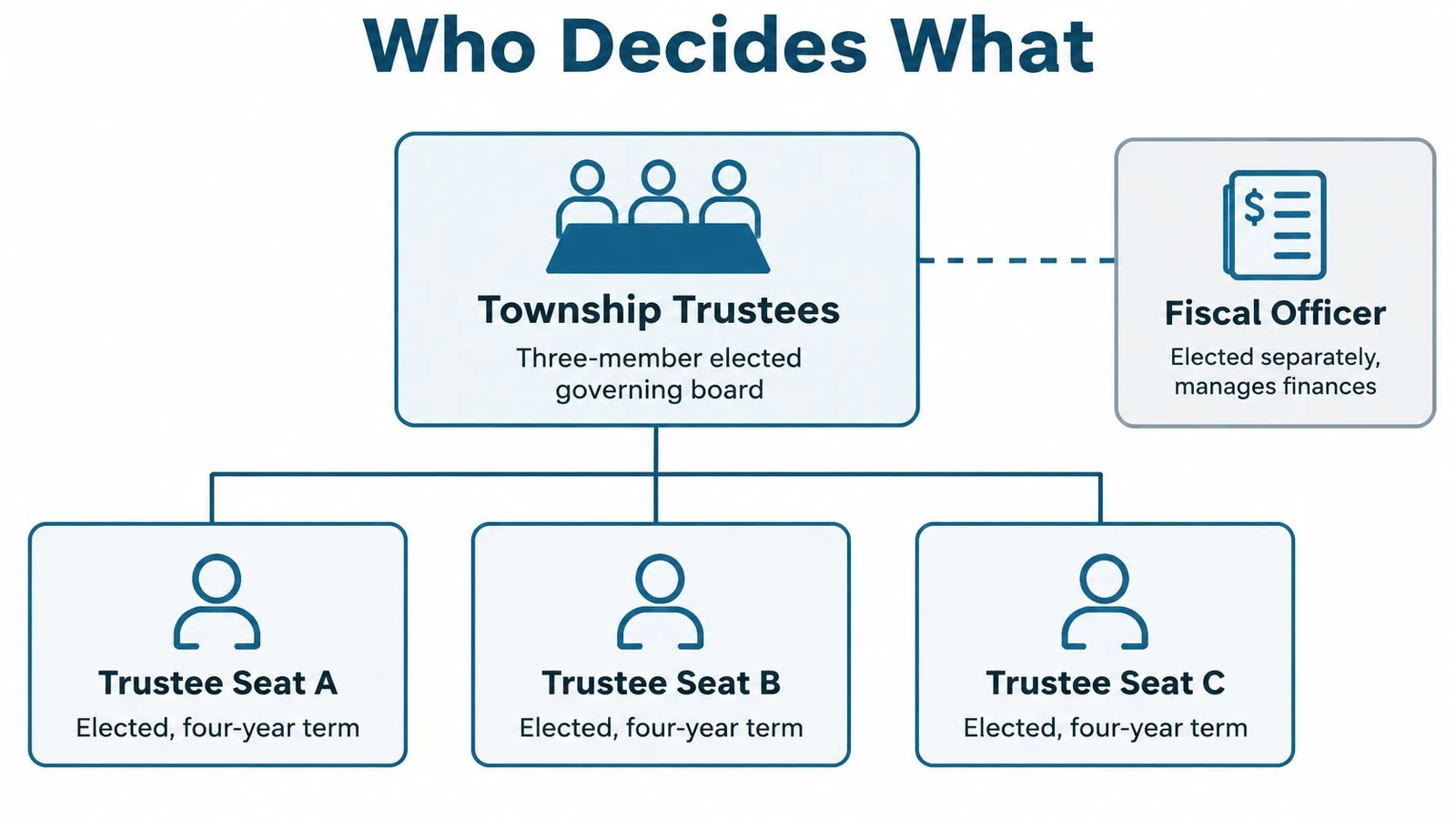
A resident who asks an individual Ohio trustee to approve a contract may need a decision from the township board instead. The board acts collectively on matters such as resolutions, taxes, contracts, and the township budget, while a separately elected fiscal officer handles financial duties.
The Ohio Legislative Service Commission’s guide to township government describes a three-member elected board with four-year terms.
Board seats carry collective authority
An Ohio trustee participates in board decisions. A single trustee cannot independently commit the township to every expenditure or contract a resident requests.
Where a township appoints an administrator, that employee helps carry out board policy, supervises township divisions, prepares reports, advises the board on financial conditions, and submits a proposed budget. The arrangement separates day-to-day administration from the board’s policy and oversight role.
That distinction also applies to school governance. School board members’ responsibilities can include authorizing and supervising work that staff carry out.
Map the decision, not just the organizational chart
A contract illustrates how authority moves through a township. Someone develops or recommends the proposal; the authorized official or board approves it; the responsible office processes payment; and the relevant records document the decision and expenditure.
The roles at each stage may differ. Identify who proposes the action, who has authority to approve it, who processes the payment, and who maintains the records. That map helps residents direct requests to the right decision-maker and evaluate whether elected officials are providing effective oversight.
An official can remain accountable for a service while staff handle its day-to-day delivery. Voters can assess trustees by examining their policy decisions and supervision, rather than attributing every staff action to one individual.
Follow Each Dollar from Claim to Public Record
A township payment should be traceable from the underlying claim to the financial record. The review begins with the purpose and authorization, continues through examination and payment, and ends with an entry that can be reconciled with the township’s accounts.
Wayne Township’s description of trustee services places budget preparation, receipt and disbursement of money, settlement of claims, itemized financial and appropriation records, and publicly inspectable proceedings within Indiana’s trustee framework. These aren’t secondary clerical duties. They provide the evidence needed to evaluate how the office exercises its authority.
What a defensible payment record establishes
Consider a hypothetical cemetery-maintenance invoice. A reviewer should be able to identify the work purchased, the authorization supporting it, the amount paid, and the account charged.
The same reviewer should distinguish the invoice from the payment. An invoice establishes what a vendor requested; the disbursement record establishes what the township paid.
Loopfour’s AP workflow guide for controllers provides background on organizing the claim-to-payment process. Township officials must still follow public-sector law and their own applicable procedures rather than treat a general accounts-payable workflow as legal authority.
Accountability test: A service announcement describes an intention. Supporting records establish what officials authorized, purchased, and paid for.
Assistance needs both eligibility and spending controls
A household-assistance case adds another decision before payment: whether the applicant and requested expense qualify. The trustee needs supporting documentation, an eligibility determination, an authorized amount, and an appropriate record of the disposition.
A legally permitted category isn’t an unconditional promise of payment. For example, a request for shelter assistance still requires review of the household’s circumstances, available resources, and applicable township standards.
If a need falls outside the trustee’s authority, the office should identify an appropriate referral rather than imply that any urgent expense can be paid. Applicants should request the written assistance standards, required documents, decision process, and applicable review or appeal information.
Financial transparency also isn’t permission to disclose sensitive household information. Residents evaluating expenditures should seek financial accountability without expecting unrestricted access to an applicant’s personal case details.
A resident’s verification routine
-
Locate the proposed and adopted budgets. Comparing them helps establish what the trustee recommended and what the board authorized. A proposal alone doesn’t establish the final spending plan.
-
Obtain the annual financial report. Review receipts, expenditures, investments, and debts together. Looking only at service spending leaves out the township’s broader financial position.
-
Inspect claims and proceedings. Match a questioned payment with its supporting claim and relevant official action. Ask for the record that establishes authorization, rather than relying solely on a meeting summary.
-
Compare approval with execution. Check the payee, purpose, account, and payment documentation. Where signatures appear, identify the signers and ask which applicable policy or legal requirement governed approval.
-
Review oversight records. Look for State Board of Accounts audit materials, responses to findings, and personnel reporting. White County’s statutory trustee checklist includes an annual personnel report to the State Board of Accounts, along with financial custody, claim examination, property management, and public-record responsibilities.
An unexplained difference warrants a focused question, not an immediate accusation. Residents should identify the transaction, describe the discrepancy, and request the supporting record.
A trustee’s performance therefore includes more than the amount of help delivered. Documented decisions, timely reporting, and independent review matter because residents need to establish that services were both useful and lawfully funded.
How State Law Changes the Job
State law shapes a trustee’s authority, financial responsibilities, and relationship to other officials. For example, Indiana assigns executive and financial duties to an individual trustee, while Ohio places governing authority with an elected board and separates the fiscal role. The Census Bureau’s Government Units Survey describes how state and local government units are organized.
How trustee structure differs by state
| Place | Governing structure | Key difference |
|---|---|---|
| Indiana | Individual township trustee and township board | State law assigns distinct responsibilities to the trustee and board |
| Ohio | Elected board of township trustees | Fiscal responsibilities are assigned to a separate elected fiscal officer |
| Other states counted as having township governments | Structures and official titles vary | State law determines fiscal custody, staff roles, and local authority |
The Census Bureau’s classification groups certain local governments for statistical purposes. It does not establish that those governments follow Indiana’s model or give their officials the same powers.
Which structural differences matter most?
A useful state-law review asks how authority and accountability are assigned. Check who keeps financial records, who can authorize spending, and whether staff may carry out administrative work under an elected official’s direction. These arrangements affect where a resident can direct a question and which public records can answer it.
The governing structure also determines how a proposed change can be made. A trustee acting alone may have different authority from a board, and financial duties may rest with another officer. State statutes and local governing documents clarify those boundaries.
Confirm Your Township’s Rules Before You Run
Before drafting a campaign plan, a prospective candidate should assemble a written election checklist containing the township’s rules, filing dates, and official contacts. Campaign preparation shouldn’t begin with assumptions borrowed from a neighboring state or a similarly named office.
The state election office or county or township clerk should confirm:
- Term and election schedule: The office’s term, election date, and seats being contested.
- Filing requirements: The deadline, required forms, filing location, and petition or signature threshold.
- Ballot route: Whether the candidate proceeds through a primary, general election, or another applicable process.
- Eligibility: Residency requirements and other qualifications for the office.
- Vacancies: The procedures that apply when a seat becomes vacant.
Build the campaign around actual authority
A candidate planning to discuss financial transparency should understand the records the office maintains. A candidate promising faster assistance should understand eligibility standards and the distinction between administrative improvements and changes requiring legislative action.
The how to run for office guide can support campaign planning, while how to become a county commissioner provides context for a different local-government role. Neither replaces published election requirements.
For field operations, doornoc lets campaigns manage voter contact lists and territories, organize canvassing routes, record door-to-door interactions, and track team performance and campaign metrics. Those activities support voter outreach; they don’t establish ballot eligibility or expand a trustee’s statutory powers.
Candidates should confirm every checklist item in writing before filing. Keeping the official instructions with the campaign’s election calendar makes responsibility clearer and reduces reliance on informal advice.
Frequently Asked Questions
Is a township trustee elected?
Yes. In the Indiana and Ohio models discussed here, voters elect township trustees.
Do all states have townships?
No. Township government is organized differently across states, and local titles alone do not establish an office’s authority. Check state law and the township’s adopted rules to determine what the trustee can decide and spend.
What is the difference between a trustee and the township board?
In Indiana, the trustee administers township functions and prepares the budget, while the township board approves it; in Ohio, elected trustees collectively serve as the governing board.
What can a township trustee legally pay for?
In Indiana, qualifying township assistance may cover food, rent or shelter, utilities, medical supplies, and emergency needs after other available resources and avenues have been exhausted. The trustee must apply legal authority and eligibility standards to each claim. A documented need alone does not authorize payment.
Where are the rules for a particular township available?
For election requirements, consult the state election office and county or township clerk. To check service authority and spending, review the applicable statutes, township assistance standards, adopted budget, and public financial records. Those documents show both what the office may do and how public money is accounted for.
Organized voter outreach depends on accurate contact lists, clearly assigned territories, and usable records of door-to-door conversations. doornoc lets campaigns manage voter contact lists and territories, plan canvassing routes, record door-to-door interactions, and track campaign metrics. Its elected-office tools cover constituent records and casework.
Looking for a tool to run this? doornoc’s canvassing software bundles voter data, automatic turf cutting, the mobile app, and live reporting in one platform.