
The website designer needs a wide banner, the printer wants a clean portrait, and the field team has only a cropped event photo for its door hanger. Meanwhile, the candidate’s calendar is filling up. A political campaign photoshoot should solve those problems together, rather than produce another attractive image that doesn’t fit the layout.
The strongest starting point is a production brief that connects each photograph to a real use. That means planning clothing, locations, permissions, crops, file delivery, and approval before the camera comes out.
Shot List Every Campaign Photoshoot Needs
One planned shoot should produce a reusable image library, not one portrait. The photographer needs a mix of controlled portraits and genuine interactions, with enough variety for designers to build materials without repeating the same expression everywhere.
Online Candidate’s campaign photography guide recommends headshots, recognizable local settings, family photographs, community scenes, and canvassing images. Its resolution advice is especially important: a large original can be reduced for print or web, but a small file can’t be enlarged meaningfully.
Shot list for one campaign photoshoot
| Shot | Framing and orientation | File requirement |
|---|---|---|
| Headshot | Facing forward or three-quarter, both shoulders visible, portrait orientation | High-resolution master file |
| Environmental portrait | Recognizable local setting, horizontal and vertical crops | Master file in both orientations |
| Family | Composed but informal at home or outdoors, space for captions | Master file plus caption-safe crop |
| Community | Candidate with voters or local groups, landscape with negative space | Wide master file for banners |
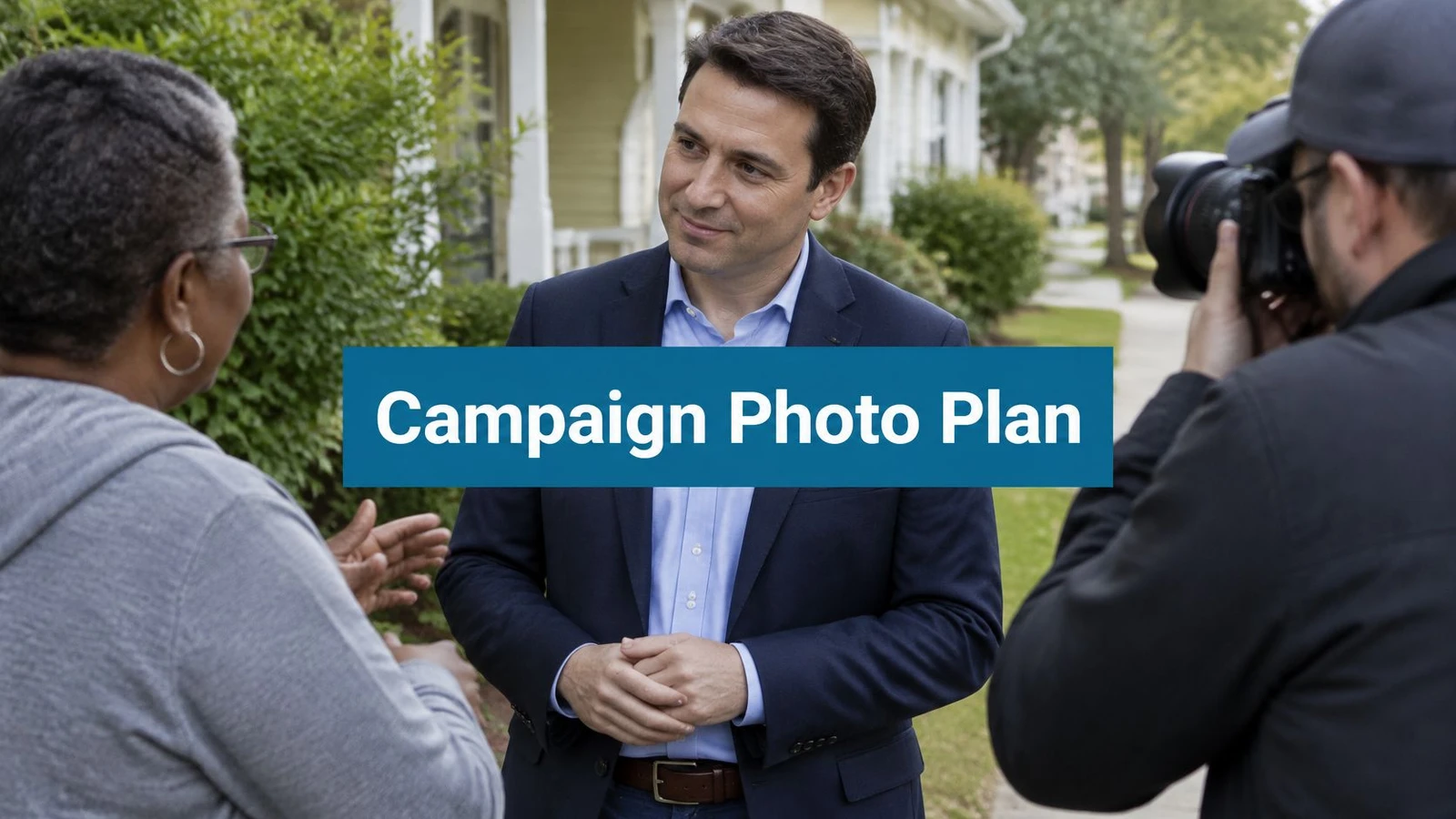
| Door knocking action | Candidate at a front door mid-conversation, respectful distance | Square and vertical crops |
| Listening interaction | Candidate listening to a constituent, medium distance | Master file plus square crop |
Give each frame a job
The headshot establishes recognition. Both shoulders should remain available in the master, even when a designer expects a tighter crop, because an aggressively cropped original leaves little room for later layouts.
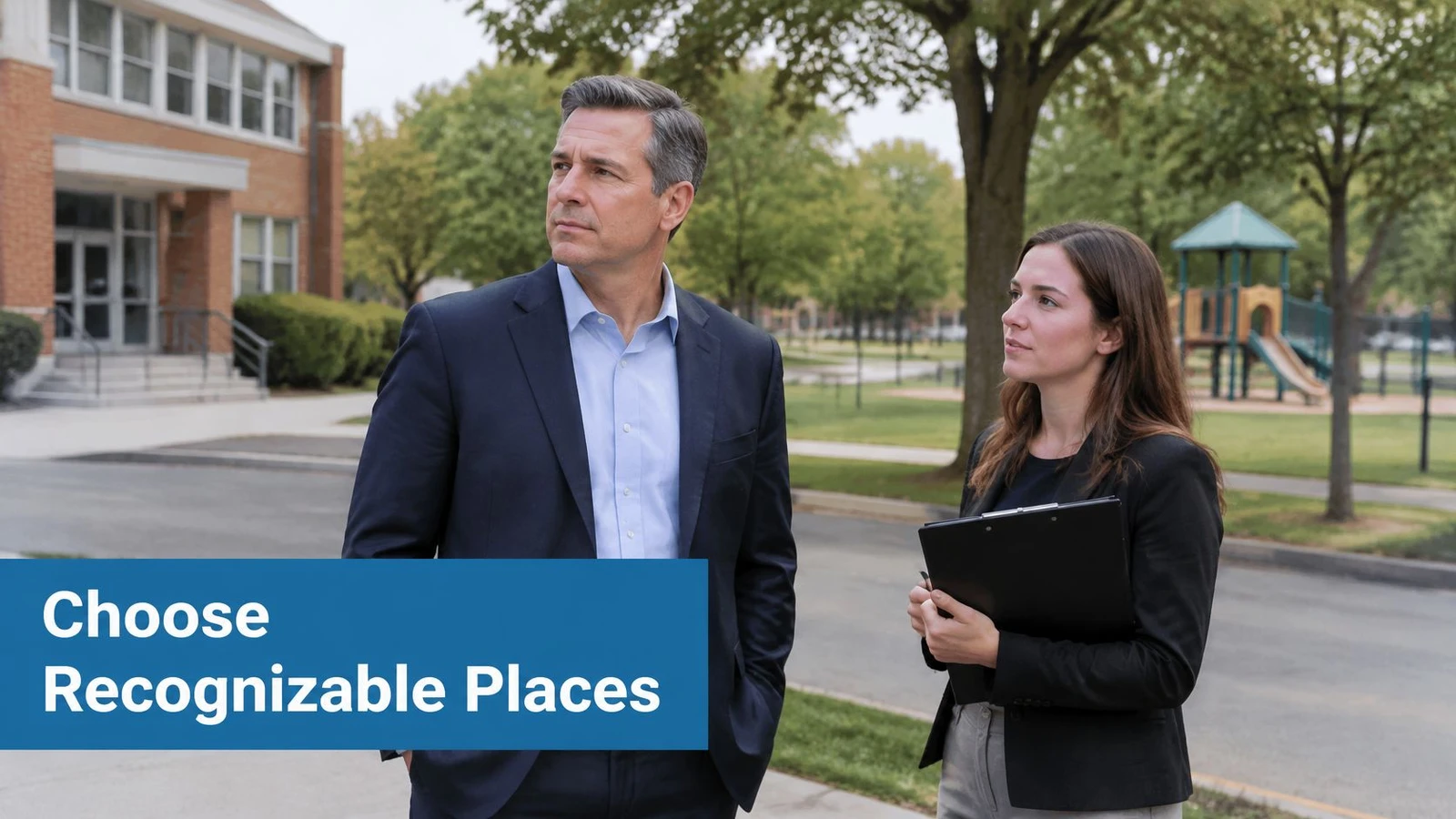
Environmental portraits establish local context without requiring a crowd. A school, waterfront, park, or main street should be recognizable enough to carry meaning, but not so visually busy that the candidate disappears.
Family photographs add personal context, provided participation is voluntary. Community photographs serve a different purpose: they should show a real relationship or activity, not a row of people assembled solely to imply support.
For door-knocking photographs, the photographer should stand back and allow the conversation to happen. Listening frames deserve their own place on the list because a candidate’s attentive expression can communicate something a handshake cannot.
Production rule: Capture room around the subject first. A designer can tighten a frame, but can’t recover a shoulder, hand, or doorway that was never photographed.
Plan the sequence before booking
A useful planning technique comes from motion production. Encore Film And Music Studio’s guidance on beat mapping and shot listing offers a way to connect intended moments with specific frames instead of improvising an entire shoot.
The campaign manager should also identify which frames need room for a political campaign advertisement. A portrait intended for an ad needs different spacing from a tightly cropped press headshot.
The written shot list should be approved before booking, with a named placement beside every requested image. The placement sheet should then specify the required crop and delivery format.
Wardrobe and Styling for Each Setting
A consistent palette makes photographs from different settings look like the same campaign. Clothing can become more relaxed between the studio and the sidewalk without changing the candidate’s visual identity.
Solid, mid-tone colors are a practical starting point. The important test is separation from the background, not whether a particular color looks good on a hanger.
Wardrobe by setting
| Setting | Wardrobe | Avoid |
|---|---|---|
| Studio headshot | Navy, charcoal or deep teal jacket over an open-collar shirt in a mid-tone | White shirt on a white backdrop, bold patterns |
| Environmental portrait | Smart casual layers in one palette, jacket optional | Colors that blend into the location, such as green on a park lawn |
| Family at home or outdoors | Coordinated colors with varied textures and comfortable fabrics | Identical matching outfits, sports team gear |
| Community event | Practical clothing with one campaign color accent | Printed slogans, heavy logos, cheap printed T-shirts |
| Door knocking and field work | Comfortable walking shoes, rolled sleeves, weather-appropriate light layer | Heels, dress shoes on wet pavement, bulky coats that hide the candidate |
Test clothing against the actual background
A white shirt against a white backdrop can lose separation and draw attention away from the face. Fine stripes and small prints can produce distracting visual interference, so a plain fabric is usually the safer choice.
Logos and slogans also restrict reuse. Clothing that works for a campaign gathering may look dated in a later profile or distract from a local-news photograph.
Family members should coordinate rather than wear identical outfits. Related colors with different textures look composed without making the photograph resemble a uniformed group.
For field photographs, clothing must work for actual walking and conversation. A candidate shouldn’t remove a necessary coat merely to preserve a preferred silhouette; the location or schedule should change when weather makes the planned outfit impractical.
- Test the palette: Photograph the proposed outfit against the intended background before shoot day.
- Pack simple fixes: Bring a spare shirt, lint roller, mirror, and a hanger for the jacket.
- Check the details: Straighten collars, empty bulky pockets, and check jacket buttons before each setting.
The wardrobe palette should reach the candidate and participating family members at least a week before the shoot. That gives everyone time to resolve missing pieces without buying an entirely new outfit.
Choosing Locations, Permissions and Who Appears in the Frame
Location selection should start with district relevance. A neighborhood street, school, park, waterfront, or landmark should connect the candidate to the constituency, not merely provide an attractive backdrop outside its boundaries.
Access, safety, and accessibility matter as much as appearance. A location that requires participants to negotiate stairs, stand in traffic, or remain outdoors without shelter isn’t a sound production choice.
Clear access before inviting participants
For planned campaign use, the team should secure written owner permission for private property. Public parks may require permits, school grounds need district approval, and recognizable landmarks can have separate photography or advertising conditions.
These aren’t interchangeable approvals. Permission to enter a property doesn’t necessarily authorize a campaign to use its name, signage, or institutional identity in an advertisement.
- Property access: Record the address, owner or managing authority, approved activity, and any restrictions.
- Participant releases: Obtain signed releases from identifiable adult participants and parent or guardian releases for minors.
- Bystander handling: Reframe, wait, or crop when an uninvolved person would otherwise become a prominent subject.
- Use restrictions: Note whether approval covers advertising, print distribution, website publication, and social posts.
Release requirements vary by jurisdiction and use. A release-first campaign policy reduces uncertainty, but it shouldn’t be presented as a universal statement of law.
Audit representation before shoot day
A review of visual political communication connects favorable evaluations with cues such as camera angle, cheerful expressions, and dynamic behavior, while examining concerns about unequal visual portrayals. Those choices deserve deliberate review rather than automatic application.
The campaign should ask who appears in the foreground, who becomes background scenery, and whether the candidate listens as well as speaks. Neighborhoods should appear as places where people live and participate, not as shorthand for hardship or prosperity.
A community photograph should show a relationship, not use residents as decoration.
A location set that looks uniformly affluent may misrepresent a mixed-income district. Staged diversity and excessive polishing can create a similarly narrow picture of campaign life.
The location register should include permission and release status, accessible access, participant roles, and caption notes. The team should aim to lock that register and its representation review two weeks before the shoot, leaving room to replace unsuitable locations.
Directing Authentic Shots Without Staging Them
An experiment on congressional-candidate Instagram images found evidence that live, authentic, and emotional images could increase stated vote likelihood while decreasing perceived electability. Candid frames can build connection, and the same frames can read as chaotic when the candidate looks out of control of the room.
A useful photograph feels human without suggesting the candidate has lost control of the situation. That trade-off makes selection harder than picking the broadest smile.
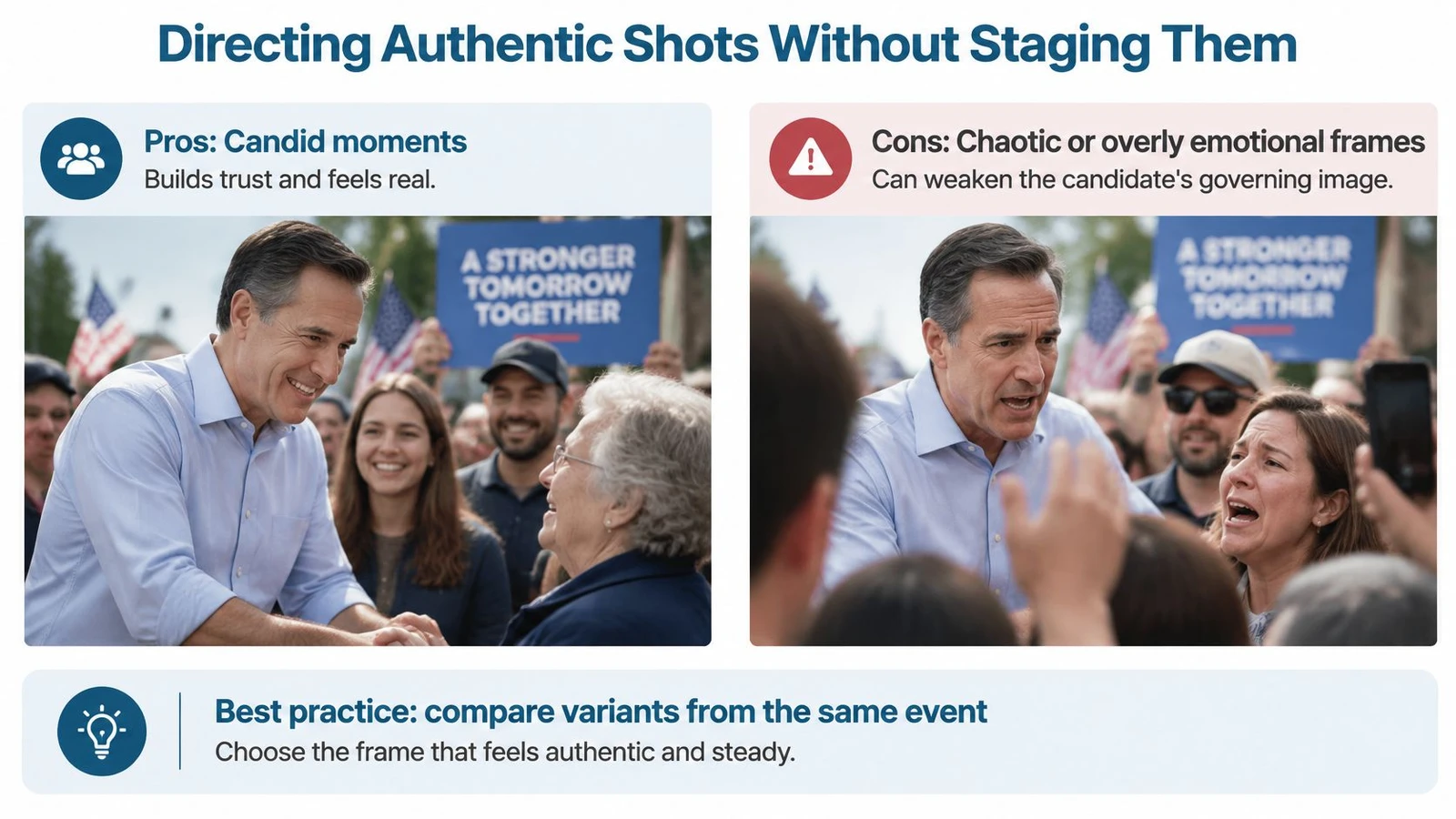
Capture matched variants from the same event
The photographer should build a small set from each genuine interaction rather than depend on a single decisive frame.
- Listening frame: Photograph the candidate at medium distance, visibly attending to the constituent without crowding the conversation.
- Composed portrait: Use a level camera, controlled background, and neutral-to-confident expression during an appropriate pause.
- Issue-action frame: Show the candidate doing something relevant to the visit, with distracting background elements excluded through camera position.
Direction should focus on behavior rather than manufactured emotion. Asking the candidate to keep listening works. Asking everyone to laugh on cue produces a different kind of photograph.
A posed portrait is legitimate when it is presented as a portrait. Repeating an entrance for camera coverage does not make the arrival spontaneous, and a staged handshake must never imply an endorsement that was not given.
Keep the documentary boundary clear
Routine adjustments cover exposure, color consistency, and cropping. Removing an object calls for more judgment. A loose cable is a distraction. A protest sign that explains the event is context.
A sign identifying a protest, organization, or venue can carry the meaning of the frame. If taking it out would change how a voter understands the event, the team should choose another frame instead.
People should not be added, settings replaced, or faces altered beyond light correction in photographs presented as documentary records. Original files stay untouched, with captions identifying time, place, and context.
Where the team records visits in a canvassing app, visit records can corroborate the time and place of action frames. They do not establish consent, prove an endorsement, or replace confirmation from the photographer.
Before shooting begins, the candidate briefing should name the moments worth preserving: listening, pausing for a composed frame, and taking relevant action. That gives the photographer real opportunities without turning a constituent visit into a performance.
Matching Each Shot to Literature, Signs and the Website
The crop matters as much as the shot. A strong portrait can fail on a sign if the face competes with the name, while a useful community photograph can become unreadable when squeezed into a narrow panel.
Alex Kaplan’s campaign-photography guide identifies websites, mailers, press releases, social feeds, door hangers, local-news articles, and community outreach as destinations for a planned image library. Those placements should be treated as separate production requirements.
Shot and crop for each placement
| Placement | Best shot | Crop and format |
|---|---|---|
| Yard sign | Clean head-and-shoulders headshot on a plain background | Vertical crop, space for the name at the bottom, proof-tested at distance |
| Palm card and brochure cover | Headshot at a three-quarter angle | Vertical or folded panel crop, negative space on one side for text |
| Mailer and door hanger | Headshot plus one community or action image | Vertical crop at print resolution, face clear of fold lines |
| Website header | Environmental portrait or community scene | Wide horizontal banner, subject offset for text overlay |
| Social post | Action or interaction frame | Square and vertical versions, subject in the center third |
| Press release and news feature | Headshot plus one unposed scene | High-resolution JPG or TIF with caption and photo credit |
Size files for the finished placement
Print preparation should begin with the printer’s finished dimensions, bleed, and image requirements. Changing a resolution label won’t restore missing detail, so the designer should check the actual file at its intended reproduction size.
Mailers and door hangers need safe space around folds, trim edges, and hanging holes. A face should never sit across a fold because the original composition looked balanced on screen.
For campaign literature, the placement sheet should identify which image leads and which supports it. Combining a recognition portrait with a relevant interaction often gives the designer more flexibility than combining similar headshots.
Proofing check: Review a printed sign at its intended viewing distance. The candidate’s name must remain readable without the photograph overwhelming it.
Adapt the image, not just the file dimensions
Website headers need wide framing and a mobile preview. An offset subject may leave excellent desktop text space but disappear when the website crops the image on a phone.
Platform conventions also deserve testing. A cross-platform study of politician images found that politics-related, candidate-centered images attracted more likes on Facebook, while comparable informal visuals didn’t show the same effect on Instagram.
That supports thoughtful selection, not a guarantee that family or candid photographs will perform better. Personal-feeling frames can suit informal posts, while family images belong naturally on the about page.
Before shooting, the designer should complete a placement sheet pairing every intended use with a crop, format, text-safe area, and approval owner.
Organizing Files So Campaign Pictures Are Easy to Find
A folder named campaign pictures quickly becomes difficult to search because it mixes portraits, rallies, neighborhood scenes, and downloaded reference images. The search phrase itself is broad: Getty Images’ political-campaign collection includes a wide range of campaign and election imagery rather than only candidate headshots.
The campaign’s own library needs narrower labels. Staff should be able to locate an approved door-knocking image without opening every photograph.
Use names, tags, and separate versions
A practical filename combines date, candidate, district or neighborhood, subject, placement, and version. A descriptive name such as candidate-neighborhood-listening-web-approved.jpg is more useful than a camera-generated filename.
SleekPost’s explanation of how to organize images with tags and versions offers useful context for separating what an image depicts from how the team plans to use it.
- Originals: Keep untouched camera files in a restricted folder.
- Masters: Store approved, high-resolution JPG or TIF files separately.
- Placement exports: Maintain folders for website banners, social posts, literature, signs, and press.
- Asset log: Record time, location, participants, consent status, credit, intended platform, and approval status.
Captions and alt text should describe what appears without inventing a participant’s motives or support. Private voter details belong in the campaign’s controlled records, not in public filenames or captions.
Make altered content identifiable
The edit log should record the change, editor, date, and approval. Routine color correction is different from changing identity, setting, event participation, or apparent endorsement.
Material changes need prominent, plain-language disclosure beside the image, not merely buried metadata. Suitable wording might identify a synthetic background or explain that the image combines separately photographed elements.
Disclosure doesn’t make a false endorsement acceptable. A materially misleading image may need to be rejected rather than labeled.
A named owner should approve publication and set a post-campaign review date for access and retention. The folder structure and log template should exist before the first shoot day.
Confirm the Shot List and Permissions Before Booking
A photographer can hold a date while the campaign is still deciding. The deposit should wait until every requested image has a placement, a realistic setting and a named signer.
Treat confirmation as a transfer of responsibility. The photographer brings availability, lighting judgment and backup equipment; the campaign brings access, consent, approvals and the decision about what may be published.
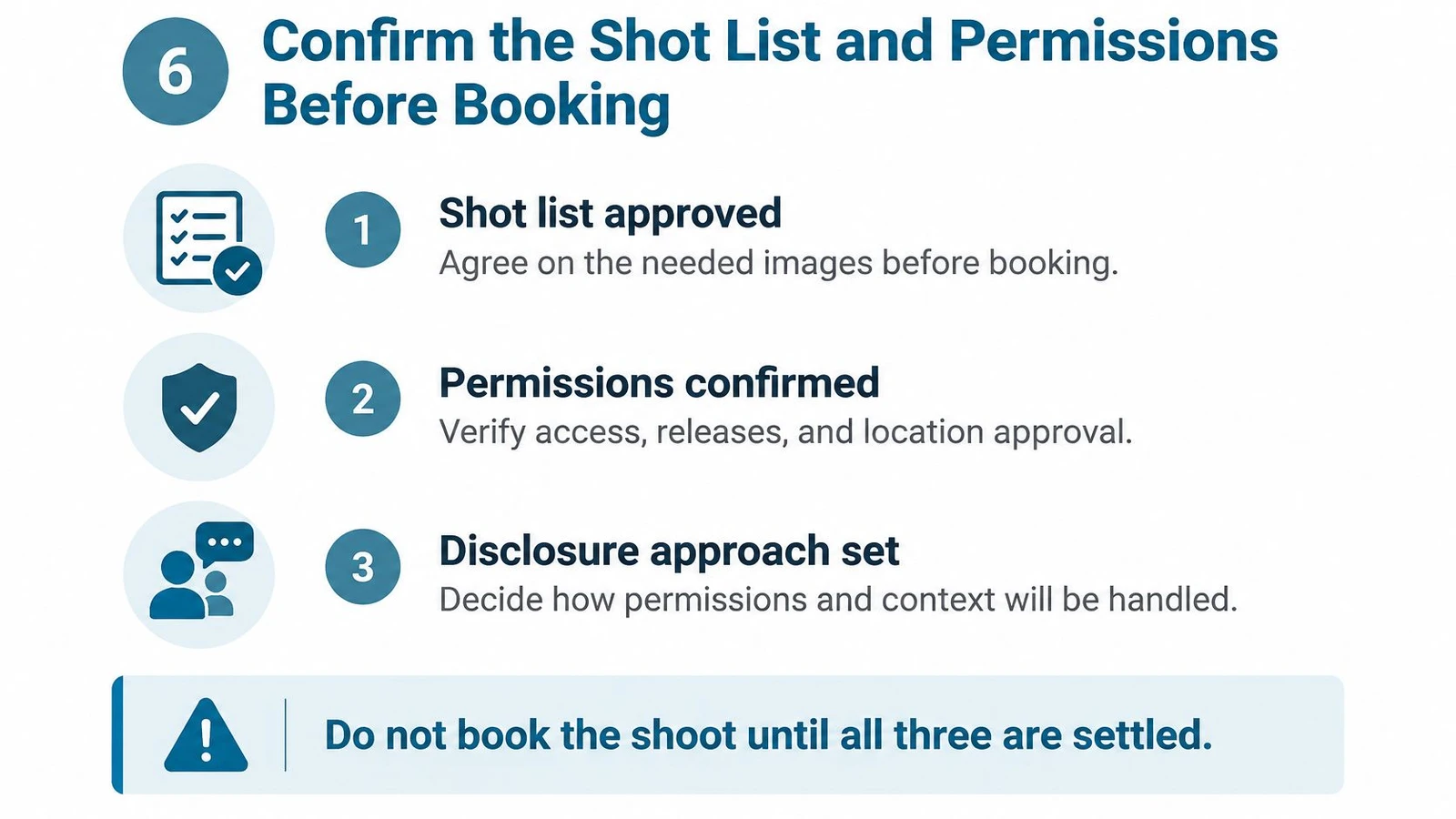
Close the production checklist
- Shot list: Campaign manager signs when each frame has a channel, crop and achievable setting, before the deposit is sent.
- People and property: Operations lead signs when releases and permission letters are gathered or clearly assigned, before invitations go out.
- Wardrobe: Candidate or family lead signs when everyone appearing has the palette and understands the setting, at the fitting.
- Representation: Communications director signs when planned participants and backdrops reflect the constituency and no attendee is framed as a supporter without consent, before locations are locked.
- Alterations: Approval owner marks which edits need a label and which should be rejected, before retouching begins.
- Publication control: Named approver takes final selects, crops and channel exports, confirmed in writing before shoot day.
If a signer cannot answer, the item stays open and the date remains a hold. That keeps one missing permission from turning into a canceled mailer or a rushed website image.
Work backward from delivery
Start from the first print order and the website launch, then reserve space for selection, retouching, approval, printer proofing and page testing. Put those deadlines on the same political campaign timeline as photography so the shoot does not land after the material that needs it.
A weather backup should protect the reason for the picture. A neighborhood portrait moved under a generic awning may stay dry and still lose the street, storefront or precinct detail that made it worth taking.
Campaigns still setting the broader sequence can use the guide on how to run for office to connect communications work with field, finance and compliance deadlines. Book firmly only when each line above has an owner, a due point and a signature.
Frequently Asked Questions
How many photos should a campaign photoshoot produce?
The deliverable is enough distinct, approved images to fill every shot-list category, with matched variants where a placement needs them. A large frame count of near-duplicates adds review time without adding coverage.
What does a campaign photoshoot usually cost?
The day rate is only part of the budget. Licensing scope, travel between locations, assistant time, and retouching volume all move the price, and rights covering paid media cost more than rights limited to the campaign’s own channels. Get the full fee structure and license terms in writing before booking.
Does the photographer need political experience?
It helps more than a strong portfolio alone. A photographer who has worked with campaigns understands release discipline, disclosure concerns, and news-cycle speed, and already knows why a flattering edit can still be unusable. A skilled generalist can shoot well, but the campaign then carries the burden of briefing them on permissions and use restrictions.
Who owns the images after the shoot?
The contract sets ownership, regardless of who paid the invoice. Some photographers assign full rights to the campaign, while others license the images for defined uses and periods. A candidate planning a long race should negotiate broad written usage terms at booking, because renegotiating mid-campaign costs more and stalls placements.
How long does image selection take?
The technical cull is quick: bad frames, duplicates, and soft focus go out in one pass. The slow stage is the approval round, where finalists are compared, participant comfort is confirmed, and crops are locked. Naming one approver before the shoot closes that round far faster than circulating proofs to a committee.
The candidate shoot feeds every channel at once; the field work it documents needs its own system. doornoc is browser-based canvassing software for building walk routes, recording door interactions, and reporting results, keeping that work organized while photo permissions and publication approvals stay in a separate production log.
Looking for a tool to run this? doornoc’s canvassing software bundles voter data, automatic turf cutting, the mobile app, and live reporting in one platform.