

A runoff election is a second election held when no candidate wins the required majority in the first round, with the top two vote-getters advancing to face each other. In the common majority-runoff system, winning outright generally requires more than 50% of the vote.
But what happens if the people who return for that final contest aren’t the same people who voted the first time? That question matters as much as the qualifying rule. A runoff narrows the candidate field, but it also asks voters to participate again, creating a separate election with its own deadlines, campaign decisions, and potentially different electorate.
What a Runoff Election Is and When It Happens
A runoff election resolves a contest in which nobody met the required winning threshold. Think of a knockout bracket that narrows a crowded field to a final match. The first contest determines who advances; the final contest determines who wins.
The distinction between plurality and majority explains why this extra election happens. A plurality means more votes than any other candidate, while a majority generally means more than half, as the USAFacts runoff election explainer describes.
How plurality differs from majority
Consider the hypothetical result used in that explanation: candidates receive 38%, 31%, 19%, and 12%. The leader finished ahead of every opponent, but most voters chose somebody else. Under the common majority-runoff rule, the leading pair advances rather than declaring the first-place candidate elected.
Contrast that with a candidate receiving 51%. That candidate has crossed the usual majority threshold, so the contest normally ends without a runoff.
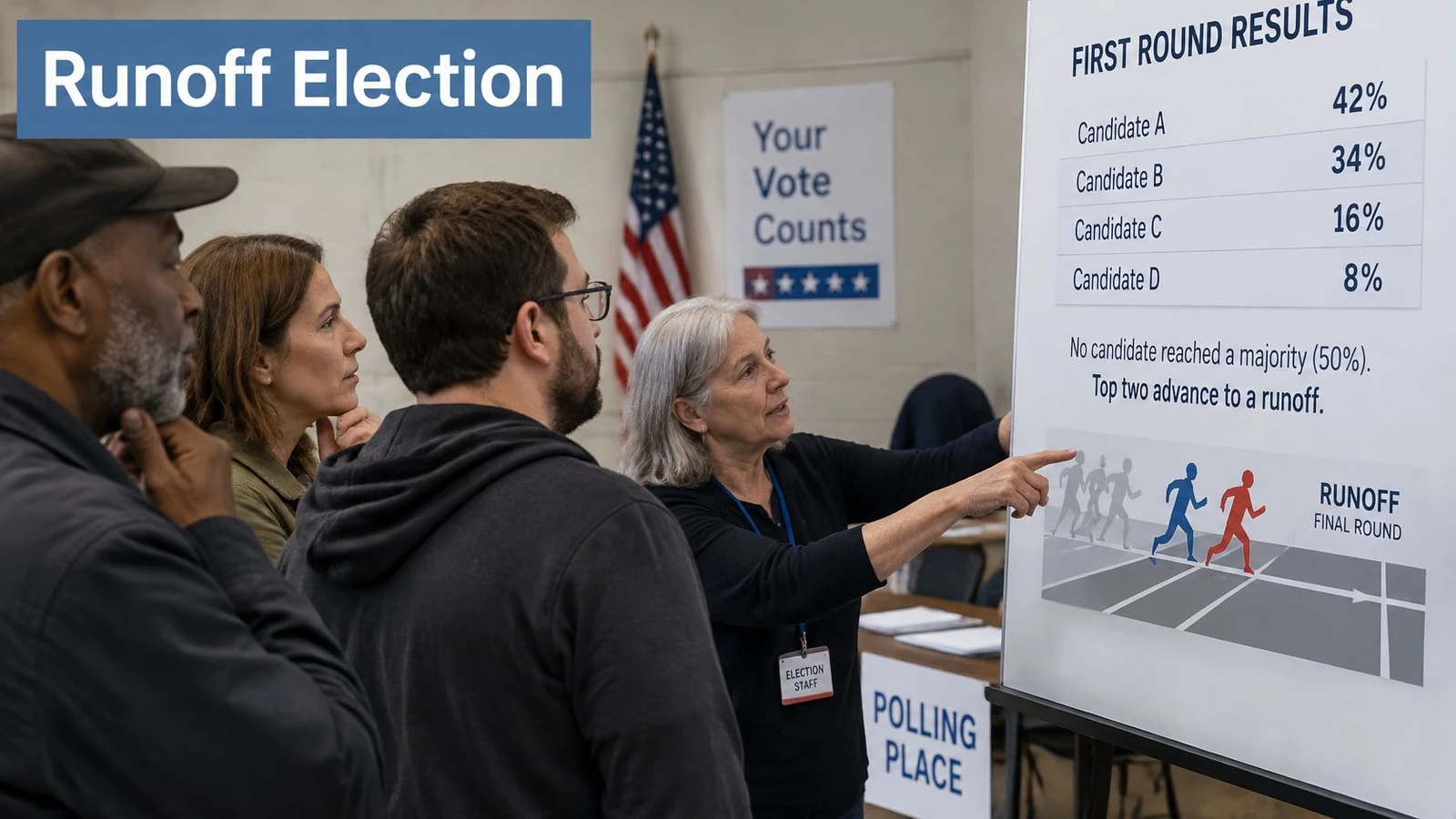
The purpose is to require the eventual winner to defeat a remaining opponent, rather than prevail because several opponents divided the vote. However, majority support means support among the votes counted under the applicable rules, not necessarily among everyone registered or eligible to vote.
Practical rule: Finishing first and winning outright aren’t always the same thing.
The legal wording matters. Some jurisdictions calculate a majority using valid votes, while others apply runoff requirements only to specified offices or election types. A primary, municipal race, and general election shouldn’t automatically be treated alike.
For someone asking what is a runoff election, the most useful next step is therefore specific: identify the race, find its governing rule, and compare the official result with the required threshold. A news headline identifying a leader doesn’t, by itself, establish that the election is finished.
Which States Hold Primary and General Runoffs
| State | Runoff type | Trigger rule |
|---|---|---|
| Alabama | Primary | More than 50% needed to avoid a runoff in most cases; verify statute |
| Arkansas | Primary | More than 50% needed to avoid a runoff in most cases; verify statute |
| Georgia | Primary and general | More than 50% needed to win outright; otherwise the top two advance |
| Louisiana | General | Majority required; verify statute |
| Mississippi | Primary and general | Majority required; verify statute |
| North Carolina | Primary | Second-place candidate may request a runoff when the leader gets less than 30% |
| Oklahoma | Primary | More than 50% needed to avoid a runoff in most cases; verify statute |
| South Carolina | Primary | More than 50% needed to avoid a runoff in most cases; verify statute |
| South Dakota | Primary | Required when nobody reaches 35% in certain federal and gubernatorial primaries with three or more candidates |
| Texas | Primary | More than 50% needed to avoid a runoff in most cases; verify statute |
The National Conference of State Legislatures’ primary runoff guide identifies nine states using primary runoffs in some form and explains the majority rules and the 30% North Carolina and 35% South Dakota exceptions summarized above. Its general-election classification includes Georgia, Louisiana, and Mississippi.
A primary runoff settles a nomination contest. A general-election runoff settles the relevant general-election race. A state’s appearance in both categories doesn’t mean every office follows identical procedures.
How to check a particular race
- Identify the office and election type. A party nomination and an election to office are different contests, even when the same candidate appears in both.
- Find the governing statute. Check whether the race requires a majority, uses a different qualifying threshold, or allows a qualifying candidate to request a runoff.
- Confirm the current rule with election officials. The state election authority should resolve questions about applicable offices, eligibility, and deadlines.
The table is a starting point, not a substitute for the statute. Local-election rules also need their own check.
North Carolina illustrates why that distinction matters: a rule allowing a candidate to request another contest isn’t the same as an automatic runoff requirement. Campaign staff should establish not only whether a threshold was missed, but also whether an additional legal step must occur before another election is scheduled.
Runoff Timelines From the First Round to the Final Vote
Georgia illustrates how a December runoff follows a November election: its historical 2024 schedule placed the general election on November 5 and the general runoff on December 3, with early voting and administrative deadlines between them, as described in the Georgia government runoff calendar. Those historical dates aren’t a calendar for a current race.
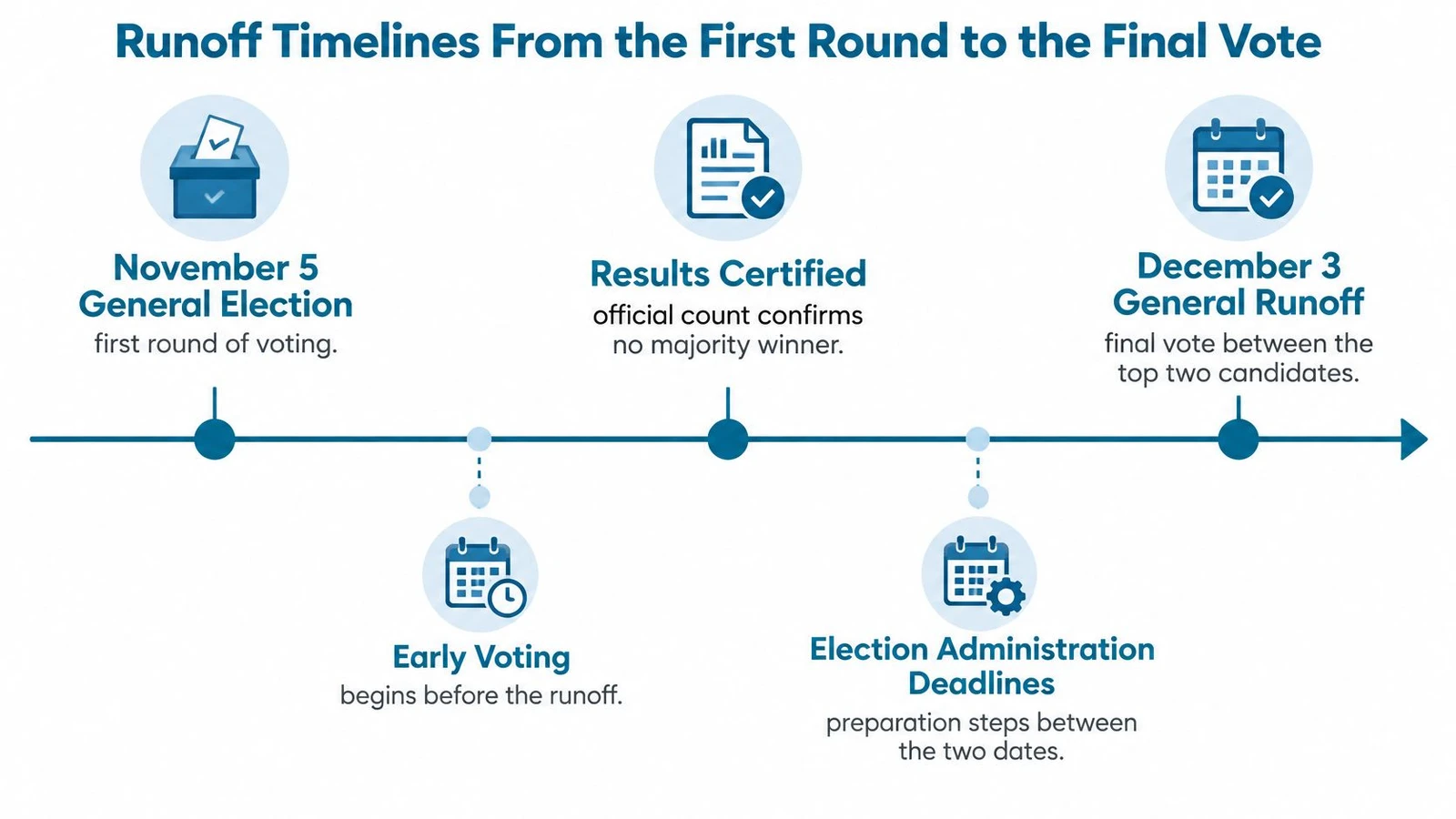
There’s no universal interval that applies to every runoff. State law and the office determine the schedule, while the practical campaign window must also accommodate voting before Election Day.
In U.S. congressional primary runoff data from 1994–2024, FairVote’s primary runoff report found a 33% median turnout decline when the gap was within 30 days, compared with 48% when it exceeded 30 days.
| Gap between rounds | Median turnout decline | Planning implication |
|---|---|---|
| Within 30 days | 33% | Short window to rebuild voter lists and re-contact supporters |
| More than 30 days | 48% | More time to prepare, but a larger drop in participation to offset |
A separate analysis of regularly scheduled congressional primary runoffs also found a substantially larger median decline when the interval was longer. These comparisons describe participation patterns, not a guarantee about any particular contest.
Dates that need verification
- Runoff Election Day: Confirm the date for the actual office.
- Early-voting start: Establish when voters can begin participating.
- Absentee deadlines: Check both request and return requirements.
- Registration deadline: Verify the applicable deadline and eligibility rules.
A short gap leaves little time to correct lists or train volunteers. A longer gap provides preparation time but requires sustained reminders rather than a burst of contact followed by silence.
A political campaign timeline should therefore work backward from the earliest voting opportunity, not just the final polling day. Every reminder should use dates verified with the election authority.
Why Turnout Falls Between the Two Rounds
The assumption that a runoff repeats the first election misses an important change: the electorate can shrink and change composition. Some first-round voters return, some don’t, and eligible people who skipped the initial contest may participate if the rules permit.
A peer-reviewed study of U.S. Democratic gubernatorial, senatorial, and congressional runoffs covering 1956–1984 found turnout declined in nearly 77% of cases, with larger declines in congressional and senatorial contests than gubernatorial contests. A later analysis of 248 regularly scheduled U.S. House and Senate primary runoffs from 1994–2020 found fewer voters in 97% of contests, an average decline of 38%, and a median decline of 37%.
That later analysis also found that runoffs held 31–40 days after the primary had a median decline more than three times that of runoffs held 11–20 days afterward. FairVote’s later-cycle findings put the median decline at 63% in 2024, compared with 52% in 2022.
A majority of which voters?
Those findings concern specific U.S. runoff contests, not every election using this system. Still, they expose the distinction between a majority of runoff votes and a majority of the original electorate.
A runoff can produce a majority winner without bringing back a majority of the people who participated earlier.
A second election requires another decision about time, transportation, and voting method. Supporters of eliminated candidates may also feel less represented by the remaining choices.
The share of registered people who participate is the core voter turnout measure to compare between rounds. Campaign analysts should also examine where participation changed, rather than assuming every precinct lost voters in equal proportions.
For field teams, a first-round conversation isn’t a completed runoff contact. Reliable participants need fresh information, while voters with less consistent participation shouldn’t automatically be written off. In a smaller electorate, their participation can matter substantially.
How Campaigns Re-Contact Voters Between Rounds
Runoff outreach begins with existing records, but it shouldn’t stop there. Campaigns need to distinguish what they know from what they merely assume, especially when identifying supporters.
A voting-history record can show participation, but it doesn’t reveal a person’s secret ballot. Support classifications should come from voluntary conversations and campaign contact records, not a claim that officials disclose candidate choices.
A practical re-contact sequence
-
Review precinct-level results when they’re certified. Compare where each finalist performed well and where support was divided. Preliminary returns can guide preparation, but staff should keep them separate from official totals.
-
Separate turnout reminders from persuasion. People who previously expressed support need updated dates and a voting plan. People who supported an eliminated candidate may need an explanation of the remaining choice before a turnout reminder is useful.
-
Refresh walk lists with updated records. Check addresses, earlier contact outcomes, and known support before sending volunteers back out. Prioritize useful return visits rather than repeating every unanswered knock indiscriminately.
-
Confirm voting deadlines and brief volunteers. Give the team a dated reference sheet covering early voting, absentee requirements, and Election Day. A volunteer who isn’t certain of an answer should refer the voter to election officials rather than improvise.
-
Retrain canvassers for the narrowed contest. Replace introductions built around a crowded field with a clear explanation of the final choice. Volunteers should also be ready to explain that earlier ballots don’t count toward the new contest.
-
Begin door contact promptly after the initial election. Staff can prepare return visits while officials finish administrative work, provided any discussion of results accurately reflects their status. For other outreach channels, political text message examples can help staff develop concise reminders without confusing persuasion with voting instructions.
-
Allocate limited time deliberately. Start with known supporters and voters likely to participate, then reserve capacity for less consistent voters who need practical help understanding the schedule. Review new contact outcomes before assigning the next set of visits.
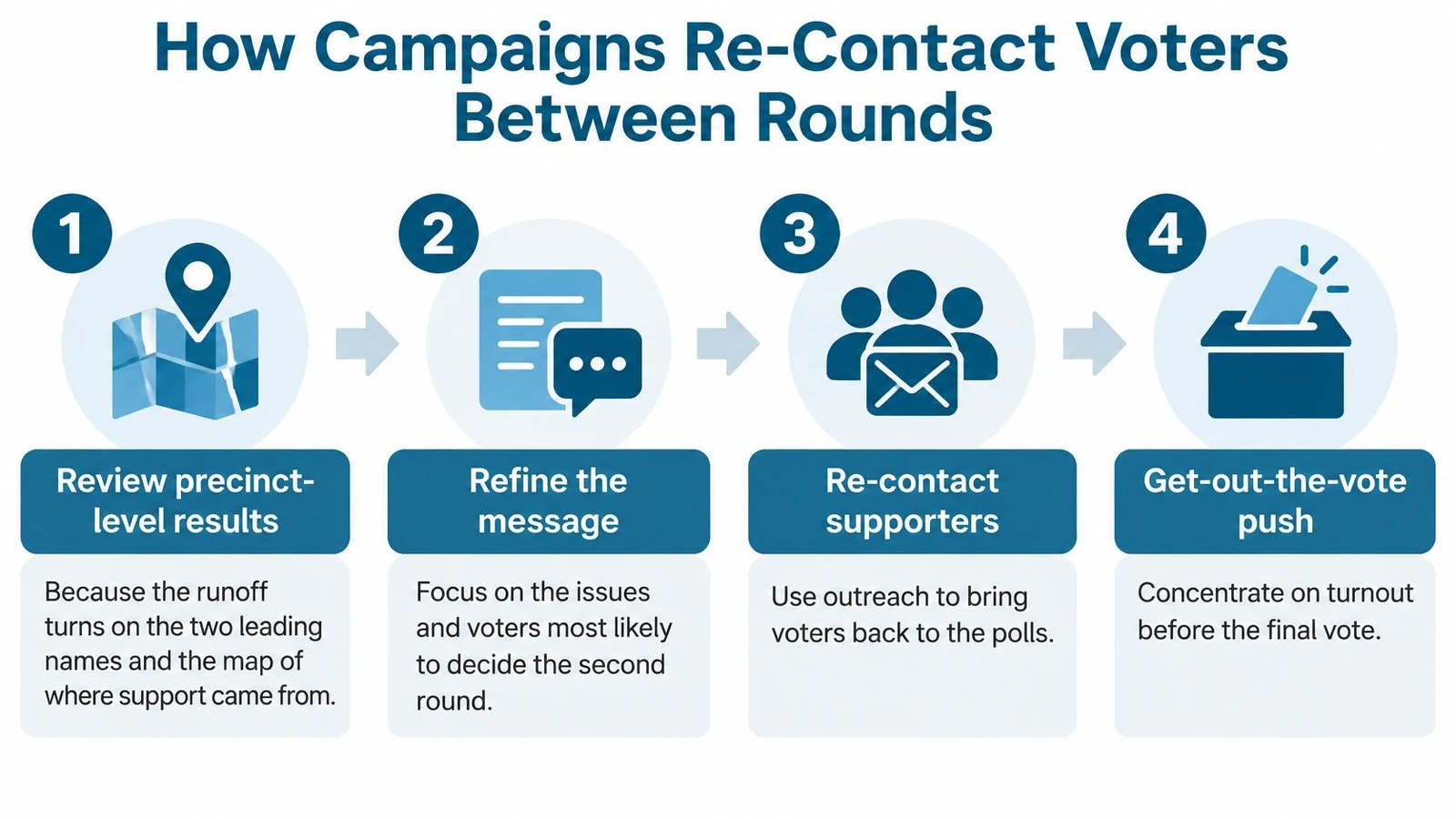
These steps support get-out-the-vote work, commonly called GOTV. Persuasion establishes support; turnout work helps supporters act on it.
Browser-based canvassing software can keep door outcomes, notes, literature drops, and updated walk-list results together. Whatever system a campaign uses, its original voter list is a starting point, not the final runoff contact list.
What Voters Can Expect in a Runoff Race
A voter should expect a new ballot and a new decision. A first-round vote doesn’t carry over, and voting for an eliminated candidate doesn’t transfer that ballot automatically to a finalist.
International IDEA’s guide to presidential electoral systems describes the standard majority-runoff system as advancing the leading pair when nobody obtains an absolute majority, usually more than 50% of valid votes. It also explains that some systems use different thresholds or allow a broader second-round field, so the familiar model isn’t universal.
The trade-off is straightforward: a runoff requires another act of participation, while a single-round plurality election avoids that extra voting occasion but can select a candidate without majority support.
A voter’s verification checklist
- Check the race: Confirm that the relevant office appears on the runoff ballot.
- Confirm the calendar: Obtain the runoff date, early-voting window, and absentee deadlines from the state election authority.
- Verify eligibility: Check registration status and any primary-participation restrictions.
- Check the location: Don’t assume the polling place or early-voting site is unchanged.
- Make a fresh plan: Choose when and how to vote, then place the date on a calendar.
Campaign reminders may help, but official election information should settle questions about eligibility or voting procedures. A GOTV explanation can clarify why campaigns make repeated contacts without serving as a substitute for those official rules.
Before treating a race as decided: Check whether the leader satisfied the legal winning threshold.
That check separates a qualifying result from a final result. It also helps voters recognize when another ballot, rather than continued counting of the original ballots, will determine the winner.
Frequently Asked Questions
Is a runoff the same as a primary?
No. A primary runoff is another nomination contest, while a general-election runoff resolves a general-election race. State law determines which applies to a particular office.
Do voters have to vote again in a runoff?
Voters who want to participate must cast a new ballot because each round is a separate contest. Their earlier vote doesn’t carry over, and election officials can confirm eligibility for the runoff.
Can a runoff happen in every state?
Only a limited set of states use the primary and general-election runoff systems listed in the state table. Local offices can have separate rules, so the state or local election authority should confirm the applicable procedure.
Is a runoff always held a few weeks later?
No, the interval depends on the state and office. December runoffs such as Georgia’s follow the November election, but voters should obtain current dates from the official election calendar.
Why does turnout usually drop in a runoff?
Voters must participate again, and the shorter candidate list or timing may reduce some voters’ interest or ability to return. The returning electorate can therefore differ from the original group, rather than being a smaller identical version.
doornoc offers browser-based canvassing tools for organizing walk lists and recording door outcomes, notes, and literature drops. Campaign teams preparing for another round can visit doornoc to organize return visits and keep new contact results available for runoff outreach.
Looking for a tool to run this? doornoc’s canvassing software bundles voter data, automatic turf cutting, the mobile app, and live reporting in one platform.