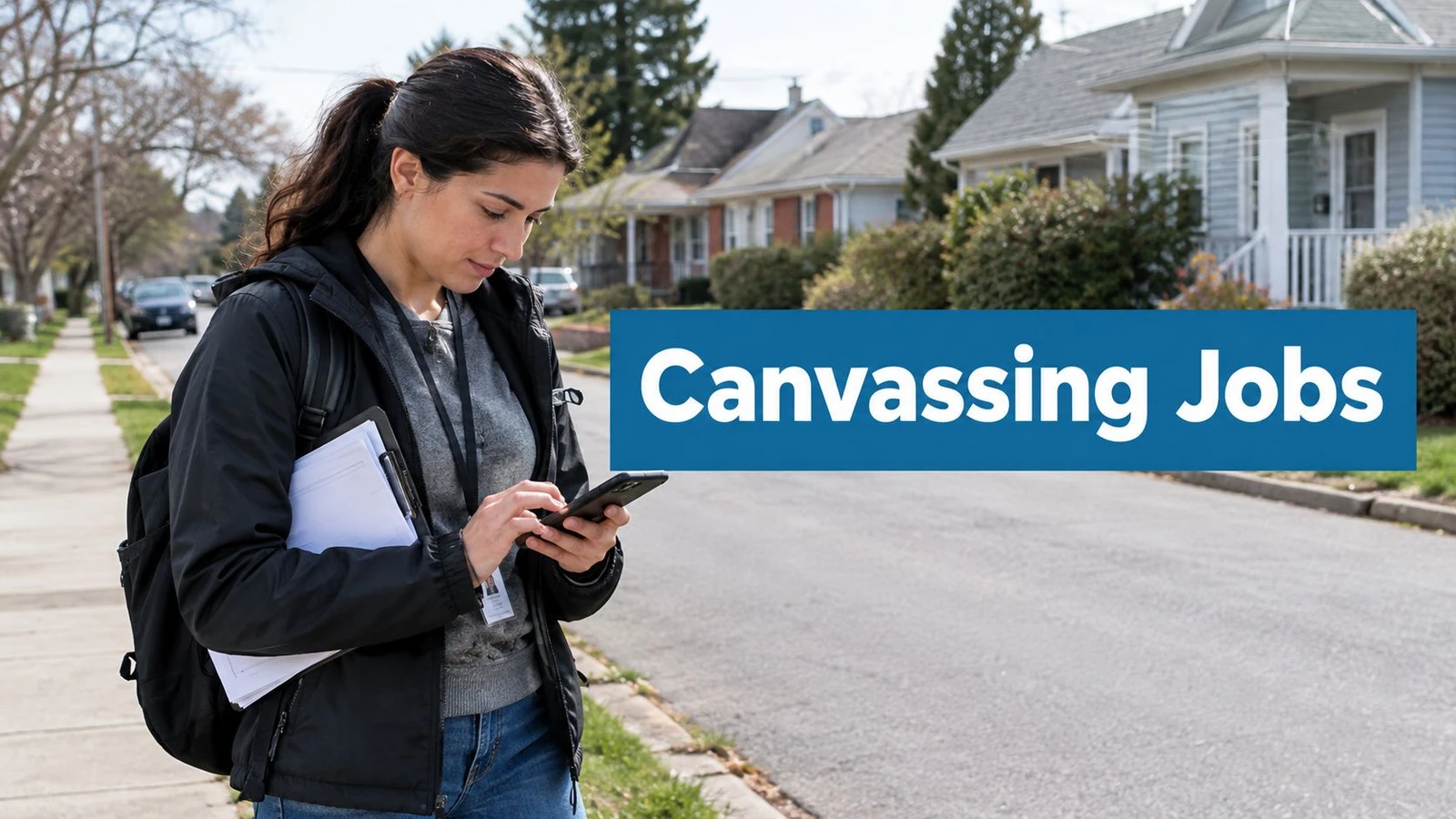

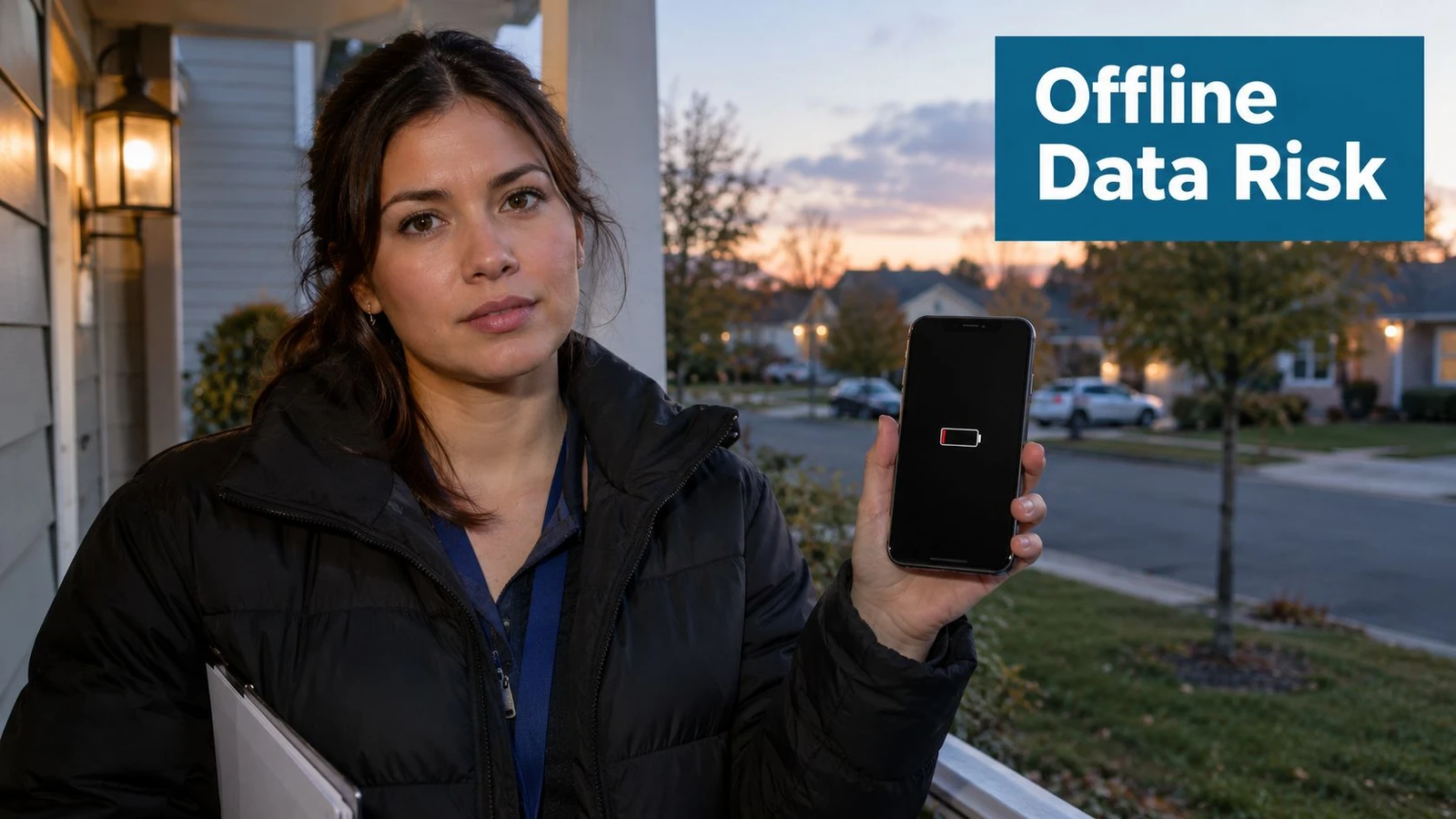
A volunteer finishes a late afternoon canvass with a nearly empty battery and no usable signal. The doors were reached, the conversations were logged, and the route looked complete on the phone. By the time the device reconnects, the campaign dashboard still shows unfinished turf, a few records appear twice, and the notes that explained a complicated household interaction are missing or attached to the wrong address.
That failure exposes the weakness in most field data collection app comparisons. They ask whether an app works offline, then stop before the difficult part. Campaign operators need to know how an app stores records, manages large attachments, handles simultaneous reconnections, and resolves edits when tired volunteers return from disconnected territory. A reliable canvassing system isn’t defined by a checkbox. It’s defined by what survives the worst day in the field.
The Offline Canvassing Problem No One Talks About
A field director sends volunteers into several neighborhoods after cutting turf for the day. Some streets have inconsistent coverage, some basements block reception, and a few volunteers conserve battery by closing every nonessential application. Each person records doors locally, expecting the app to upload everything once the signal returns.
That expectation is reasonable, but it hides several separate risks. A completed contact can remain in a local queue, a partially completed address can be edited by another volunteer, and a photo or audio attachment can consume far more storage than a short outcome code. If many devices reconnect around the same time, the campaign isn’t dealing with one sync event. It’s dealing with a burst of local decisions arriving at the central system together.
The failure appears after the walk
Consider a hypothetical turf-cutting cycle. One volunteer marks a household as contacted and records that a resident requested a follow-up. A second volunteer, working from an older local copy of the list, marks the same address as not home. Both records may be valid from the perspective of the device that created them. A simplistic last-write-wins rule can silently replace the more useful conversation note with the later status update.
The campaign may not discover the problem immediately. The route can look complete while the underlying voter record has lost context, retained a duplicate, or assigned an attachment to the wrong interaction. A field director then spends the next shift asking volunteers to reconstruct conversations from memory, which is exactly the kind of manual recovery that digital collection was supposed to prevent.
A practical explanation of conflict resolution for mobile apps helps clarify why this issue deserves separate evaluation. Conflict handling isn’t just a technical detail. It determines whether the system preserves both edits, chooses a defined winner, flags a review, or discards information without making the operator aware.
Operational rule: An offline promise is incomplete until the campaign knows what happens to duplicate, partial, and conflicting records after reconnection.
Why comparisons miss the operational risk
Most comparison pages focus on form builders, GPS, dashboards, and offline mode. Those features matter, but a canvassing operation also needs answers to harder questions:
- Queue visibility: Can a volunteer see which submissions are waiting, failed, or confirmed?
- Payload control: Does the form limit large photos, audio, and unnecessary map data?
- Edit history: Can supervisors identify which device changed a record and when?
- Conflict behavior: Does the system merge fields, preserve versions, or request a review?
- Reconnection tolerance: Can devices resume interrupted uploads instead of restarting them?
Campaign managers facing sync trouble can also use this troubleshooting guide for canvassing data not syncing as a practical checklist. The central lesson is uncomfortable but useful: offline collection protects a campaign only when local storage, transmission, and reconciliation work as one operational process.
What Offline-First Really Means for Field Operations
Offline-first means the field workflow is designed to function without a network rather than merely tolerate a temporary outage. A device should save a valid record locally, keep the submission in a durable queue, and resume synchronization when connectivity returns. The central system then needs rules for validation, ordering, duplicate detection, and conflicting edits.
This distinction matters because field data collection apps have become a substantial software category. One industry estimate places the market at $2.38 billion in 2025, $2.73 billion in 2026, and $4.7 billion by 2030, with a projected 14.6% CAGR. The same estimate identifies North America as the largest region in 2025 and Asia-Pacific as the fastest-growing region, while another estimate values the category at USD 2.26 billion in 2025E and projects USD 6.55 billion by 2033. These are market projections, not proof that any individual product will perform well, but they show why offline capability has moved from a niche requirement to core infrastructure. The market estimates and regional outlook provide that context.
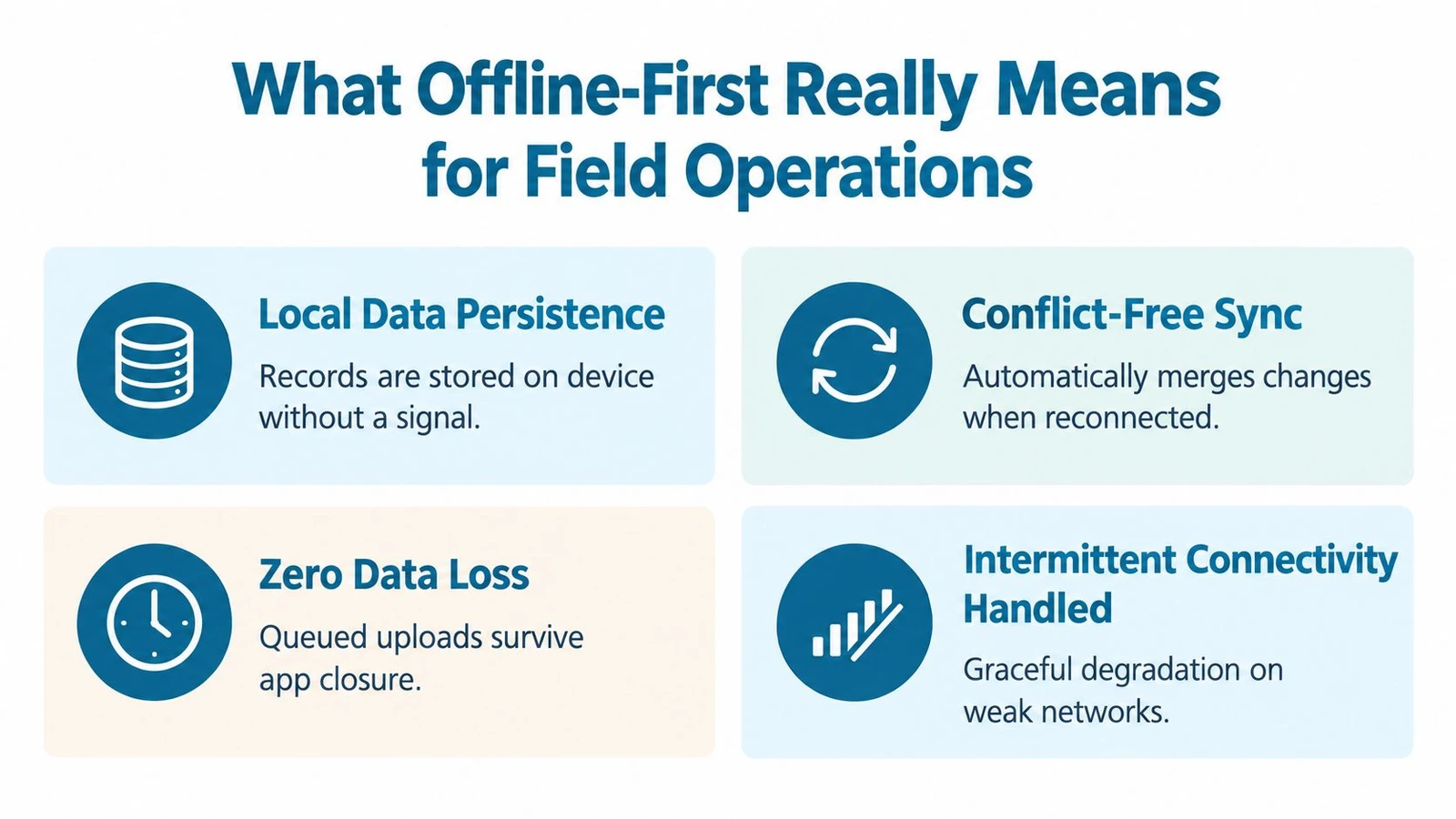
The four layers of an offline workflow
A campaign should evaluate four layers separately rather than treating offline mode as one feature.
-
Local persistence keeps a submitted record on the device even when the app closes or the connection disappears. Local persistence should cover the record itself, its status, and any permitted attachment.
-
Queue management controls what gets sent, what has already been confirmed, and what needs another attempt. A queue that restarts large uploads from the beginning can leave volunteers waiting and create repeated submissions.
-
Conflict handling decides what happens when two devices work from overlapping information. A mature process might merge non-overlapping fields, preserve both notes, or send an exception to a supervisor. The important point is that the rule is explicit and observable.
-
Recovery and verification tells the operator whether the central system accepted the record. A spinning icon isn’t enough. A volunteer needs a clear distinction between saved locally, queued, uploaded, and rejected.
A peer-reviewed mobile data collection study documented offline survey completion without network coverage, automatic upload after connectivity returned, and local storage of approximately 50 completed standard-length surveys on entry-level phones. The same study recorded 39,665 households over four months with no data loss, demonstrating that offline synchronization can support a large field operation when the workflow is engineered for it. The study and related fieldwork evidence support the infrastructure argument.
Payloads shape reliability
The record isn’t only a set of text fields. Photos, signatures, audio, and map resources increase storage requirements and make reconnection slower. Independent guidance on offline collection notes that form size and attachment handling strongly affect sync time and device storage, which makes payload design a technical performance measure rather than a cosmetic form decision.
A canvassing form with a short disposition, a structured response, and a concise note may synchronize gracefully. The same workflow with several high-resolution images and long recordings can produce a backlog that volunteers interpret as a failed app. Teams should therefore assess advanced capture by its effect on the whole interaction, not by whether the feature exists.
A useful campaign-specific guide to essential offline canvassing app features should be read alongside a stress test. The question isn’t whether a device can save one record without signal. It’s whether a dispersed operation can reconnect, reconcile, and verify hundreds of local records without forcing staff to repair the database by hand.
Comparing Three App Categories for Canvassing Reliability
Campaigns generally choose among three architectural categories. The first is a campaign-native platform, built around turf, routes, voter records, contact outcomes, and field supervision. The second is a general-purpose survey tool, which usually offers flexible forms and offline queues but may require separate routing and voter-data workflows. The third is an open-source framework, which can provide deep control and customization but places more responsibility on the campaign’s technical team.
The comparison below avoids treating any category as universally superior. Reliability depends on form complexity, team discipline, integration requirements, and the quality of the synchronization design.
Field Data Collection App Categories Compared
| Category | Best For | Sync Reliability | Setup Friction | Scalability Limit |
|---|---|---|---|---|
| Campaign-native platform | Political teams connecting turf, routes, contacts, and voter data | Usually aligned to campaign records and field states, but conflict rules still require testing | Lower for volunteers, because the workflow is purpose-built | May depend on plan structure, integration depth, and operational configuration |
| General-purpose survey tools | Structured questionnaires, inspections, and targeted contact programs | Strong for queued forms when payloads stay controlled, less complete for campaign-specific record conflicts | Moderate, especially when routing and voter databases sit elsewhere | Coordination becomes harder as external systems and concurrent devices increase |
| Open-source frameworks | Technical teams requiring custom schemas, hosting, or integrations | Potentially highly controllable, but the campaign owns implementation and recovery logic | Highest, particularly for volunteer onboarding and support | Technical capacity, maintenance, and monitoring become the practical constraint |
Sync reliability under real campaign load
A campaign-native system has an architectural advantage when a door interaction, route assignment, and voter record belong to the same workflow. A general survey tool may capture the answer correctly but leave staff to reconcile it with turf status and the voter database later. An open-source framework can solve either problem, but only if the campaign has implemented reliable identifiers, versioning, retry behavior, and audit trails.
The critical comparison isn’t “which app syncs?” All three categories can support offline capture. The sharper question is whether synchronization understands the meaning of a canvassing record. A changed phone number, an updated contact preference, and a route completion status may need different conflict rules. Treating them as interchangeable fields creates avoidable ambiguity.
Form size, onboarding, and integrations
General-purpose tools often make it easy to add fields, media, and conditional logic. That flexibility can become a liability when volunteers face a long form on a small screen. Campaign-native workflows tend to narrow the interaction around the decisions a canvasser must make at the door. Open-source systems can be optimized either way, but the result depends on design and maintenance.
The same pattern appears in onboarding. A volunteer who receives a route, sees the next address, selects an outcome, and closes the interaction has fewer decisions than a volunteer navigating a configurable research form. Integrations also matter. If voter data requires repeated exports and imports, staff may introduce mismatched records even when the mobile app itself works correctly.
For teams assessing a political canvassing app, five questions deserve priority:
- Conflict ownership: Which team reviews ambiguous records?
- Identifier discipline: Does every address and interaction retain a stable identity?
- Payload policy: Which attachments are necessary at the door?
- Volunteer path: How many actions complete a normal contact?
- System boundary: Where does the authoritative voter record live?
The category choice should follow those answers, not a feature count.
Making the Choice Based on Your Team and Territory
The right architecture changes with the people carrying the phones and the streets under their feet. A technically confident coordinator can maintain a custom system for a small, consistent team. A dispersed campaign with frequent volunteer turnover needs a shorter path from invitation to first completed door, even if that means accepting less customization.
Connectivity deserves the same attention. A city route with stable coverage tests usability and speed. A rural or suburban route with dead zones tests local persistence, queue recovery, and the campaign’s ability to confirm that records arrived. A tool that performs well in an office demonstration may reveal its weakness only after devices spend a long shift disconnected.
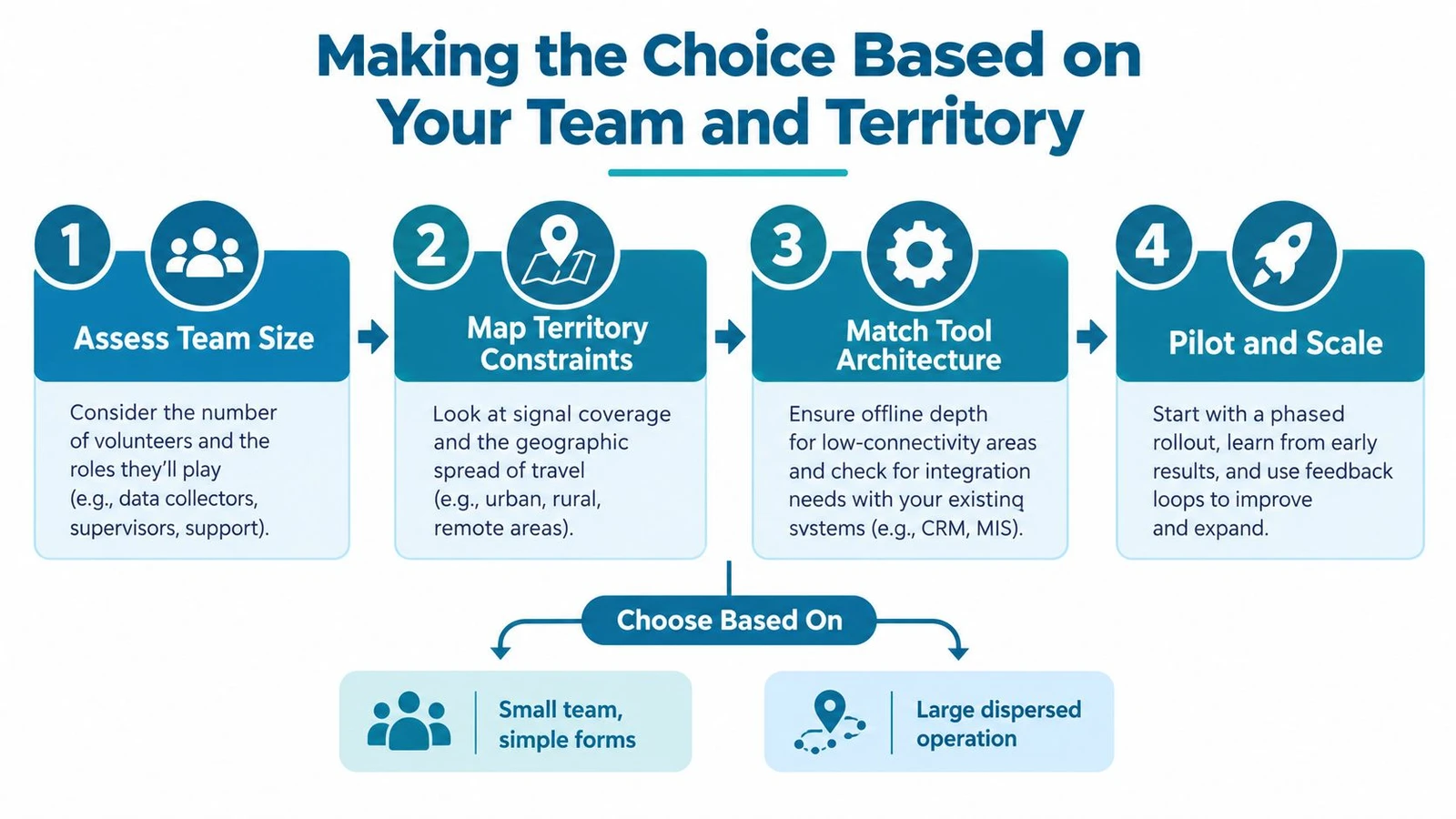
Three variables should drive the decision
Team composition comes first. Volunteer experience affects the cost of every extra screen, instruction, and recovery step. A field director should map the roles involved, including administrators, shift leads, canvassers, and data staff. A platform that requires specialists for ordinary sync review may be appropriate for a technical operation, but it can burden a volunteer-heavy campaign.
Territory determines the failure mode. Teams should map where signal disappears, where travel time separates supervisors from canvassers, and where volunteers are likely to return online in groups. The issue is not only coverage. It’s the pattern of disconnection and reconnection. A scattered team may create a slow trickle of uploads, while a group leaving the same dead zone may create a concentrated backlog.
Data complexity sets the payload ceiling. Simple outcomes and short notes place modest demands on a device. Attachments, signatures, audio, conditional forms, and live location features require a more deliberate design. Independent guidance describes offline apps as tools that queue submissions locally and synchronize later, while emphasizing that large media payloads increase storage use and sync time. The guidance on offline payload design supports a practical conclusion: form architecture is part of field strategy.
Scenario matching prevents expensive mistakes
A small local campaign with simple forms and a technically comfortable administrator may value customization and control. A larger operation with dispersed turf and rapid volunteer onboarding may gain more from a campaign-native workflow that hides infrastructure complexity. A research-oriented team may prioritize rich data capture, while a canvassing team may need a one-tap outcome and an immediate next address.
The choice should be tested with representative operators, not only staff. A pilot needs one ordinary shift, one low-signal route, one device with limited battery, and at least one deliberately incomplete interaction. The team should then inspect whether records remain legible, whether the dashboard reflects actual progress, and whether supervisors can resolve ambiguity without guessing.
A field tool earns trust when its recovery path is easier to follow than its failure path is to create.
Implementing Offline Reliability Regardless of Platform
Platform selection can’t compensate for an oversized form or unclear volunteer instructions. A campaign can improve reliability across categories by reducing the amount of data each interaction must carry, testing the synchronization path under pressure, and teaching operators how to verify a saved record.
Start with the door, not the database
Every field should justify its presence at the point of contact. A required question that doesn’t affect targeting, follow-up, compliance, or reporting adds friction. A media field should have a defined purpose, because each attachment increases local storage use and the amount of data waiting for transmission.
A practical form review can ask:
- What must be captured immediately? Keep the primary outcome, essential response, and short context close to the interaction.
- What can wait? Move administrative enrichment and nonessential categorization to a supervisor workflow.
- What should be constrained? Limit attachment types and sizes where the campaign doesn’t need full-resolution media.
- What must be validated locally? Use controlled values for outcomes and clear rules for incomplete addresses.
- What happens after an interruption? Make sure a closed or backgrounded app can recover the draft without forcing a repeat conversation.
Incremental synchronization is preferable to a bulk upload pattern when a team operates in weak coverage. The system should send smaller confirmed units, resume interrupted transfers, and avoid treating an entire shift as one indivisible package.
Test the conditions that marketing demos avoid
A campaign should run a controlled pilot before assigning critical turf. The test can include:
- Downloading routes before signal disappears.
- Completing ordinary doors while fully offline.
- Closing and reopening the app during queued work.
- Adding a deliberately limited attachment.
- Reconnecting several devices within the same period.
- Editing overlapping records from separate devices.
- Comparing device totals with the central dashboard.
- Reviewing rejected, duplicated, and unresolved records.
The point isn’t to create an artificial disaster. It’s to expose the recovery behavior that an ordinary demonstration never measures. Logistics teams also use mobile workflows under variable field conditions, and the Faberwork LLC logistics case studies offer useful context for evaluating mobile systems through operational execution rather than feature descriptions.
Train verification, not just navigation
Volunteers need to know the difference between a record saved locally and a record accepted centrally. Training should show the offline indicator, the queue state, the retry action, and the point at which a supervisor needs to intervene. Shift leads should have a simple escalation path for dead batteries, failed uploads, duplicate records, and missing routes.
A short post-shift review can reveal more than a long prelaunch workshop. Staff should compare what volunteers remember submitting with what the system received, then adjust the form or instructions before the next deployment. Reliable offline canvassing is a joint result of software behavior, payload discipline, and human verification.
Choosing the Right Field Data Collection App for Your Campaign
The strongest choice is rarely the app with the longest feature list. It’s the system whose offline behavior matches the campaign’s territory, whose form fits the volunteer’s attention span, and whose records can move into the operational database without manual repair.
A campaign-native platform is a logical category for teams that need route planning, turf execution, voter-data handoff, and field monitoring in one workflow. A survey-focused tool can fit a targeted contact program with limited routing needs and a carefully controlled form. An open-source framework can suit a technically capable operation that needs custom integrations and is prepared to own testing, hosting, support, and conflict policy.
A practical decision framework
Campaign managers can score candidates against the following questions:
- Worst-case offline behavior: Can the app preserve completed work during prolonged disconnection?
- Reconnection behavior: Does it resume safely when many devices return online?
- Conflict treatment: Can staff see and resolve overlapping edits without losing context?
- Payload discipline: Does the form remain usable when photos, audio, or other attachments are included?
- Volunteer consistency: Can a tired or first-time canvasser complete the standard interaction without coaching?
- Operational continuity: Do routes, voter records, outcomes, and reporting remain connected?
Offline capability exists on a spectrum. Basic local storage is not the same as durable queues, incremental synchronization, audit history, and conflict-aware reconciliation. A campaign that evaluates only the first layer may mistake temporary convenience for operational resilience.
The final decision should come from a pilot that resembles the actual operation. The pilot should include the least reliable territory, the least experienced volunteers, the intended form, and the expected route workflow. If the system preserves data but volunteers abandon it because every interaction takes too long, it has failed. If the interface feels simple but staff can’t reconcile records after reconnection, it has also failed.
The most dependable field data collection app is therefore the one that remains understandable under fatigue, useful without signal, and auditable after devices reconnect. Campaign directors should demand evidence from those conditions before committing the next turf cycle.
doornoc combines offline door-knocking, route planning, voter-data workflows, and field progress monitoring for campaigns that need reliable execution beyond connected urban areas. Campaign managers can review how the platform supports this workflow and explore a setup for their operation at doornoc.
Looking for a tool to run this? doornoc’s canvassing software bundles voter data, automatic turf cutting, the mobile app, and live reporting in one platform.