
The field director’s phone is blowing up. Volunteers are asking for new walk lists, the spreadsheet is already out of date, someone can’t get signal at the edge of the district, and tonight’s report still has to be clean enough for the candidate to trust by morning. That is the moment when a political campaign app stops being a convenience and becomes field infrastructure.
The wrong tool adds one more layer of chaos. The right one keeps canvassers moving, gets data back from the field the same day, and prevents the campaign from losing voter contacts to paper, duplicates, or bad sync behavior. The decision is not whether the app has a polished interface, it’s whether it holds up under volunteers, weak coverage, and election-week pressure.
| Evaluation area | What fails in the field | What holds up in the field |
|---|---|---|
| Canvassing | Raw address dumps, uneven routes, confusing shifts | Balanced walk lists, route logic, simple territory assignment |
| Volunteer management | Training-heavy setup, slow onboarding, scattered assignments | Fast invites, clear tasks, low-friction scheduling |
| CRM and voter data | CSV churn, manual matching, messy record handling | Automatic matching, clean voter histories, structured notes |
| Reporting | Late exports, stale dashboards, no same-day visibility | Live progress, useful dashboards, quick reallocation |
Why Modern Campaigns Run on Apps Instead of Paper
Paper still looks simple until the field team starts moving. Printed walk lists get marked up in the rain, clipboards go missing, and data entry waits until the end of the day, which is usually when the campaign needs answers already. During the 2024 UK general election, major parties used canvassing apps to keep volunteers focused on conversations instead of retyping notes later, and the move from paper logs to real-time entry was visible across mainstream campaign operations (Open Rights Group report coverage).
What changes when the field goes digital
A dedicated app changes the job in small but important ways. Volunteers don’t just carry a list, they carry the route, the script, the survey, and the follow-up action in one workflow. Field managers don’t wait for a nightly email, they can see progress while the shift is still active.
Practical rule: if the team still has to re-enter door knocks after the shift, the app is only replacing paper on the surface.
The historical shift matters because it changes campaign expectations. People on the ground now assume a phone can show the next door, capture the response, and push the result into the campaign’s records without a second step. That’s why the old model, printed turf plus later cleanup, now feels slow even in local races.
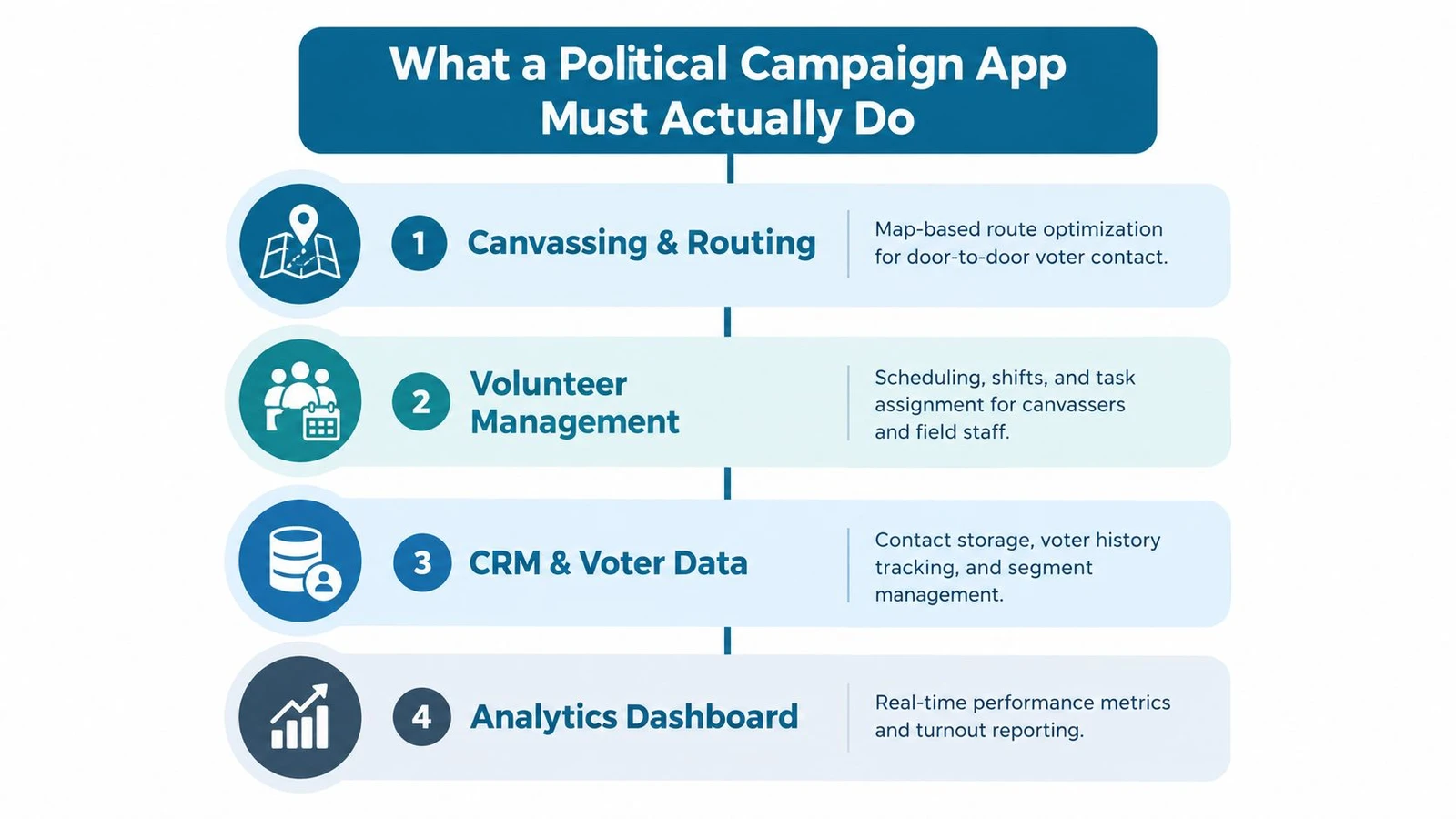
The four pillars that matter are canvassing, volunteer management, CRM, and reporting. Those are the areas that decide whether the app helps the campaign move faster or just creates a more expensive version of the same bottlenecks.
What a Political Campaign App Must Actually Do
The category is consolidating around cloud delivery and mobile workflows. A market report estimates the political canvassing software market at $1.55 billion in 2025 and projects it to reach $4.84 billion by 2034, with a 13.5% compound annual growth rate. The same report says cloud-based deployment accounts for 72% of deployment revenue, and voter outreach software represents 38% of application share.
The four functions have to work as one system
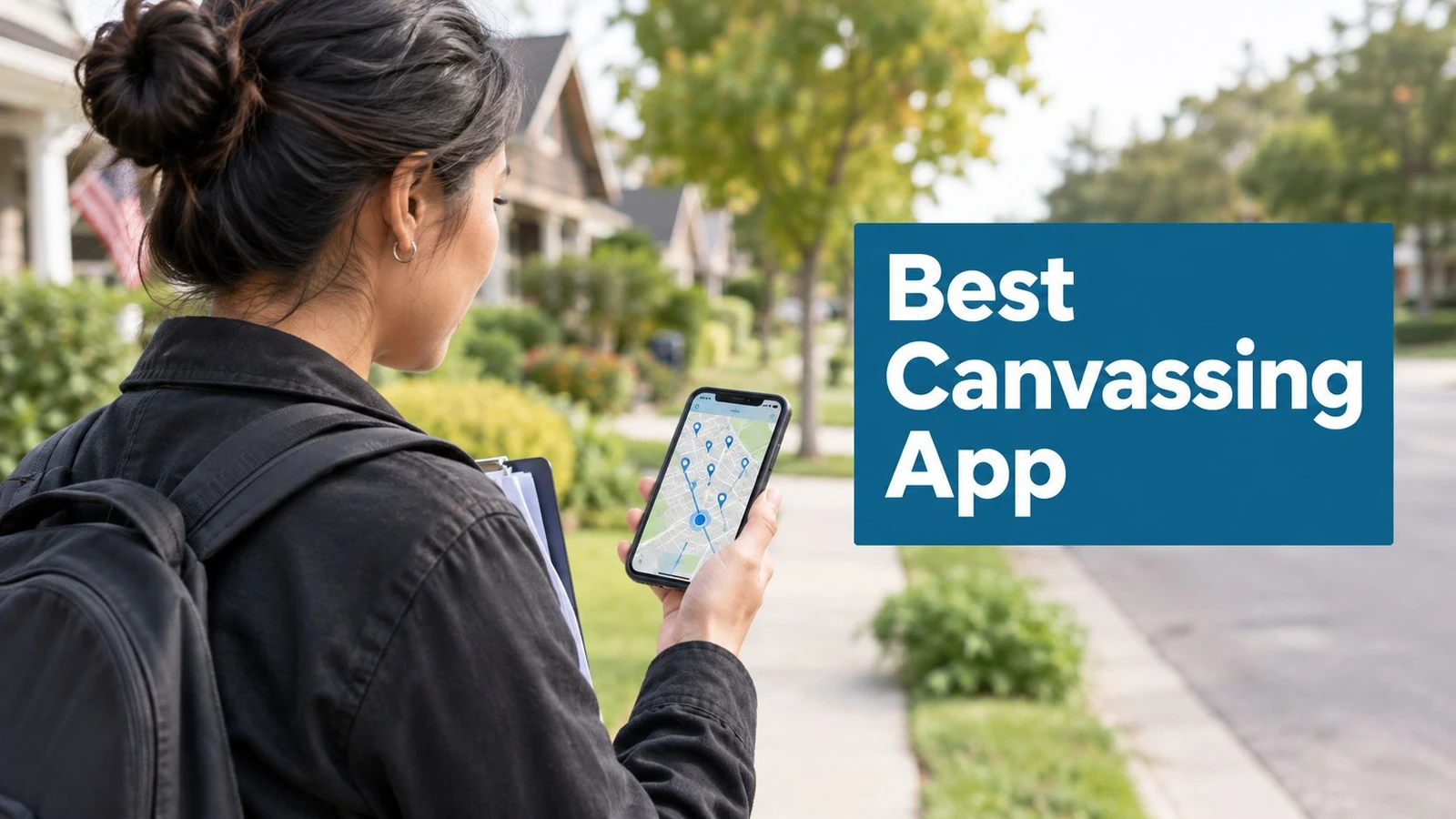
The first pillar is canvassing and routing. Good routing creates walkable shifts, keeps territories balanced, and gives volunteers a path they can follow without constant direction. Weak routing just dumps addresses into a phone and leaves the team to figure out pacing on the fly.
The second pillar is volunteer management. That includes scheduling, shift assignment, and onboarding that doesn’t require a long training session before anyone can start knocking. When the setup is clumsy, campaigns spend their energy teaching the tool instead of using it.
The third pillar is CRM and voter data handling. A strong system matches records cleanly, preserves voter history, and lets managers segment lists without manual spreadsheet work. The weak version turns every list update into a CSV import problem.
The fourth pillar is reporting. A useful dashboard shows what happened while there’s still time to act on it. That can mean reassigning canvassers, adjusting turf, or changing the day’s priority before the shift ends.
The real test is not whether the app has each feature in isolation, it’s whether a knock logged in the field appears in the voter record and on the dashboard without manual re-entry.
For teams looking to structure setup quickly, pre-built campaign templates can be useful as a planning reference for forms, workflows, and field structure before the first canvass begins.
Canvassing Volunteer Management CRM and Reporting Compared
| Pillar | Weak Implementation | Strong Implementation |
|---|---|---|
| Canvassing | Raw address dumps, uneven territory size, hard-to-follow routes | Balanced shifts, route logic, map-based navigation |
| Volunteer management | Confusing permissions, slow onboarding, repeated explanations | Fast invites, clear roles, simple task assignment |
| CRM | Manual CSV imports, weak matching, fragmented notes | Automatic matching, geocoding, persistent voter history |
| Reporting | Late exports, stale totals, no same-day action | Live dashboards, shift-level visibility, quick reallocation |
Canvassing
A weak canvassing setup treats routing like a static list. Volunteers get too much ground, too little guidance, or streets that make no sense to walk in a single shift. Strong routing solves for the field first, not the database first.
Key differentiator: the route should feel walkable before the first door is knocked.
Volunteer management
Volunteer management breaks down when first-time helpers need a separate explanation for every screen. Good systems let coordinators assign shifts, confirm tasks, and get people into the field quickly. Bad systems create a support burden right when the team needs speed.
CRM and reporting
CRM work is where many campaigns lose time. If the tool can’t match records, preserve notes, and keep data organized as volunteers move through the turf, staff end up cleaning exports instead of managing the race. Reporting should be immediate enough to support same-day changes, not just end-of-week summaries.
For teams trying to replace scattered scheduling and field coordination with something more coherent, replace siloed tools for volunteers is a helpful lens for thinking about how separate workflows create friction across people, tasks, and records.
Matching the Right App to Your Campaign Size and Race
A city council campaign with six volunteers does not need the same stack as a statewide operation. Small races usually care most about quick setup, simple surveys, and low-friction list handling, because the team is too small to absorb a complicated rollout. Large campaigns need structured permissions, broader team management, and ways to connect the field app to the rest of the data pipeline.
Local races
Local campaigns should prioritize setup speed, clean list upload, and an interface volunteers can learn in minutes. If the app needs a long training session just to start a simple canvass, it’s too heavy for a small race. A straightforward field flow matters more than broad feature depth.
Larger field operations
A congressional or statewide effort needs more than simple canvassing. It needs tiered access, enough administrative control for multiple captains, and API access if the campaign already runs data pipelines elsewhere. At that scale, the app has to behave like part of an operation, not like a standalone gadget.
Advocacy and non-voter contact work
Advocacy organizations often need constituent contact tools as much as voter contact tools. The useful question is whether the app supports nonpartisan outreach, issue-based logging, and flexible contact records. That matters when the program is built around service, mobilization, or public engagement rather than an election file.
Doornoc fits naturally in this middle ground because it combines mobile canvassing, route planning, offline data capture, and data services for campaigns of different sizes, including local races and larger field programs. For operational teams comparing field workflows, the useful reference point is field ops software, not a feature checklist detached from real campaign structure.
Offline Reliability and Data Sync in the Field
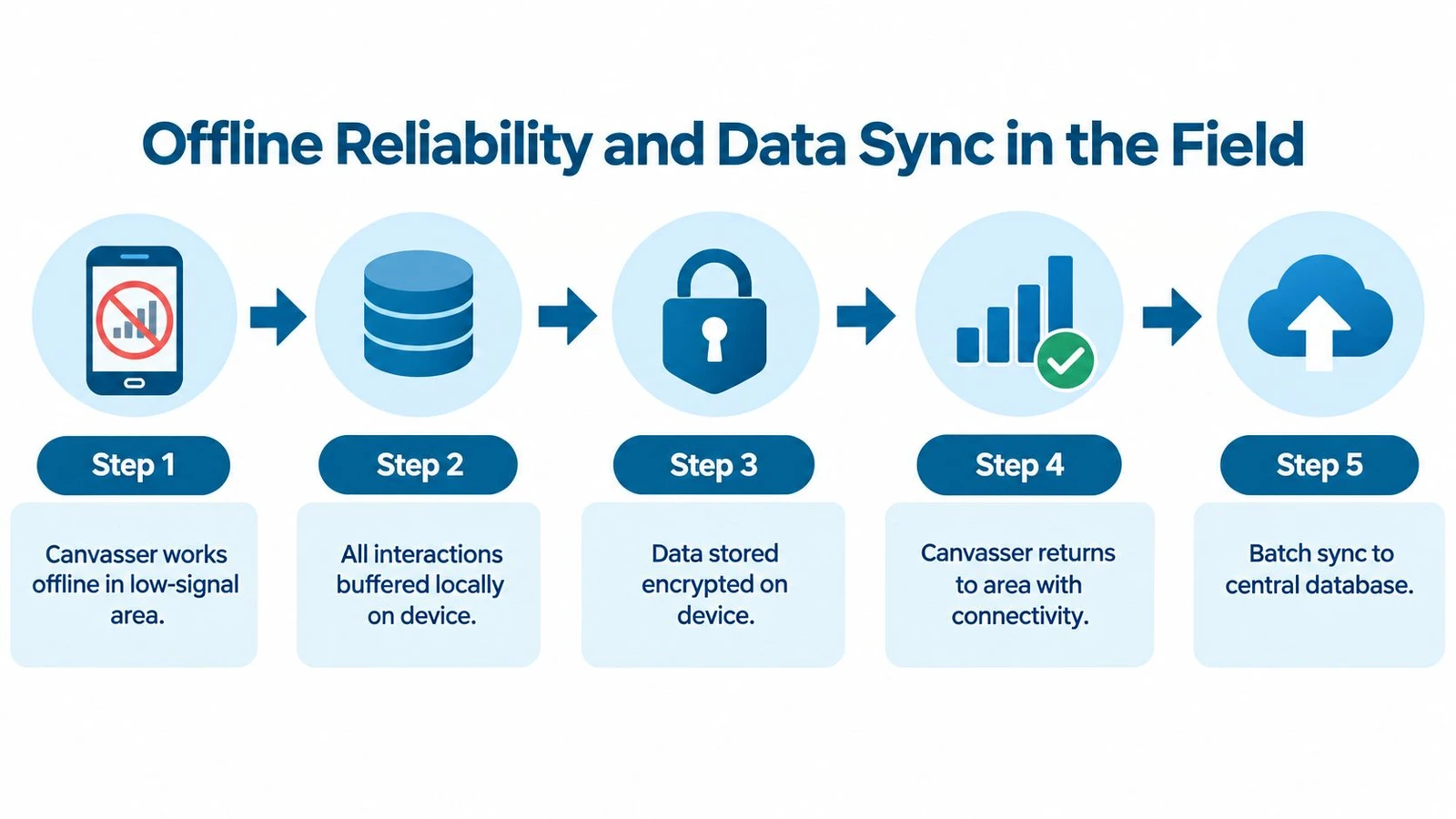
Connectivity fails in the places campaigns need to work. That is why offline-first design matters more than glossy dashboard screenshots. A reliable app buffers interactions locally, queues knocks securely on the device, and syncs when signal returns, while pre-downloaded map tiles keep navigation usable in dead zones.
What offline-first really protects
The point is not just convenience. Offline logging preserves support scores, notes, and follow-up tasks even when LTE drops, and it reduces the risk of duplicate or missing voter contact records during same-day canvasses. That protection is especially important when multiple teams are covering adjacent turf and the field manager needs a clean picture by evening.
Good offline behavior is invisible. Volunteers should notice the signal loss, not the data loss.
What to probe in a trial
Trial a vendor in a low-signal area, not just in an office with strong Wi-Fi. Watch whether interactions queue cleanly, whether the map still behaves, and how the app handles reconnects after a long stretch offline. Then check what happens to duplicate records, merged records, and follow-up tasks after sync.
The hard questions matter more than the demo script. How are collisions handled when two volunteers touch the same household? What happens when a phone goes offline for most of a shift? Does the app keep working after sync, or does it stall while trying to catch up?
For a deeper look at field behavior under weak signal, essential offline canvassing app features for 2026 elections is the right topic to examine before a live rollout.
Privacy and Data Governance Considerations Most Buyers Skip
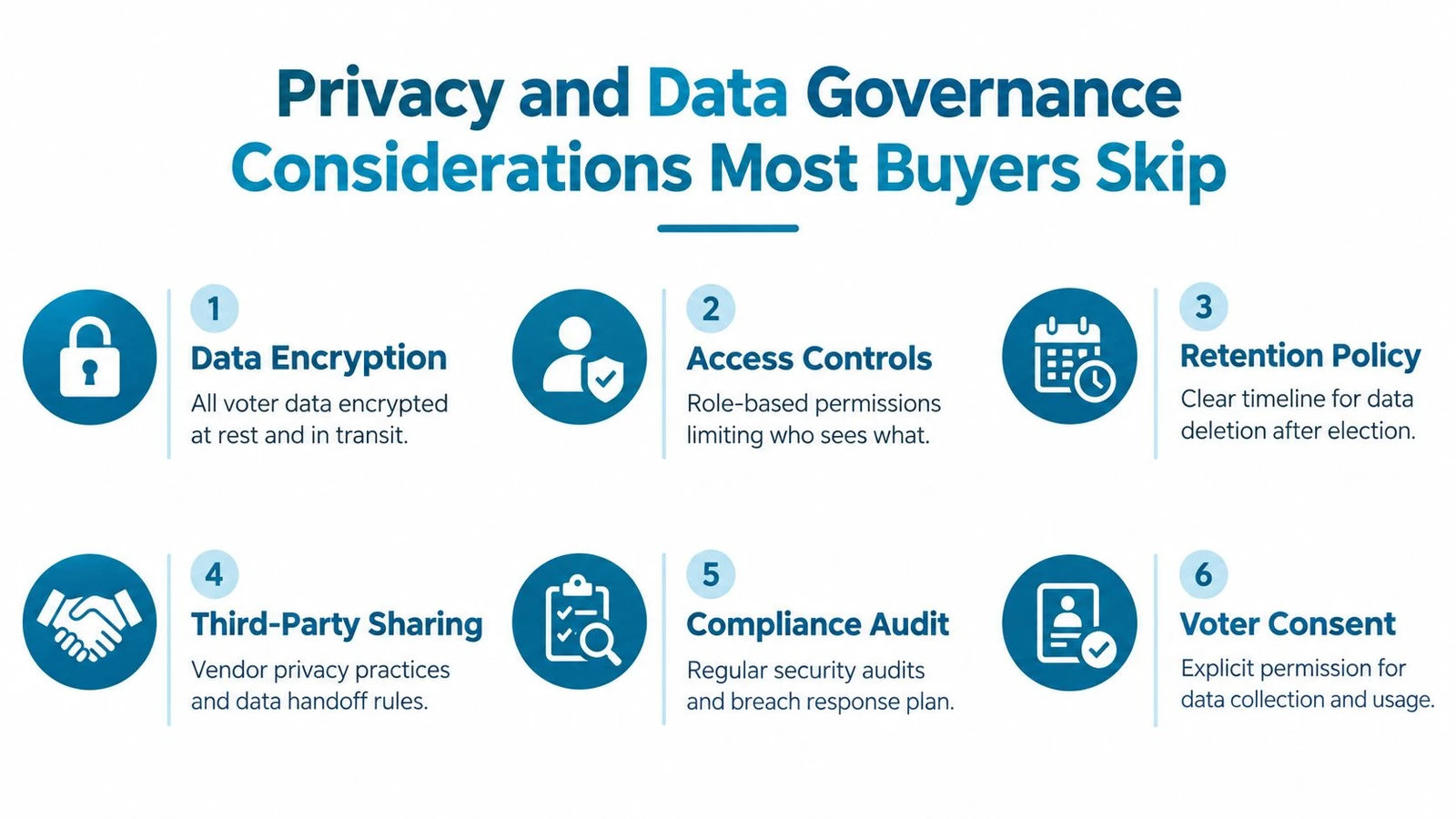
Political field tools collect a sensitive mix of data. The Open Rights Group report lists name, address, electoral-roll identifiers, political opinion, voting history, contact details, survey responses, geolocation, device data, and usage data as categories that election-canvassing apps may gather (Open Rights Group PDF). That makes governance a selection criterion, not a legal afterthought.
What to inspect before a contract
Role-based access should be strict enough that a volunteer sees only what they need in the field. Secure synchronization matters because offline data has to be protected before it reaches the central database. Retention rules matter too, because campaigns should not keep sensitive records longer than their operating need requires.
If the vendor can’t explain who can see what, when data is deleted, and how offline records are secured, the product is not mature enough for sensitive field work.
Recent market coverage also points to stronger attention on privacy compliance, GDPR, and CCPA, but most product pages still foreground canvassing and texting instead of governance. That gap matters because modern platforms often bundle canvassing, voter intelligence, constituent outreach, and API-linked pipelines into one stack, which expands the number of people and systems that can touch the same record.
For teams reviewing data-handling posture, API Direct data handling is a useful reference point for thinking about privacy language, access control, and how vendors frame responsibility around sensitive records. The broader lesson is simple, the app has to help the campaign reduce exposure, not just move data faster.
Your Buyer Checklist and Integration Questions
Before signing anything, the campaign should test five things. Offline behavior, route quality, volunteer onboarding time, CRM handling, dashboard latency, and governance all need to work together under real pressure. If one of those areas fails, the tool usually becomes a burden by week two.
Questions to ask every vendor
- List formats supported: Can the platform take the campaign’s current file structure without forcing a manual cleanup cycle?
- Data flow: Does voter data move into the app directly, or does the team still need CSV exports and reimports?
- API access: Can the system connect to existing data pipelines and custom workflows?
- Scaling behavior: How do logins, campaigns, and permissions change as the team grows?
- Pricing model: Is the cost based on records, subscriptions, or both, and what happens as field volume rises?
A one-week trial should include at least one low-signal turf, one volunteer with no prior training, and one same-day reporting cycle. That is the fastest way to separate a useful field app from one that only looks polished in a demo. If the app survives those conditions, it is worth serious consideration.
doornoc supports route planning, offline data capture, live tracking, and campaign data workflows for teams that need more than a static walk list. For campaigns comparing field operations tools under real conditions, doornoc is worth reviewing as part of a practical shortlist.
Looking for a tool to run this? doornoc’s canvassing software bundles voter data, automatic turf cutting, the mobile app, and live reporting in one platform.