


A neighbor asks at a school board meeting, a city council hearing, or a precinct walk why nobody credible is running for the open state house seat, and the question lands differently when the filing deadline is already on the calendar. That’s the moment many first-time candidates discover that how to become a legislator isn’t a single announcement, it’s a sequence of legal checks, paperwork, money decisions, and voter contact that has to fit one specific district. A candidate can be qualified on paper and still miss the ballot. A candidate can win and still be unprepared for what session does to income, family time, and a day job.
The distinction that matters most is legal eligibility versus practical viability. Eligibility gets a name past the state code. Viability means the signatures validate, the treasurer files on time, the budget covers voter contact, and enough identified supporters vote in the primary that decides most safe seats.
Check Eligibility for Your State and Chamber
A candidate who meets the age rule for a state house seat may still fail the residency rule for that same seat. Check the state code for the specific chamber before setting a campaign calendar: eligibility rules differ by state and office. The National Conference of State Legislatures eligibility guide reports that minimum ages range from 18 to 25 for state representatives and 18 to 30 for state senators.
| Requirement | Rule or range | Examples by state |
|---|---|---|
| Minimum age, state representative | 18 to 25, depending on state | The minimum varies by state |
| Minimum age, state senator | 18 to 30, depending on state | Senate minimums can exceed house minimums |
| District residency at filing | Required in 13 states, according to the NCSL eligibility guide | Nevada requires 30 days; Massachusetts requires five years for a Senate seat |
| State residency at filing | Required in 6 states, according to the NCSL eligibility guide | Kansas, Michigan, New Mexico, Oklahoma, South Carolina, and Washington |
| Residency period in other states | 30 days to seven years, according to the NCSL eligibility guide | Rhode Island requires 30 days; New Hampshire requires seven years for a Senate seat |
| Voter registration | Required for some offices | Texas requires candidates for many offices to be registered voters of the relevant territory by the regular filing deadline |
Why a National Checklist Misleads
Residency requirements can depend on both the chamber and the date the rule must be met. A move into a district shortly before filing may satisfy one state’s rule but fail another’s. Check whether the code measures residency on filing day, election day, or another specified date.
Practical rule: For one chamber, write down the age floor, district and state residency rules, voter registration requirements, and filing deadline. Check each against the state election code before announcing a run or collecting signatures.
Registration can have its own deadline. In Texas, candidates for many offices must be registered voters of the relevant territory by the regular filing deadline. A recent move may therefore require a registration update before the candidacy paperwork is due. Check party affiliation rules too, because a missed deadline can affect primary eligibility.
Eligible Is Not the Same as Viable
Meeting the eligibility rules only means you can seek the office. Filing deadlines, nomination signatures, party rules, financial disclosure, and campaign finance requirements determine whether you complete the process and appear on the ballot. Confirm the requirements early enough to budget time and money for them.
Age eligibility does not settle whether a campaign is practical. A first-time candidate still needs time to meet voters, cover campaign costs, and manage obligations outside the race. Those constraints vary by candidate and district, so build a realistic calendar and budget rather than treating eligibility as a readiness test.
Start with one chamber and one election cycle. Record when each requirement must be met, then check the relevant state code. If you do not qualify, consider a later cycle or an office with different eligibility rules.
Chamber, Pay and the Actual Cost of Serving
House and senate seats ask for different campaigns before they ask for different votes. A senate district usually covers more constituents than a house district, which means a larger voter file, more doors, more mail, and a longer runway to build name recognition. A house race is typically the more reachable first run precisely because the universe is smaller and a candidate can personally contact a meaningful share of it.
Pay then decides whether winning is sustainable. The National Conference of State Legislatures 2025 legislator compensation survey reports annual salaries ranging from $100 in New Hampshire to $142,000 in New York, an average annual base salary of $46,279 among states paying annual salaries, no salary in New Mexico, and per-day pay of $301 in Utah and $221.94 in Kentucky for legislators elected after January 1, 2025. Those figures produce the spread below:
| Legislature example | Pay basis | Reported 2025 pay | What it means for you |
|---|---|---|---|
| New Hampshire | Annual salary | $100 | Serving must be funded by other income |
| New York | Annual salary | $142,000 | A salary that can support a full-time public role |
| Average across states paying annual salaries | Annual base salary | $46,279 | A benchmark, not a guarantee for your state |
| New Mexico | No salary | $0 | Budget for serving as unpaid time |
| Utah | Per legislative day | $301 per day | Income depends on how many session days occur |
| Kentucky (elected after January 1, 2025) | Per legislative day | $221.94 per day | Income depends on how many session days occur |
Part-Time in Name, Demanding in Practice
Legislative professionalism shows up in session length, compensation, staffing, and institutional resources. Some legislatures meet for long or unlimited sessions with staff support, while others meet briefly and pay by the day. Neither model is light during session. Committee hearings, floor votes, constituent casework, and travel to the capitol stack on top of the job and family the member already has.
Per-day pay changes the math again. Where compensation is tied to legislative days, total income depends on session length the member doesn’t control, and special sessions plus interim committee work can add unpaid or lightly paid days that never appear in a headline salary figure. A member whose employer allows unpaid session leave faces different math than one who would have to resign.
The actual cost calculation has four parts:
- Income lost from session days, travel days, and reduced hours at a regular job
- Household costs such as childcare, caregiving coverage, and lodging near the capitol
- Employer flexibility confirmed in writing before filing, not assumed from goodwill
- Constituent service load that continues between sessions, including casework and district events
Candidates budgeting only for the campaign often miss the second budget entirely. A clear-eyed look at how much it costs to run for local office helps separate one-time campaign spending from the recurring personal cost of holding the seat.
Run a simple test before choosing a chamber. Estimate the session days that could realistically be missed from work, multiply by the daily pay or compare the annual salary against current income, and check whether the household still works. If it doesn’t, a smaller chamber or a later cycle is a budget decision that keeps the household intact.
How to File Your Candidacy Paperwork
Treat candidacy as a compliance and validation pipeline, not a press release. The Texas Secretary of State candidate guide illustrates the pattern candidates face in state systems, where registration status must be settled by the regular filing deadline and each office carries its own procedure. One missed form can end a campaign that had real support.
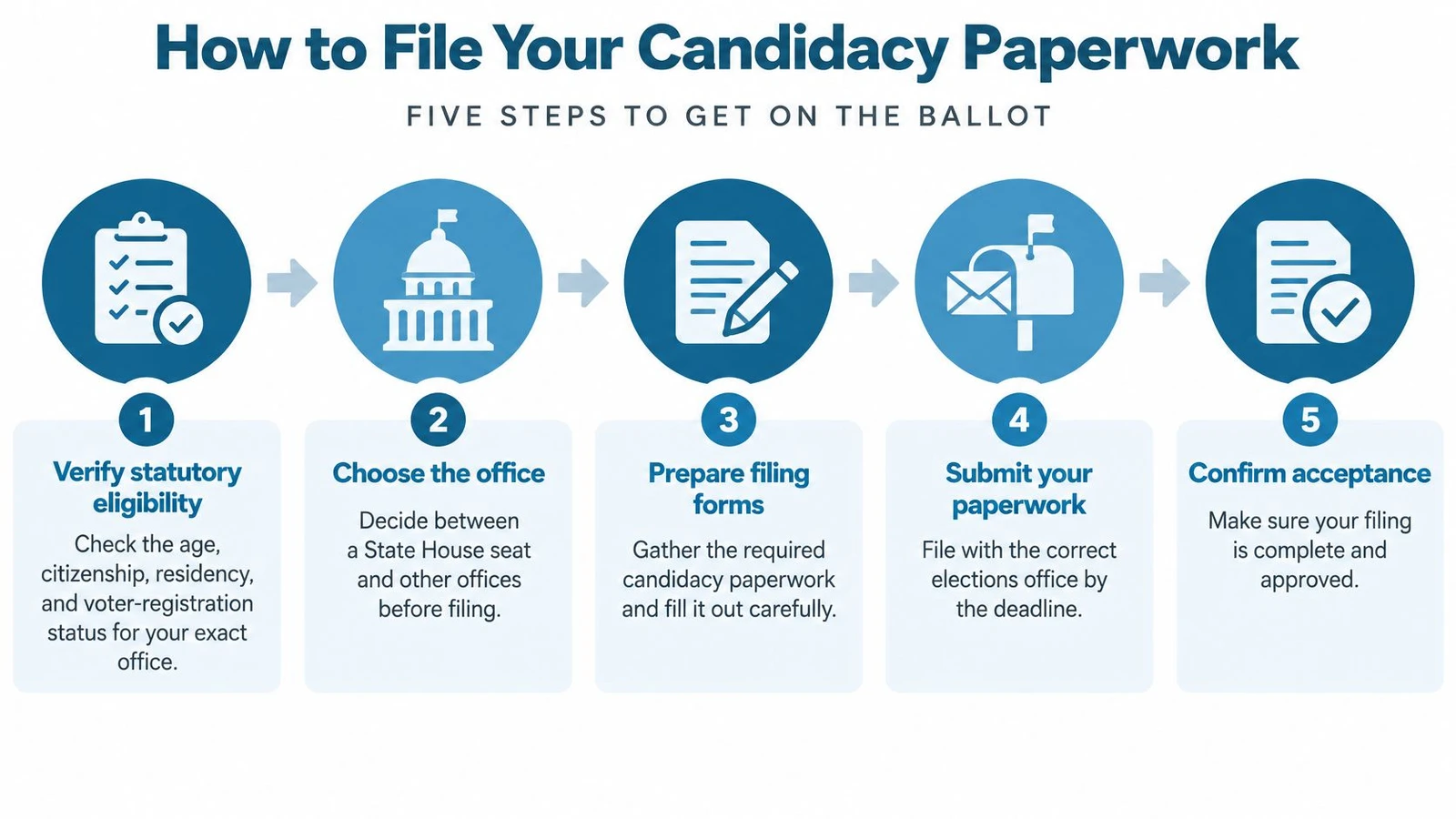
The Seven Filing Steps
-
Verify statutory eligibility for the exact office, including age, citizenship, residency, and voter registration status. The common mistake is checking the rules for the legislature generally instead of the specific chamber and district.
-
Choose the office and the ballot route. A party primary, a nominating petition, a convention, and an independent or nonparty path each carry different deadlines and signature rules. Picking the route late can strand a candidate between two incompatible calendars.
-
Build a written filing matrix. List every form, signature threshold, notarization rule, filing location, opening date, deadline, and backup submission method in one document. This single artifact prevents the classic failure of collecting support before confirming the petition format and filing window are legally valid.
-
Obtain the current election authority guide before recruiting volunteers or printing petitions. Guides change between cycles, and a petition sheet copied from a prior race can be rejected for outdated language, wrong office title, or missing circulator statements.
-
File the declaration or statement of candidacy with the correct filing officer. Arizona separates a pre-petition Statement of Interest, online nomination paperwork, and financial disclosure from in-person petition filing. New Mexico requires nominating petitions with the declaration of candidacy and directs candidates to file with either the Secretary of State or a county clerk depending on the office.
-
Submit financial disclosures and satisfy petition or filing fee requirements. Disclosure forms ask about income, business interests, and liabilities, and sloppy answers create opposition research. Fees and signature thresholds also differ by route, so the matrix should show both options where the code allows a choice.
-
Confirm acceptance and keep the confirmation. A stamped copy, receipt, or written confirmation from the filing officer is the proof that matters if a form is later questioned. Don’t leave the office, or close the portal, without it.
Build the Deadline Buffer Backward
Count backward from the filing deadline and reserve time for signature challenges, rejected forms, and correction opportunities. Petition signatures fail validation for ordinary reasons: signers outside the district, illegible addresses, duplicate names, and voters registered with another party where party registration matters. Collecting only the minimum number guarantees a shortfall.
File early enough that a rejected form is an inconvenience, not the end of the candidacy.
Waiting until the deadline shrinks every other step. Volunteers can’t legally circulate petitions that haven’t been approved, donors hesitate before ballot access is real, and endorsers wait to see whether the campaign clears compliance. Build the filing matrix first, before recruiting volunteers or printing petitions, and the rest of the campaign gets a foundation it can trust. Electoral success still depends on the contest, incumbency, district composition, fundraising, and ballot access, but none of those factors matter if the name never reaches the ballot.
Build a Team and an Early Supporter Base
The assumption worth challenging is that ambition comes first and a team follows. Research summarized by the Center for American Women and Politics on women candidates and their campaigns reports that decisions to seek state legislative office are more relationally embedded, shaped by family effects, encouragement, and support from political actors. Recruitment conversations aren’t flattery around the campaign. For many credible candidates, they’re the mechanism that makes the campaign happen.
The Recruitment Sequence That Works
Form a small advisory group first, then run structured interviews with local party officials, civic leaders, donors, and community organizations. Test a clear issue rationale with representative voters, map likely endorsers and petition signers, and only then commit to a district-specific field and finance plan. Each conversation should end with a specific ask: a role, an introduction, a signature, a hosted conversation, or an honest no.
Assign early roles by function, not friendship:
- Treasurer owns compliance records, contribution tracking, and filing reports
- Field director owns the canvass plan, turf, and voter contact data
- Volunteer coordinator owns shift recruitment, reminders, and second-shift retention
Practical guidance on building and motivating a volunteer canvassing team fits here, because a named coordinator with clear shifts retains people far better than a group chat and good intentions. Short, consistent video updates can also keep that early circle informed between meetings, and candidates learning to distribute videos to reach your audience from Unfloppable can apply the same discipline to supporter updates and issue explainers without turning every post into an ad.
Track Conversion, Not Applause
Raw contact totals hide where a campaign stalls. Track each stage where a person either deepens commitment or drops out.
| Conversion stage | What you count | Why it matters |
|---|---|---|
| Recruitment conversation to commitment | People who agree to a specific role | Filters out polite interest |
| Committed supporter to valid signer | Supporters whose signature passes validation | Petition math depends on valid signatures |
| Signer to volunteer | Signers who take a shift or host a conversation | Turns paper support into field capacity |
| Volunteer contact to identified supporter | Voters at the door who express support | Shows the voter file is working |
| Identified supporter to voter who turns out | Supporters who cast a ballot in the target election | Tests whether the contact plan reaches election day |
Two pitfalls recur. The first is assuming ambition must precede recruitment, when ambition and candidacy often develop together through encouragement and early wins. The second is treating demographic stereotypes as evidence about electability. Candidate performance should be judged against comparable contests, district conditions, and campaign quality, not assumptions about who looks like a legislator.
Three signals show the base is real: people commit to a named role, signers pass validation, and volunteers return for a second shift. Commit to filing when those signals are present and a basic budget reserve is funded. Polite encouragement alone isn’t a campaign.
Build a State House Campaign Plan From District Data
A credible state house plan starts from the district’s own numbers. Gather district population, registration totals by party, prior primary and general turnout, and the votes recent winners received, then convert the registered-voter file into a measurable contact program. Registration by party tells you early whether the primary or the general will decide the seat. For broader context on how to run for office, use that planning frame, then narrow it to this one district.

- Set the vote goal above the most recent winning total and add a cushion for uncertainty.
- Divide the goal into identified supporters, persuadable voters, and turnout targets from the voter file. Strong voter data filtering strategies keep that universe focused on voters who can decide the race.
- Size the door work. A team completing 500 quality door attempts per week for 20 weeks has a 10,000-attempt capacity, and canvassing software can organize that door work, record outcomes, and monitor reporting. If the capacity falls short of the contact universe, the answer is more canvassers or a smaller universe, never thinner contact quality.
- Build the budget line by line: filing and compliance, voter data, mail, digital, staff, field materials, and a reserve. Fund the reserve before paid media. I would rather leave a mail piece unsent than reach the final month with a compliance fine or a stalled field program and no cash to fix it. A written plan to build a social media campaign plan keeps digital content tied to field dates instead of improvised weekly.
Seek endorsements early from trusted local organizations and elected officials, and treat them as credibility rather than voter contact; an endorsement that never reaches a door changes few votes. Plan the primary and the general as two campaigns with separate target lists and timelines, because the primary electorate is smaller, more partisan, and often decisive in a safe seat. In a plurality single-member contest, finishing first wins, so set the vote goal against the actual field on the ballot and the district’s real turnout history.
Plan the Final Stretch to Election Day
Work backward from the primary and general dates on the state election calendar. The final stretch isn’t persuasion at scale anymore. It’s turning identified support into cast ballots while protecting the count.
A Backward Timeline for the Close
-
Confirm the mechanics. In the final weeks, verify polling locations, ballot listing, ballot name, and party label with the election office. Errors discovered by voters at the polling place are errors discovered too late.
-
Schedule reminder contacts. Every identified supporter and turnout target gets planned reminder contacts, logged against the conversion stages so the team knows who has voted early, who promised to vote on election day, and who has gone quiet.
-
Staff election day by name. Recruit shifts for poll sites, phone reminders, and rides, with a named coordinator for each shift. A shift without an owner becomes a gap at the busiest hour.
-
Train on the rules. Volunteers need the state rules for poll observers and campaigning distance from polling places before they arrive, plus a written incident log for anything unusual. Guessing at distance rules risks removal from the site.
-
Track against the win number. Set up election-night tracking that reads early returns against the vote goal by precinct. Raw percentages mislead when strong precincts report first. Votes banked versus votes needed tells the full story.
-
Learn the post-election calendar in advance. Know the canvass and certification schedule, recount rules, and who can request a recount before results arrive. Close races don’t leave time to learn procedure from scratch.
-
Prepare to take office. If the result holds, confirm the swearing-in date, onboarding requirements, ethics and disclosure obligations, and how the session calendar affects job and family plans. The transition is short, and constituent requests start before the oath.
Closing discipline: Every name on the turnout list should have a next contact, a date, and an owner until the ballot is cast.
Campaigns lose winnable races in the close by chasing new persuasion while identified supporters stay home. The final stretch rewards boring execution: confirmed lists, staffed shifts, logged contacts, and returns measured against a number set months earlier from district data.
Frequently Asked Questions
Do I need to be a registered voter to run for the state legislature?
Some states require it, and the state code decides for the specific chamber and office. Texas, for example, requires candidates for many offices to be registered voters of the relevant territory by the regular filing deadline, so registration should be verified well before filing opens.
How much does a state house campaign cost?
No single figure applies, because cost follows district size, voter data, mail volume, digital spending, staff, and field materials. Build the budget line by line from the district planning worksheet, fund a reserve, and treat any national average as background rather than a target.
Can I run as an independent for the state legislature?
A nonparty or independent route exists in many states, usually through a nominating petition or filing fee path separate from party primaries. The filing matrix should show that route’s signature threshold, deadline, and filing officer before any signatures are collected.
Is a state legislator a full-time job?
It depends on the chamber’s session length, staffing, and pay structure. The NCSL’s legislator compensation survey shows base pay ranging from $100 a year to $142,000 a year, with some states paying per legislative day. Even part-time legislatures demand full attention during session, plus constituent service between sessions.
What happens if my petition signatures are challenged?
Challenges test whether signatures are valid, from district voters, and properly collected, and correction opportunities depend on the filing officer and state rules. A deadline buffer, extra signatures above the minimum, and early filing give the campaign time to respond instead of being removed from the ballot.
For a state house race built from district data, doornoc helps campaigns filter the voter file by party, election history, district, precinct, and age, turn selected voters into walk routes, and record door outcomes in any phone or desktop browser. Visit the site to see how turf cutting, route assignment, and knock reporting can support the vote goal, door capacity, and turnout plan for a first legislative run.
Looking for a tool to run this? doornoc’s canvassing software bundles voter data, automatic turf cutting, the mobile app, and live reporting in one platform.