NGP VAN is an integrated political CRM and campaign operating system that combines voter data, organizing, fundraising, and compliance tools for Democratic and progressive campaigns across the United States. For a first-time field director staring at messy voter lists, it’s the system that turns scattered contact data into a live campaign workflow.
You know the moment. The field team needs tonight’s doors, finance wants donor history, the compliance lead needs clean records, and someone in the office is still trying to reconcile three spreadsheets that don’t match. That’s the kind of daily operational chaos NGP VAN was built to replace, and understanding it starts with seeing it as infrastructure, not just software.
What Is NGP VAN?
A campaign doesn’t usually feel like a single machine. It feels like a stack of urgent tasks, a voter list that needs cleaning, a volunteer shift that needs assigning, a file that needs syncing, a finance question that needs answering, and a compliance deadline that can’t slip. NGP VAN is the platform many Democratic and progressive organizations use to bring those pieces into one working system, so staff aren’t constantly exporting CSVs and checking whether the same person exists in five different places.
The basic definition
At its simplest, what is NGP VAN? It’s a campaign CRM, but that label is too small for what field teams use it for. The platform combines voter records, organizing tools, fundraising data, and compliance workflows in a single environment, so the same person can be tracked as a voter, supporter, donor, volunteer, or advocate inside one record system (NGP VAN getting started docs).
That integration matters because campaigns run on coordination. A field director wants to know who was contacted, a finance manager wants to know who gave, and an organizer wants to know who still needs a follow-up. NGP VAN keeps those actions attached to the same profile, which reduces the kind of fragmentation that slows down real campaigns.
Practical rule: if a system makes staff move data by hand between tools, it’s adding work instead of removing it.
The platform’s roots help explain why it feels so central to campaign operations. NGP VAN was formed in late 2010 by merging NGP Software, founded in 1997 by Nathaniel Pearlman, and the Voter Activation Network, founded in 2001 by Mark Sullivan. The merged company became NGP VAN, Inc. in January 2011 (NGP VAN history).
That origin story matters because it wasn’t built as a generic business CRM and later adapted for politics. It grew out of political field work from the start, which is why campaign staff often treat it as a system of record rather than just another app. For more on the kinds of voter data fields campaigns usually manage inside these records, see this breakdown of voter file fields.
From Voter File to Campaign Operating System
The easiest mistake is to call NGP VAN “the voter database.” That’s not wrong, but it misses the design logic. The platform became important because it connected voter-file management to organizing, then layered in fundraising and compliance, turning separate campaign jobs into one shared operating environment.
How the platform grew
The company’s expansion has been deliberate. In 2007, the Democratic National Committee issued a request for proposal for a technology provider that could support a national operation across all 50 states, and VAN won that contract ahead of the 2008 presidential election. Later, in 2013, it acquired NationalField, a campaign dashboard startup launched by Obama 2008 campaign alumni. In 2021, its parent company EveryAction was acquired by Apax Partners (Micah Sifry’s timeline of progressive movement tech).
That sequence tells you something useful about the product. The platform did not stay frozen around a voter file. It absorbed campaign management functions as political work became more multi-channel and more data-heavy. If a campaign is trying to manage field, finance, digital, and compliance from the same operational core, that history starts to make sense.
The public product story points in the same direction. NGP VAN describes itself as an integrated system for campaigns, nonprofits, unions, PACs, and advocacy groups, and its newer product launches show it still keeps widening beyond classic CRM duties. The current emphasis includes natural-language search, agentic AI, improved turf cutting, inbox deliverability insights, and disclosure review for filings (NGP VAN about page).
What that evolution means in practice
The important takeaway is not the corporate history itself. It’s that campaigns now rely on NGP VAN for more than list storage. A campaign can segment voters, log contact history, raise money, and handle required reporting inside one operating structure. That’s why it behaves more like infrastructure than a standalone app.
The merged system also reflects why national committees and larger organizations adopted it. Once a platform becomes the common record system for outreach and reporting, it stops being optional plumbing and starts becoming the layer other tools have to work around.
Core Components That Power a Campaign
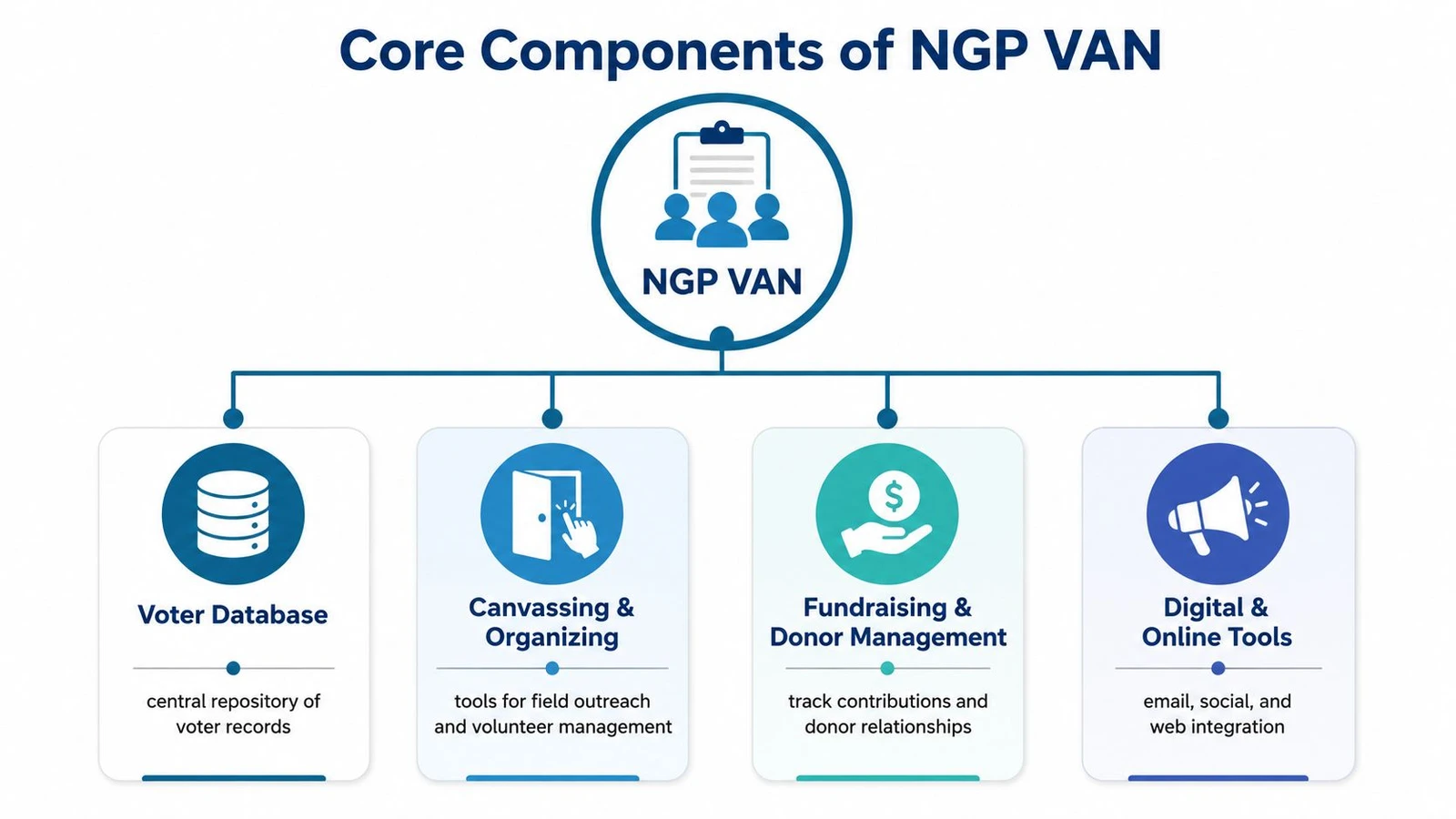
A campaign using NGP VAN is usually working from one shared record system. The voter file is not just a list of names. It functions as the base layer for contact plans, walk lists, donor history, volunteer records, and compliance work, so staff can look at the same person through different campaign functions.
The voter database
The voter database is where the work begins. Campaigns use it to segment universes, assign targets, and track who has already been contacted. When a field team asks for a universe for tonight’s canvass, it usually needs a clean slice of that database, not a raw export.
Canvassing and organizing
The organizing layer is the part volunteers touch most directly. MiniVAN and related workflows let canvassers log conversations from their phones, then send that data back to the office without piles of paper forms. The practical benefit is simple. Staff do not have to wait until the end of the week to know what happened at the doors.
Fundraising and donor management
Fundraising sits in the same ecosystem, which is why the platform goes beyond a field tool. A donor record can sit next to contact history and volunteer history, so finance and organizing are working from the same picture of a person. That shared view helps staff follow up in a way that feels coordinated rather than random.
Compliance and filing
Compliance is the part many outsiders miss. Campaigns do not only need to persuade people, they also need to file the reports their rules require. When the same system carries the underlying records, compliance staff can work from the same source of truth instead of chasing mismatched exports from different teams.
| Component | What staff use it for | Why it matters |
|---|---|---|
| Voter database | Segmenting and targeting voters | Keeps outreach lists organized |
| Canvassing | Logging doors, calls, and volunteer activity | Makes field work visible quickly |
| Fundraising | Tracking donor relationships | Connects giving to campaign history |
| Compliance | Preparing required filings | Reduces record fragmentation |
The real value is not any single feature. The same record follows a person across contact, giving, and compliance.
For teams comparing campaign systems, NGP VAN’s integration ecosystem shows where adjacent tools connect to the platform instead of trying to replace it.
How NGP VAN Works in a Real Campaign Shift
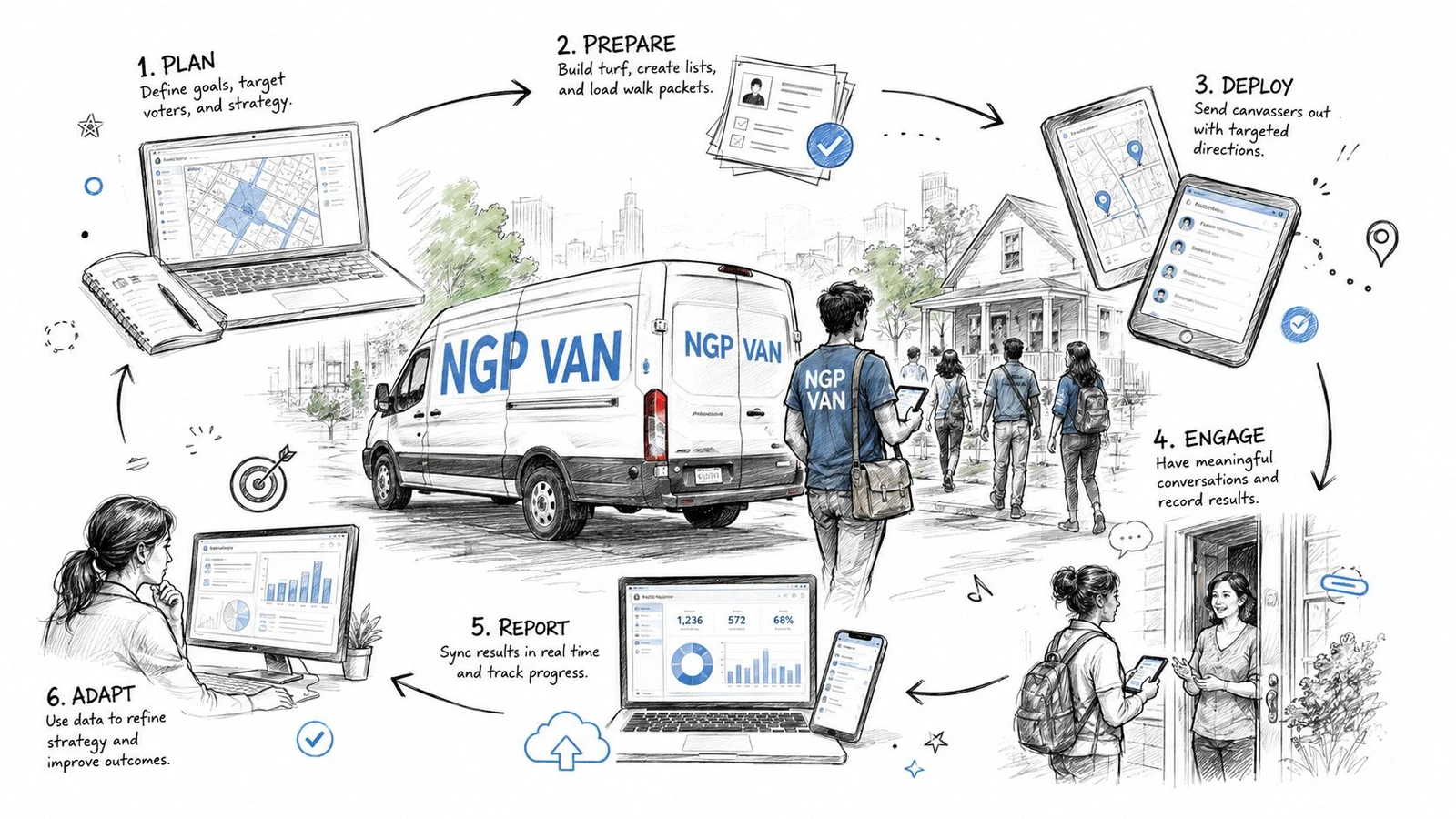
A canvassing shift starts before anyone knocks a door. Someone in the office loads the target universe, checks the turf, and assigns routes. Volunteers arrive with phones in hand, and the field manager needs one thing above all else, a clean feedback loop that shows what happened while the shift is still underway.
Morning setup
The day usually begins in the dashboard. A field director prepares the list, checks walkable routes, and makes sure volunteers are working the right universe. If the target list is wrong, everything downstream gets messy, because the conversations at the doors will be aimed at the wrong people.
Afternoon in the field
Once canvassers head out, MiniVAN is the part they touch. For large field programs, NGP VAN says MiniVAN handled a major share of canvassing activity in the 2024 cycle, which shows how central mobile logging has become in modern field organizing (NGP VAN 2024 scale update). The point is simple. The app is not just a note-taking layer, it is the live handoff between the street and the office.
Evening review
By the time the shift ends, staff can review results and decide what to do next. Maybe one precinct needs another pass. Maybe a volunteer team found more undecided voters than expected. Maybe a list needs to be tightened before tomorrow. The value of the system is that the office does not have to wait for a stack of notes to learn that.
If the field team cannot get clean data back into the office the same day, the campaign is making tomorrow’s decisions blind.
That is why VAN matters as the backbone behind the shift. NGP VAN describes it as a scalable, secure, distributed voter-file system that supports canvassing, phone banking, and targeted outreach through tools like MiniVAN Manager and integrated voter-file workflows. In practice, it works like the campaign’s control room. The list goes out, the results come back, and the next round of decisions starts from the same record.
NGP VAN and the Broader Campaign Tech Stack
A campaign office usually starts with a simple problem. Field data, voter lists, fundraising notes, and compliance records all need to point to the same person, and they need to stay in sync as work moves from desk to door.
Where other tools fit
That is why NGP VAN often serves as campaign infrastructure rather than just another app. It gives a team one shared record, while smaller tools handle narrower jobs around it. A field crew might use a canvassing app for route work, a data tool for sourcing lists, or another system for offline capture before results flow back into the central file.
| Platform | Primary Role | Best For | Key Strength |
|---|---|---|---|
| NGP VAN | Campaign operating system | Larger and multi-channel campaign operations | Integrated voter data, organizing, fundraising, and compliance |
| doornoc | Mobile canvassing companion | Field teams that need route planning and offline logging | Door-knocking workflow with live tracking |
| MailVotes | Voter data sourcing | Teams that need targeted voter lists | Per-record data access with filters |
That split matters for smaller campaigns. They may not need a full operating system on day one. They may need one tool for knocking doors, another for building lists, and a central system that keeps the record straight when the work comes back from the field. doornoc focuses on mobile canvassing, offline capture, route planning, and live dashboards, while MailVotes is built for sourcing targeted voter data. NGP VAN sits above those point solutions when a team needs field, finance, and compliance tied to the same record.
The central question is which layer the campaign needs today. A municipal race with a small field team may care most about route generation and offline logging. A larger operation with fundraising and compliance burdens may need the deeper system integration that NGP VAN provides.
That is the practical way to design the stack. If you want to see how one field tool can connect into a broader workflow, doornoc’s integration approach shows how campaigns can link tools without forcing every team into the same heavyweight setup.
The value is that the same record follows a person across contact, giving, and compliance.
Privacy, Security, and Pricing Considerations
Any platform holding voter records has to earn trust on two fronts. It needs to protect the data it stores, and it needs to be understandable enough for the people using it. NGP VAN’s public-facing material stresses that it serves thousands of campaigns and organizations and supports organizing programs of every size, but it doesn’t clearly answer the questions smaller campaigns ask first, like pricing, implementation time, data migration, or how steep the learning curve is for a first-time field team (NGP VAN home page).
What small teams should ask
That gap matters. A local candidate doesn’t just need software that can work in theory. They need to know whether they can get set up without losing time to training, whether their data can move cleanly, and whether their staff can realistically learn the system before the campaign calendar gets tight.
A strong buying process starts with three questions:
- Can the team operate it quickly? If the field director has to spend weeks learning the basics, the software may be too heavy for the timeline.
- Can existing data migrate cleanly? Voter files, donor lists, and volunteer records need to land in the right structure.
- Can the budget absorb the full cost? That includes setup, training, and the internal time needed to maintain it.
Security as campaign hygiene
Security isn’t an abstract concern in political work. Campaigns handle voter contact information, giving records, and internal strategy data, so data handling has to be treated as part of field discipline. A system that keeps the same record across outreach channels can reduce the number of copies floating around, which is often where risk starts.
The honest answer is that NGP VAN may be the right backbone for a lot of organizations, but public materials don’t fully remove the uncertainty for smaller ones. That’s not a flaw in the concept of the platform, it’s a reminder that scale and usability are different problems.
Is NGP VAN Right for Your Campaign and What Comes Next
The decision comes down to campaign shape. If you’re running a coordinated operation with field, fundraising, and compliance all moving at once, NGP VAN’s integrated record system can save a lot of coordination pain. If you’re running a smaller race with a lean staff, the learning curve and onboarding burden may matter more than the power of the system itself.
A simple decision framework
Start by looking at how your team works.
- Choose a fuller operating system if your organizers, finance staff, and compliance lead all need the same live record.
- Choose a lighter field tool if your main problem is route planning, canvass logging, and quick reporting.
- Choose a hybrid stack if you need campaign-wide records but want a simpler mobile layer for day-to-day field work.
The comparison becomes clearer when you separate infrastructure from execution. NGP VAN is the infrastructure layer for many Democratic and progressive campaigns. That doesn’t mean every campaign should start there. It means the teams that need integrated voter data, organizing, fundraising, and compliance often end up there because the workflow pressure pushes them toward one source of truth.
For a side-by-side look at the tradeoffs, this NGP VAN vs doornoc comparison is useful if you’re weighing a heavier operating system against a more focused canvassing setup.
The next step is practical, not philosophical. Map your current data, identify who will use the system every day, and ask whether your staff has the time to learn it before launch. If the answer is yes, NGP VAN may fit. If the answer is no, start with a simpler field tool and grow into a larger stack later.
If you’re trying to build a field program without the overhead of a full campaign operating system, doornoc gives you a practical way to handle canvassing, route planning, and voter data in one place. It’s a useful option to compare against NGP VAN when your team needs the field side to work cleanly before anything else.