

Key Takeaways
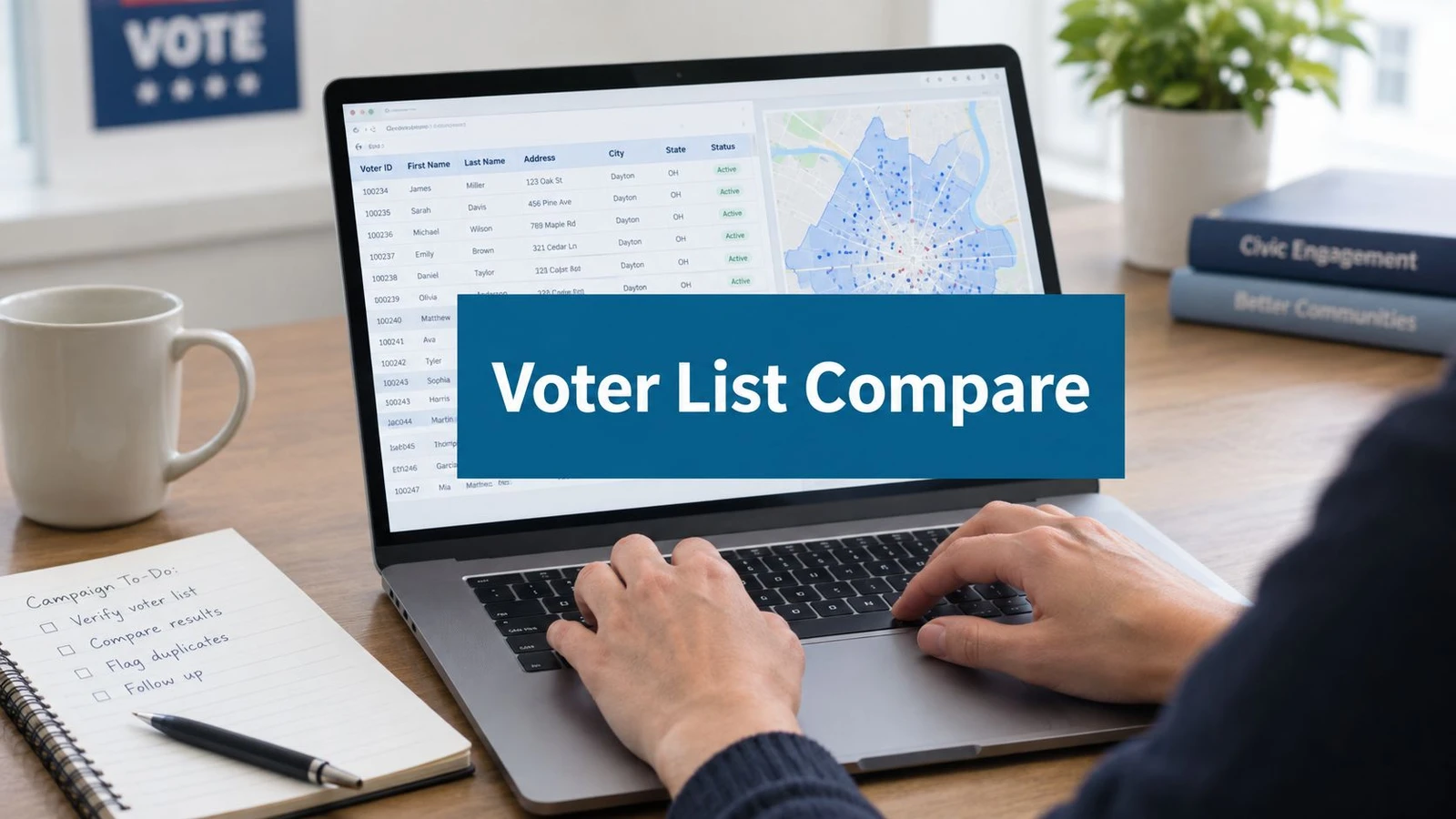
- Voter files contain three distinct layers: core registration data (name, address, party), voting history records (election participation dates and methods), and enhanced commercial appends (demographics, consumer behavior, and predictive scores).
- Basic voter registration fields are standardized by state law and include voter ID, registration date, party affiliation, precinct assignment, and contact information — these fields are publicly available in all states.
- Enhanced voter data from commercial vendors adds 50-200 additional fields including age, income estimates, education level, homeownership status, and modeled political scores that dramatically improve targeting precision.
- Understanding the difference between static fields (party registration) and dynamic fields (voting history) is critical for building accurate voter segments and avoiding outdated targeting assumptions.
Understanding What Fields Are in Voter Files: The Foundation of Modern Campaigns
Voter files contain dozens to hundreds of individual data fields that describe registered voters, their voting behavior, and their demographic characteristics. Understanding what fields are in voter files is essential for any political campaign, advocacy organization, or political consultant building targeted outreach strategies in 2026.
At their core, voter files are structured databases where each row represents one registered voter and each column represents a specific data field about that voter. The most basic voter files contain 15-25 fields drawn directly from voter registration records. Enhanced commercial voter files can contain 150-200+ fields after vendors append demographic, consumer, and predictive modeling data.
The distinction between different types of voter file fields matters enormously for campaign strategy. Basic registration fields tell you who is legally eligible to vote and their party affiliation. Voting history fields reveal actual participation patterns. Enhanced commercial fields add layers of demographic and behavioral insight that transform generic voter lists into precision-targeted outreach universes.
Core Voter Registration Data Fields: What Every File Contains
Every voter file, regardless of vendor or state, contains a set of core registration data fields mandated by state election law. These fields come directly from voter registration applications and are maintained by county election offices or state boards of elections.
Voter Identification Fields
The foundation of every voter record is the unique voter identification number assigned by the state. This field — often called voter ID, state voter ID, or registration number — serves as the primary key that distinguishes one voter from another even when names or addresses are similar.
Full legal name fields are broken into separate components: first name, middle name or initial, last name, and name suffix (Jr., Sr., III). Some states also include maiden names or previous names in separate fields. This granular name structure allows for more accurate matching and mail merge operations.
Date of birth is a standard field in most states, though some states only provide age or birth year for privacy reasons. Registration date indicates when the voter first registered at their current address or in their current jurisdiction.
Address and Geographic Fields
Residential address is the cornerstone of voter file geography. This field is typically broken into multiple components: street number, street name, street type (Ave, St, Rd), apartment or unit number, city, state, and ZIP code. Some voter files include additional precision fields like ZIP+4 or census tract identifiers.
Mailing address is a separate field set used when a voter’s mail should be sent somewhere other than their residential address. This is common for voters who use PO boxes, college students, military personnel, or voters temporarily relocated.
Precinct assignment is a critical geographic field that determines which ballot a voter receives and which races they’re eligible to vote in. Related geographic fields include:
- Congressional district
- State senate district
- State house district
- County commission district
- School board district
- Municipal ward or district
- Judicial district
These geographic assignments change after redistricting and must be updated in voter files to remain accurate. In 2026, many states are still updating files to reflect post-2020 census redistricting changes.
Party Affiliation and Registration Status
Party affiliation is one of the most strategically valuable fields in voter files, though it’s only available in states with partisan voter registration. As of 2026, 31 states plus DC require voters to declare a party affiliation (or choose “unaffiliated”) when registering.
The party field typically contains values like:
- Democrat (DEM)
- Republican (REP)
- Unaffiliated/Independent (UNA, IND, NPA)
- Libertarian (LIB)
- Green (GRN)
- Other minor parties
Voter status indicates whether a registration is active, inactive, pending, or cancelled. Active voters are eligible to vote in upcoming elections. Inactive voters are those who haven’t responded to address verification notices or haven’t voted in several election cycles. Understanding status fields prevents campaigns from wasting resources on voters who can’t participate.
Voting History Fields: The Behavioral Data Layer
Voting history fields transform voter files from static registration lists into dynamic behavioral databases. These fields show which elections each voter has participated in historically, creating a participation record that’s far more predictive than party registration alone.
Election Participation Records
For each election in the file’s history range (typically 10-20 years), the voter file contains a field indicating whether that specific voter cast a ballot. These fields are usually coded as simple yes/no, 1/0, or Y/N indicators.
For example, a voter file might contain these fields:
- Voted_2024_General
- Voted_2024_Primary
- Voted_2022_General
- Voted_2022_Primary
- Voted_2020_General
- Voted_2020_Primary
Each field shows whether that voter participated in that specific election. This granular election-by-election data allows campaigns to identify super voters (those who vote in every election), sporadic voters (those who only vote in presidential years), and newly registered voters with no history.
Vote Method Fields
Increasingly important in 2026, vote method fields indicate how each voter cast their ballot when they participated. Common values include:
- In-person on Election Day
- Early in-person voting
- Absentee/mail ballot
- Provisional ballot
These fields have become strategically critical as vote-by-mail patterns shifted dramatically after 2020. Campaigns use vote method history to identify voters who prefer mail voting (and should receive absentee ballot applications early) versus those who prefer in-person voting (and need Election Day GOTV reminders).
Some enhanced voter files also include vote date fields showing exactly when during an early voting period each voter cast their ballot. This temporal data helps campaigns identify voters who vote in the first days of early voting versus those who wait until the final weekend.
Calculated Voting Frequency Scores
Many voter file vendors calculate derived fields based on raw voting history. The most common is a voting frequency score or turnout score that summarizes overall participation patterns.
A typical voting frequency score might be calculated as:
- 0-1: Rarely or never votes
- 2-3: Occasional voter (presidential years only)
- 4-5: Regular voter (most major elections)
- 6-7: Super voter (nearly every election including primaries)
These scores compress 20+ individual election fields into a single targetable metric. Learn how to segment voters by voting history for maximum impact to understand how campaigns use these scores strategically.
Enhanced Commercial Data Fields: The Demographic Layer
Commercial voter file vendors append dozens of additional fields to basic registration data by matching voter records to consumer databases, census data, and public records. These enhanced voter data fields dramatically improve targeting precision but come at additional cost.
Demographic Append Fields
Age and generational cohort fields provide more precise targeting than date of birth alone. Vendors typically append:
- Exact age (calculated from birth date)
- Age range buckets (18-24, 25-34, 35-44, etc.)
- Generation (Gen Z, Millennial, Gen X, Boomer, Silent)
Gender is modeled based on first names and consumer data, typically with a confidence score. While not perfectly accurate, gender fields achieve 95%+ accuracy in most files.
Ethnicity and race fields are modeled using surname analysis, census tract demographics, and consumer data. These fields are sensitive and subject to varying accuracy, but they enable campaigns to target ethnic communities for culturally relevant messaging.
Marital status and presence of children fields help campaigns identify families versus single households, enabling family-focused messaging or education-issue targeting.
Socioeconomic Append Fields
Income is never directly available in voter files, but vendors model household income ranges based on address, property values, consumer behavior, and census tract data. Income fields typically appear as ranges:
- Under $25,000
- $25,000-$49,999
- $50,000-$74,999
- $75,000-$99,999
- $100,000-$149,999
- $150,000+
Education level is similarly modeled, typically as:
- High school or less
- Some college
- College graduate
- Post-graduate degree
Homeownership status (owner vs renter) is appended from property records and is highly accurate. Related fields include estimated home value, years at residence, and property type (single-family, condo, apartment).
Occupation and industry fields are modeled from various sources and indicate likely employment sectors. These fields help campaigns identify union households, healthcare workers, educators, or other occupation-based constituencies.
Contact Information Appends
Phone numbers are appended by matching voter names and addresses to consumer phone databases. In 2026, typical match rates are:
- Landline: 40-50% (declining annually)
- Mobile: 60-70% (primary phone type)
- Any phone: 75-85%
Phone type indicators (landline vs mobile) are critical for compliance with TCPA regulations governing automated calls and texts.
Email addresses are appended from consumer databases, online registrations, and public records. Match rates in 2026 average 50-60% but vary significantly by age — younger voters have 70%+ match rates while voters over 65 often have rates below 40%.
Email validation flags indicate whether an email address is currently active, bounced, or unverified. This prevents campaigns from wasting resources on dead email addresses.
Predictive Modeling Fields: The Intelligence Layer
The most sophisticated voter files include predictive modeling scores that estimate voter behavior and attitudes based on demographic patterns, consumer data, and machine learning algorithms.
Turnout Propensity Scores
Turnout scores predict the likelihood that a specific voter will participate in an upcoming election, typically expressed as a 0-100 score or 1-10 decile. These scores are calculated using:
- Historical voting frequency
- Demographic characteristics
- Election type (presidential vs midterm vs special)
- Competitive context of the election
A voter with a turnout score of 85 is highly likely to vote, while a score of 30 indicates low probability. Campaigns use these scores to prioritize GOTV resources on persuadable voters with moderate turnout likelihood (scores of 40-70) rather than wasting effort on definite voters or definite non-voters.
Partisan and Support Scores
Partisan scores estimate how likely a voter is to support Democratic vs Republican candidates, even in states without party registration. These scores range from 0 (strong Republican) to 100 (strong Democrat), with 50 representing true independents.
Candidate support scores are custom models built for specific races, predicting support for a particular candidate based on demographics, geography, and issue attitudes. These scores are typically purchased separately from general voter files.
Issue attitude scores model voter positions on specific policy issues like healthcare, education, gun rights, abortion, or climate change. These scores enable issue-based targeting rather than just partisan targeting.
Engagement and Activism Scores
Some vendors provide activism scores that predict which voters are likely to volunteer, donate, or engage beyond just voting. These scores identify potential campaign volunteers and small-dollar donors.
Social media presence indicators flag voters who are active on specific platforms, enabling digital advertising targeting and social media outreach strategies.
How Voter File Fields Vary by State
While core registration fields are similar across states, significant variations exist in what data is publicly available and how it’s structured.
Party Registration States vs Non-Party States
The 31 states with party registration provide party affiliation as a standard field. The remaining states don’t collect party information, making partisan modeling scores essential for targeting in those states.
Some party registration states (like California and Florida) have very high rates of “no party preference” or “independent” voters, reducing the utility of the party field. Other states (like Wyoming and West Virginia) have very low independent rates and strong party registration patterns.
Voting History Depth and Detail
States vary in how much voting history they maintain in public files:
- Some states provide 20+ years of election history
- Others only provide 4-10 years
- A few states limit public access to recent history only
Vote method detail also varies. Some states provide granular vote method fields (early in-person vs mail ballot vs Election Day), while others only indicate “voted” without method detail.
Address Standardization and Geographic Precision
Address formatting and standardization quality varies significantly by state. States with centralized voter registration systems typically have cleaner, more standardized addresses. States with county-level registration often have inconsistent formatting that requires additional cleaning.
Geographic assignment fields are more detailed in some states than others. States with complex local government structures (like Pennsylvania) have numerous district fields, while states with simpler structures have fewer.
Understanding Field Types: Static vs Dynamic
Voter file fields fall into two critical categories that affect how campaigns use them:
Static Fields: Slow-Changing Demographics
Static fields rarely change and can be used for long-term strategic planning:
- Age (changes predictably)
- Gender (rarely changes)
- Race/ethnicity (essentially fixed)
- Geographic location (changes slowly)
- Homeownership (changes infrequently)
Campaigns can build targeting strategies around static fields knowing they’ll remain accurate throughout an election cycle.
Dynamic Fields: Frequently Updated Behavior
Dynamic fields change regularly and require frequent file updates:
- Party registration (voters switch parties)
- Voter status (active to inactive)
- Address (voters move)
- Phone numbers (people change numbers)
- Voting history (updated after each election)
Campaigns must refresh dynamic fields regularly to avoid targeting inactive voters, using disconnected phone numbers, or mailing to old addresses. Browse mailing list options that include recent file updates to ensure data accuracy.
Voter File Field Quality and Match Rates
Not all voter file fields are equally reliable. Understanding field quality and match rates prevents campaigns from over-relying on low-confidence data.
High-Confidence Fields (95-100% Accuracy)
- Voter ID
- Name
- Residential address
- Registration date
- Party affiliation (in party states)
- Voting history
- Precinct assignment
These fields come directly from official registration records and are highly reliable.
Moderate-Confidence Fields (70-90% Accuracy)
- Phone numbers (75-85% match rate)
- Email addresses (50-60% match rate)
- Age/date of birth (95%+ in most states)
- Gender (95%+ accuracy)
- Homeownership (90%+ accuracy)
These appended fields are generally reliable but not perfect.
Modeled Fields (60-80% Accuracy)
- Income estimates
- Education level
- Ethnicity/race
- Occupation
- Marital status
- Presence of children
These fields are statistically modeled and should be used for aggregate targeting, not individual assumptions.
Predictive Scores (Varies by Model)
- Turnout scores (70-85% predictive accuracy)
- Partisan scores (75-85% accuracy)
- Issue attitude scores (60-75% accuracy)
Predictive scores are probabilistic and work best for large-scale targeting, not individual voter contact decisions.
How Commercial Vendors Enhance Voter Files
Commercial voter data vendors like L2 Political, Aristotle, and TargetSmart take basic state voter files and add extensive enhancements. Compare top voter data vendors to understand how different providers structure their enhanced fields.
 Field organizer at campaign office map wall using tablet to filter voter segments for targeted outreach
The enhancement process involves:
-
Data acquisition: Vendors obtain raw voter files from all 50 states, typically refreshing them monthly or weekly
-
Standardization: Addresses are cleaned and standardized, names are parsed into components, and geographic codes are validated
-
Matching: Voter records are matched to consumer databases, property records, phone directories, and other sources using name, address, and date of birth
-
Appending: Matched records receive dozens of additional fields from consumer databases
-
Modeling: Statistical models generate predictive scores based on demographics, behavior, and geography
-
Validation: Appended data is validated and confidence scores are assigned
The result is a voter file with 150-200+ fields compared to the 20-30 fields in raw state files. This enhanced data enables sophisticated micro-targeting that would be impossible with registration data alone.
Strategic Applications: Using Field Knowledge for Better Targeting
Understanding what fields are in voter files isn’t academic — it directly impacts campaign effectiveness. Here’s how field knowledge translates to strategic advantage:
Building Precise Target Universes
Instead of broad targeting like “all Democrats,” field knowledge enables precision:
- “Democrats who voted in 2020 but not 2022, ages 18-35, with emails”
- “Unaffiliated voters with turnout scores 40-70, homeowners, income $75K+”
- “Republican women ages 35-55 with children, in competitive suburban precincts”
These multi-field segments dramatically improve message relevance and response rates. Learn about advanced voter data filtering strategies to build winning target universes.
Optimizing Contact Method Selection
Field availability determines which contact methods are viable:
- Voters with accurate mailing addresses but no phone/email → direct mail
- Voters with mobile phones and high turnout scores → text messaging
- Voters with email addresses and low turnout scores → email persuasion series
- Voters with no contact appends → door-to-door canvassing
Matching contact strategy to available fields prevents wasted budget on impossible contacts.
Personalizing Message Content
Demographic and behavioral fields enable message personalization:
- Age fields → generationally relevant messaging
- Homeownership → property tax and housing policy messages
- Presence of children → education and family policy emphasis
- Vote method history → early voting vs Election Day messaging
Personalized messages based on actual data fields outperform generic messages by 40-60% in typical campaign tests.
Prioritizing GOTV Resources
Voting history and turnout score fields enable efficient GOTV resource allocation:
- Super voters (scores 80-100) → minimal contact, they’ll vote regardless
- Moderate propensity (scores 40-70) → intensive GOTV, highest ROI
- Low propensity (scores 0-40) → expensive to turn out, usually skip
This field-based prioritization can double GOTV efficiency compared to contacting all supporters equally.
Accessing and Working with Voter File Fields
Campaigns access voter file fields through several channels:
State Voter File Purchases
Campaigns can purchase raw voter files directly from state election offices. These files contain core registration and voting history fields but lack commercial enhancements. Prices vary from $25 to $5,000+ depending on the state. Learn how to access Florida voter data for state-specific guidance.
Commercial Voter File Vendors
Vendors like L2, Aristotle, TargetSmart, and others sell enhanced voter files with full demographic and predictive appends. Pricing typically starts at $0.01-0.05 per record depending on field selection and file size.
Voter File Platforms
Platforms like MailVotes provide access to enhanced voter files with intuitive filtering interfaces. Instead of purchasing entire state files, campaigns can build targeted voter lists using dozens of field filters and only pay for the specific records they need.
This approach is more cost-effective for smaller campaigns and allows real-time field filtering without database expertise.
Party Committee Voter Files
Democratic and Republican party committees at state and national levels provide enhanced voter files to their candidates, typically through platforms like VoteBuilder (Democrats) or GOP Data Center (Republicans). These files include party-specific modeling scores and activist history.
Field Selection: Choosing What Data You Actually Need
Not every campaign needs every field. Strategic field selection reduces costs and complexity:
Essential Fields for Every Campaign
- Voter ID
- Full name
- Address (residential and mailing)
- Party affiliation (where available)
- Voting history (last 3-4 election cycles minimum)
- Age or date of birth
- Geographic assignments (precinct, districts)
These core fields enable basic targeting and contact.
High-Value Add-On Fields
- Phone numbers (especially mobile)
- Email addresses
- Turnout propensity scores
- Partisan scores (in non-party states)
- Vote method history
These fields dramatically improve targeting precision and enable digital contact.
Situational Fields
- Income estimates (for donor prospecting)
- Ethnicity (for culturally targeted outreach)
- Issue attitude scores (for issue-based campaigns)
- Homeownership (for property-related issues)
- Education level (for education-focused races)
Select these based on specific campaign needs and message strategies.
Usually Unnecessary Fields
- Extremely granular consumer data (magazine subscriptions, pet ownership)
- Voting history beyond 10 years
- Highly speculative modeling scores
- Redundant geographic fields
These fields add cost without proportional strategic value for most campaigns.
Privacy, Ethics, and Compliance Considerations
Working with voter file fields requires attention to privacy laws and ethical standards:
What’s Legal vs What’s Ethical
Voter registration data is public record in all states, making it legal to use. However, ethical campaigns consider:
- Using sensitive fields (race, ethnicity, modeled income) only for legitimate targeting
- Avoiding discriminatory exclusion based on protected characteristics
- Being transparent about data sources when voters ask
- Respecting opt-out requests even when not legally required
Compliance with Contact Regulations
Different fields trigger different compliance requirements:
- Mobile phone fields → TCPA compliance for calls and texts
- Email fields → CAN-SPAM compliance
- All fields → state-specific political communication laws
Understanding which fields you’re using determines which compliance frameworks apply.
Data Security and Storage
Voter files contain personally identifiable information requiring secure handling:
- Encrypt files at rest and in transit
- Limit access to authorized campaign staff only
- Delete or return files after the election
- Never sell or share voter files with non-political entities
Many states have specific requirements for voter file security and usage.
The Future of Voter File Fields in 2026 and Beyond
Voter file data continues evolving as technology advances and privacy standards change:
Emerging Field Types
- Social media identifiers: Matching voter records to social media profiles for digital advertising
- Device IDs: Mobile advertising identifiers for programmatic ad targeting
- Real-time verification: Live phone number and email validation
- Behavioral web data: Online browsing and purchase behavior matched to voter records
Improving Accuracy
Machine learning models are improving the accuracy of appended and modeled fields:
- Ethnicity models now exceed 85% accuracy (up from 70% in 2020)
- Income estimates have narrowed to $10K ranges instead of $25K ranges
- Turnout models incorporate real-time early vote data for mid-election updates
Privacy-Driven Changes
Increasing privacy regulations are affecting field availability:
- Some states considering restrictions on commercial voter file sales
- GDPR-style consent requirements may limit certain appends
- Phone number and email matching may face new restrictions
Campaigns should expect continued evolution in what fields are available and how they can be used.
Practical Example: Anatomy of a Voter Record
Here’s what a complete voter record looks like with all field layers:
Core Registration Fields:
- Voter ID: FL-12345678
- First Name: Jennifer
- Last Name: Martinez
- Address: 1234 Oak Street, Tampa, FL 33602
- Registration Date: 2018-03-15
- Party: Democrat
- Status: Active
- Precinct: 145
- Congressional District: 14
Voting History Fields:
- Voted 2024 General: Yes (Mail ballot)
- Voted 2024 Primary: Yes (Early in-person)
- Voted 2022 General: Yes (Mail ballot)
- Voted 2022 Primary: No
- Voted 2020 General: Yes (Mail ballot)
- Voting Frequency Score: 6/7
Enhanced Demographic Fields:
- Age: 34
- Gender: Female
- Ethnicity: Hispanic
- Income Range: $75,000-$99,999
- Education: College graduate
- Homeowner: Yes
- Home Value: $285,000
- Marital Status: Married
- Children Present: Yes
Contact Append Fields:
- Mobile Phone: (813) 555-0123
- Email: jmartinez@email.com
- Email Validation: Active
Predictive Modeling Fields:
- Turnout Score 2026: 78
- Partisan Score: 68 (Lean Democrat)
- Climate Issue Score: 72 (Supportive)
This complete record enables highly targeted, personalized outreach based on Jennifer’s registration status, proven voting behavior, demographics, and modeled attitudes.
Making Field Knowledge Actionable
Understanding what fields are in voter files is the foundation of modern campaign data strategy. The campaigns that win in 2026 are those that:
- Know which fields exist and what they measure
- Understand field quality and use appropriate confidence levels
- Select fields strategically based on actual campaign needs
- Combine multiple fields to create precise target universes
- Match contact methods to available field data
- Update regularly to maintain data accuracy
Whether you’re buying voter data for a political campaign or building targeted lists through a platform like MailVotes, field knowledge translates directly to more efficient spending, better response rates, and ultimately, more votes.
The difference between campaigns that treat voter files as simple mailing lists and those that understand the rich field structure within them is often the difference between winning and losing in competitive races. Master the fields, master the data, master the campaign.
Frequently Asked Questions
What are the basic fields in every voter file?
Every voter file contains core registration fields mandated by state law: voter ID number, full name, residential address, mailing address (if different), date of birth or age, registration date, party affiliation (in states with party registration), precinct/district assignments, and voter status (active/inactive). These fields are standardized across all voter files regardless of vendor.
What is enhanced voter data and how does it differ from registration data?
Enhanced voter data refers to commercial data appends that vendors add to basic voter registration records. While registration data comes from government sources, enhanced data includes demographics (income, education, ethnicity), consumer behavior (homeownership, vehicle ownership), contact information (phone numbers, emails), and predictive modeling scores (turnout likelihood, partisan scores). Enhanced data typically adds 50-200 additional fields beyond basic registration.
Can I get voter phone numbers and email addresses from voter files?
Phone numbers and email addresses are not part of standard voter registration data in most states. However, commercial voter file vendors append this contact information by matching voter records to consumer databases, public records, and other sources. Match rates vary — typically 60-75% for phone numbers and 40-60% for email addresses in 2026, with higher accuracy for younger, digitally active voters.
What voting history information is included in voter files?
Voting history fields show which elections each voter participated in, typically going back 10-20 years depending on the state. For each election, the file indicates whether the voter cast a ballot (yes/no), the method used (in-person, absentee, early voting), and sometimes the date voted. Importantly, voter files never reveal how someone voted — only that they participated and through which method.
How often are voter file fields updated?
Update frequency varies by field type. Voter registration data (party changes, address updates, new registrations) is updated continuously by election offices and refreshed in commercial files weekly or monthly. Voting history is updated after each election, typically 30-60 days post-election once results are certified. Enhanced commercial appends are typically refreshed quarterly, though some vendors offer monthly updates for premium files.