
Key Takeaways
- Florida voter data is publicly accessible through the Florida Division of Elections, with files available for purchase at $5 per county or $937.50 for the statewide database as of 2026.
- The Florida voter file includes voter registration details, party affiliation, voting history, demographic information, and precinct assignments — but excludes Social Security numbers, driver’s license numbers, and dates of birth.
- Campaigns can access voter data through three primary methods: direct purchase from the Division of Elections, third-party data vendors like MailVotes, or county-level Supervisor of Elections offices.
- Processing and utilizing Florida voter data requires understanding data formats (typically CSV or fixed-width files), compliance with Florida’s data use restrictions, and integration with campaign management tools for maximum effectiveness.
How to access Florida voter data is one of the most common questions political campaigns face when planning outreach strategies in the Sunshine State. Florida’s voter file contains detailed information on over 14.2 million registered voters as of 2026, making it an essential resource for any campaign seeking to identify, target, and mobilize supporters effectively.
Florida voter data is publicly accessible and legally available for purchase, but navigating the request process, understanding what information is included, and knowing how to use the data effectively requires specific knowledge. This comprehensive guide walks you through every step of accessing Florida voter data in 2026, from initial request to practical implementation in your campaign.
What is the Florida Voter File?
The Florida voter file is a comprehensive database maintained by the Florida Division of Elections that contains registration and voting history information for every registered voter in the state. This statewide database aggregates data from all 67 county Supervisors of Elections offices into a single, standardized format.
Florida’s voter file includes voter name, complete residential address, mailing address (if different), phone number (when provided during registration), email address (when provided), party affiliation, race, gender, date of registration, precinct assignment, congressional district, state legislative districts, and a complete history of which elections the voter has participated in since 1996.
The voter file does not include how someone voted — ballot secrecy is protected by law. It only shows whether a voter participated in a given election, not their candidate choices. The file also excludes Social Security numbers, driver’s license numbers, dates of birth, and signatures, which are considered exempt from public disclosure under Florida Statute 119.071.
For campaigns, the Florida voter file serves as the foundation for virtually all voter contact activities. Whether you’re planning direct mail campaigns, phone banking, door-to-door canvassing, or digital advertising, the voter file provides the targeting data needed to reach the right voters with the right message.
Understanding Florida’s Public Records Law for Voter Data
Florida operates under one of the nation’s most transparent public records frameworks, commonly known as the “Sunshine Law.” Under Florida Statute 97.0585, voter registration information is explicitly designated as public record, with specific exceptions for sensitive personal data.
The law establishes that voter data can be requested by any person or organization, but restricts its use to political purposes, governmental purposes, journalistic purposes, or academic research. Commercial use — such as selling products or services to voters — is strictly prohibited and carries civil penalties of up to $5,000 per violation.
When you request Florida voter data, you must certify the intended use and acknowledge that you understand the legal restrictions. This certification is part of the standard request form provided by the Division of Elections. Misuse of voter data can result in both civil penalties and potential criminal charges under Florida’s data protection statutes.
The transparency of Florida’s system means that your request for voter data is itself a public record. Other campaigns, journalists, or interested parties can potentially learn that you’ve requested voter data, though the specific uses you make of the data remain private.
Who Can Access Florida Voter Data?
Practically anyone can access Florida voter data, including political campaigns, political parties, political action committees, candidates, elected officials, government agencies, journalists, academic researchers, and nonprofit organizations engaged in voter education or registration activities.
You do not need to be a Florida resident to request voter data, nor do you need to demonstrate any particular qualification beyond certifying that you will use the data for permissible purposes. This open access policy reflects Florida’s commitment to electoral transparency and enables robust political participation.
How to Request Florida Voter Data from the Division of Elections
The most direct method for accessing Florida voter data is purchasing it directly from the Florida Division of Elections. This process has been streamlined significantly in 2026 with improved online ordering systems and faster delivery options.
Step 1: Determine Your Data Needs
Before submitting your request, identify exactly what data you need. The Division of Elections offers several options:
Statewide voter file: Contains all registered voters across Florida’s 67 counties. As of 2026, this file includes approximately 14.2 million voter records. Cost: $937.50.
Individual county files: Contains all registered voters in a specific county. Useful for local campaigns or organizations focused on particular geographic areas. Cost: $5 per county.
Voter history file: A separate file showing voting participation history for all voters. This can be purchased in conjunction with the registration file or separately. Cost: Included in statewide file; $5 per county for individual county history files.
Most statewide campaigns purchase the complete statewide file, while local campaigns (city council, county commission, school board) typically purchase only the counties relevant to their district. For campaigns spanning multiple counties but not the entire state, calculate whether purchasing individual counties or the full statewide file is more cost-effective.
Step 2: Complete the Voter Registration List Request Form
Access the official request form through the Florida Division of Elections website at dos.myflorida.com/elections. The 2026 version of the form is available as a fillable PDF that can be completed electronically or printed and filled by hand.
The form requires:
- Your name and organization (if applicable)
- Complete mailing address
- Phone number and email address
- Specification of which counties or statewide file you’re requesting
- Preferred delivery format (CD/DVD, USB drive, or electronic download)
- Certification of intended use (political, governmental, journalistic, or academic)
- Signature and date
Be precise when specifying your data needs. The form includes checkboxes for the statewide file, individual counties (with space to list specific counties), and whether you want voter history included.
Step 3: Submit Payment
The Division of Elections accepts payment by check, money order, or credit card. For credit card payments, you can include card information on the request form or call the Division’s data services line at (850) 245-6280 to provide payment information securely.
Make checks or money orders payable to “Florida Department of State.” Include your request form with your payment. For electronic submissions, email the completed form to elections@dos.myflorida.com and follow up with payment information.
Processing typically begins within 1-2 business days of payment receipt. The Division prioritizes requests during election cycles, so expect slightly longer processing times during the 90 days before major elections.
Step 4: Receive and Verify Your Data
The Division of Elections delivers voter data through your chosen method:
Electronic download: Most common in 2026. You’ll receive a secure download link via email, typically within 3-5 business days. Files are compressed (ZIP format) and require extraction before use.
Physical media (USB drive): Delivered via USPS, typically arriving within 7-10 business days. Useful if you have limited internet bandwidth or prefer physical backup copies.
CD/DVD: Still available but increasingly uncommon. Same delivery timeline as USB drives.
Upon receiving your data, immediately verify the file integrity. Check that:
- All requested counties are included
- The record count matches expected voter registration totals
- Files open correctly in your chosen software
- Data fields are properly formatted and readable
The Division of Elections provides a data dictionary document explaining each field in the voter file. Review this carefully to understand the data structure and field definitions.
Alternative Methods: County-Level Access and Third-Party Vendors
Accessing Voter Data Through County Supervisors of Elections
Each of Florida’s 67 counties maintains its own voter registration database, and you can request data directly from county Supervisors of Elections offices. This approach makes sense for hyperlocal campaigns or when you need more frequent updates than the weekly statewide file provides.
County offices typically charge the same $5 fee established by state law, though processing times and delivery methods vary by county. Larger counties like Miami-Dade, Broward, and Hillsborough have sophisticated online ordering systems similar to the state’s, while smaller counties may require in-person visits or mail requests.
One advantage of county-level requests is the potential for more current data. While the statewide file updates weekly, county databases update daily as new registrations are processed. For time-sensitive campaigns in the final weeks before an election, this currency can be valuable.
To request data from a county Supervisor of Elections, visit the county’s election website or contact the office directly. The Florida Division of Elections maintains a directory of all county Supervisors at dos.myflorida.com/elections/supervisors.
Using Third-Party Voter Data Vendors
Third-party vendors like MailVotes offer enhanced voter data services that go beyond the raw files provided by the Division of Elections. These vendors purchase the statewide file, process it, append additional data, and provide user-friendly interfaces for filtering and exporting targeted lists.
Advantages of third-party vendors include:
Pre-processed data: Files are cleaned, standardized, and ready to import into campaign management systems without technical manipulation.
Enhanced filtering: Advanced search capabilities let you target voters by dozens of criteria simultaneously — party affiliation, voting frequency, age range, geographic boundaries, and more.
Additional data appends: Some vendors append consumer data, property records, or modeled political scores to help identify persuadable voters or likely supporters.
Ongoing updates: Rather than purchasing new files periodically, many vendors provide continuous access to updated data throughout your campaign.
Technical support: Vendors typically offer customer support to help you use the data effectively and troubleshoot issues.
MailVotes specializes in providing targeted mailing lists for political campaigns, with sophisticated filtering tools that let you build your voter list based on precise criteria. For campaigns without in-house data expertise, this can be more cost-effective than hiring data staff to process raw voter files.
Third-party vendors typically charge between $500 and $2,500 depending on the level of data enhancement, filtering capabilities, and support services included. While more expensive than the $937.50 statewide file from the Division of Elections, the time savings and enhanced functionality often justify the additional cost for well-funded campaigns.
What Information Does the Florida Voter File Include?
Understanding exactly what data fields are available in the Florida voter file is essential for effective campaign targeting. The 2026 statewide file includes approximately 40 data fields for each registered voter.
Core Registration Information
Name fields: Last name, first name, middle name, and name suffix (Jr., Sr., III, etc.). Some records include maiden names or previous names if the voter has updated their registration.
Address information: Complete residential address including street number, street name, apartment/unit number, city, ZIP code, and ZIP+4. A separate mailing address is included if the voter receives mail at a different location (common for voters who use PO boxes or temporarily reside elsewhere).
Contact information: Phone number (when provided during registration — approximately 68% of Florida voters have phone numbers on file as of 2026). Email address (when provided — approximately 52% of voters have emails on file in 2026).
Demographic Data
Party affiliation: Registered party (Republican, Democrat, No Party Affiliation, or one of Florida’s qualified minor parties). Florida is a closed primary state, so party registration is particularly significant for primary election targeting.
Race: Self-reported race category. Options include White, Black, Hispanic, Asian, Native American, Other, Multi-Racial, and Unknown. Approximately 12% of voters do not provide race information.
Gender: Male, Female, or Unknown. Derived from name and other registration information when not explicitly provided.
Age/Date of Registration: While date of birth is exempt from public disclosure, the voter file includes the date when the voter first registered in Florida, which can be used to identify newly registered voters.
Geographic and Political Boundaries
Precinct: The voter’s assigned precinct for voting purposes.
Congressional district: Current U.S. House district (updated after redistricting).
State legislative districts: Florida House and Florida Senate districts.
County commission district: County-level district assignments.
School board district: In counties with district-based school board elections.
Municipal boundaries: City limits designation for incorporated areas.
These geographic fields are essential for campaigns to identify voters within their specific electoral district. After redistricting in 2022, all district assignments were updated and are current as of 2026.
Voting History
The most valuable component of the Florida voter file for campaign targeting is the comprehensive voting history. For each election since 1996, the file indicates whether the voter participated and, if so, whether they voted by mail, early in-person, or on Election Day.
This history allows campaigns to calculate crucial metrics:
Voter frequency: How many of the last 8 general elections did this voter participate in? High-frequency voters (6-8 of 8) are much more likely to vote in the upcoming election than low-frequency voters (1-3 of 8).
Primary participation: Does this voter participate in primary elections? Primary voters are typically more politically engaged and ideologically consistent.
Voting method preference: Does this voter consistently vote by mail, early, or on Election Day? This informs when and how to contact them.
Surge voters: Did this voter participate in the 2020 presidential election but not in 2022 midterms? These “surge voters” who only participate in high-profile elections require different messaging than consistent voters.
As detailed in our guide on how to use voting history data to win elections, voting history is often the single most predictive variable for future turnout and should be central to any targeting strategy.
Processing and Using Florida Voter Data
Understanding Data Formats
The Florida Division of Elections provides voter data in two primary formats:
Delimited text files (CSV): Comma-separated values format where each field is separated by a comma and each record is on a new line. This is the most common format and can be opened in Microsoft Excel, Google Sheets, or imported into databases and campaign management software.
Fixed-width text files: Each field occupies a specific number of characters, with fields aligned in columns. This format is more compact but requires a layout file (provided by the Division) to parse correctly.
For most campaigns, the CSV format is preferable due to its compatibility with standard software. However, be aware that CSV files can have issues with addresses containing commas (e.g., “123 Main Street, Apt 4”) which may cause field misalignment. Quality voter data vendors handle these formatting issues during processing.
Data Import and Management
Once you receive the voter file, you’ll need to import it into software that can handle large datasets. The statewide Florida file contains over 14 million records and exceeds the row limits of standard spreadsheet programs.
Options for managing Florida voter data:
Database software: Microsoft Access, MySQL, or PostgreSQL can handle the full statewide file and enable complex queries. Requires technical expertise but offers maximum flexibility.
Campaign management platforms: Tools like NGP VAN, EveryAction, or NationBuilder have built-in voter file import functions and provide user-friendly interfaces for searching and filtering.
Voter data platforms: Services like MailVotes provide pre-imported Florida voter data with intuitive filtering tools, eliminating the need for manual import and database management.
Spreadsheet software with limitations: For county-level files with fewer records, Excel or Google Sheets may suffice, though performance degrades with files exceeding 100,000 records.
When importing data, verify that:
- Field headers are correctly mapped
- Date fields are formatted properly
- Phone numbers and ZIP codes aren’t converted to numbers (losing leading zeros)
- Special characters in names and addresses are preserved
Many campaigns hire data consultants for initial import and setup, then train staff on using the system for ongoing list generation.
Creating Targeted Lists
The power of voter data lies in targeting. Rather than contacting all 14.2 million Florida voters, effective campaigns identify specific subsets most likely to support their candidate or cause.
Common targeting strategies include:
High-propensity voters in your party: Registered Democrats (for Democratic campaigns) or Republicans (for Republican campaigns) who voted in at least 3 of the last 4 general elections. These are your base voters most likely to support you and most likely to vote.
Swing voters in competitive districts: No Party Affiliation voters in precincts where recent elections were decided by margins under 5%. These voters determine close elections.
Infrequent voters who match your demographic profile: Registered supporters who vote sporadically. Mobilizing these voters requires different messaging than persuading undecided voters.
Geographic micro-targeting: Voters in specific precincts, neighborhoods, or ZIP codes where your campaign has particular strengths or needs.
Our article on voter data filtering strategies that win campaigns provides detailed guidance on combining multiple criteria for maximum targeting precision.
Combining Voter Data with Other Information
Sophisticated campaigns enhance voter file data by appending additional information:
Consumer data: Purchasing patterns, magazine subscriptions, vehicle ownership, and lifestyle indicators can help identify voters likely to support specific policy positions.
Property records: Homeownership status, property values, and mortgage information provide insights into economic concerns and priorities.
Political modeling scores: Vendors use machine learning to assign each voter a probability score for supporting your candidate based on demographic patterns and voting history.
Survey responses: Campaigns conducting voter ID calls or online surveys can append response data to voter records for increasingly refined targeting.
When combining data sources, ensure compliance with privacy laws and maintain data security. Voter files should be stored securely, with access limited to authorized campaign staff.
Compliance and Best Practices for Florida Voter Data
Legal Use Restrictions
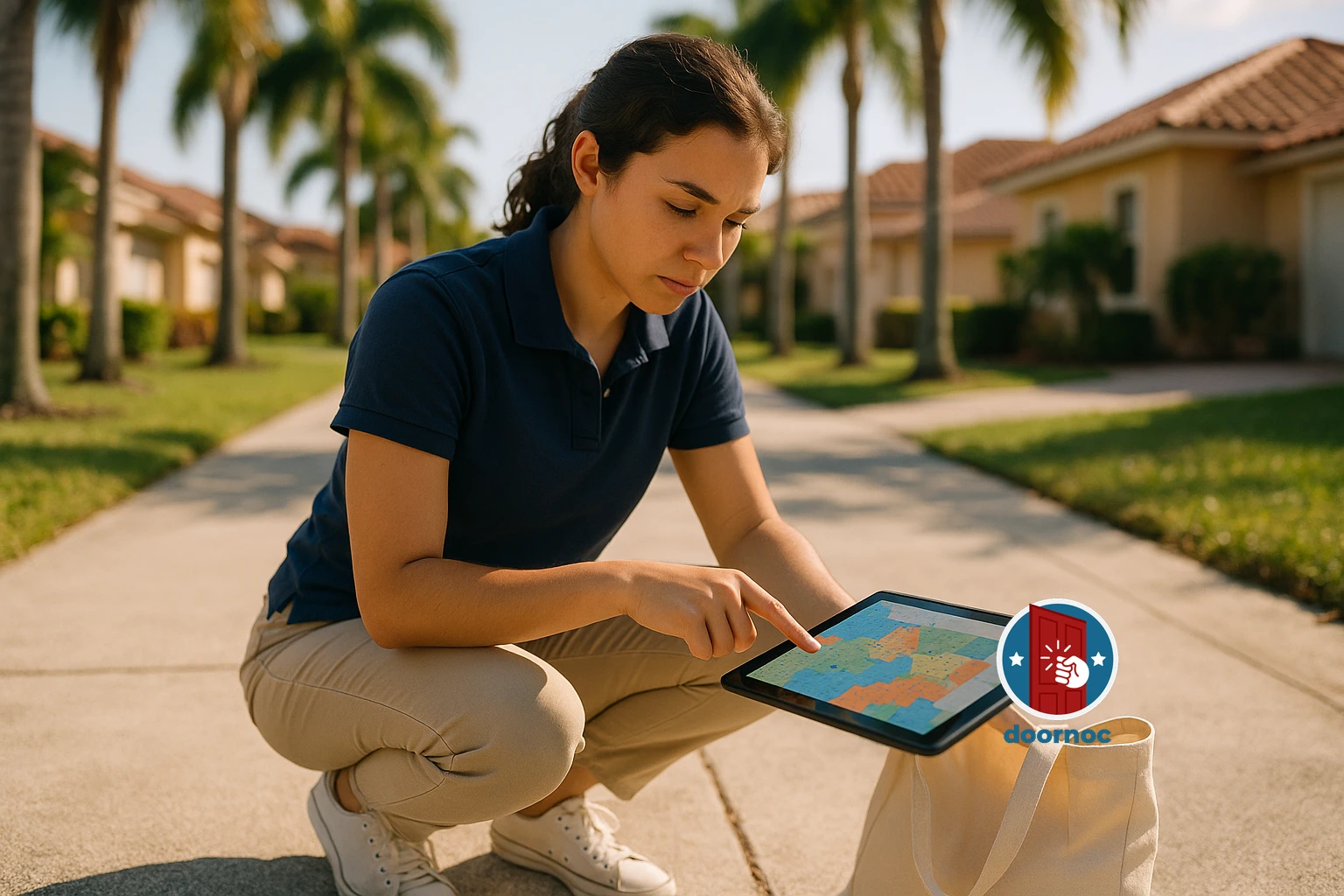 Field volunteer crouching outdoors on suburban sidewalk using tablet displaying voter precinct map data
Florida law (Statute 97.0585) strictly limits voter data use to:
- Political purposes (campaigns, political parties, PACs)
- Governmental purposes (official government functions)
- Journalistic purposes (news reporting, political analysis)
- Academic research (scholarly study of elections and voting behavior)
Prohibited uses include:
- Commercial solicitation or marketing
- Selling products or services to voters
- Creating mailing lists for non-political purposes
- Harassment or stalking
- Any use that violates voter privacy rights
Violations carry civil penalties up to $5,000 per violation. Campaigns should implement clear policies ensuring all staff understand these restrictions.
Data Security Requirements
While Florida law doesn’t mandate specific security measures for voter data, campaigns should implement basic protections:
Access controls: Limit voter file access to authorized staff. Use password protection and user authentication.
Secure storage: Store voter data on encrypted devices or secure cloud platforms. Avoid storing files on unsecured personal devices.
Transmission security: When emailing voter lists or sharing data, use encrypted email or secure file transfer services.
Disposal procedures: When a campaign ends, securely delete voter data files rather than leaving them on abandoned devices or servers.
Vendor agreements: If working with consultants or vendors, ensure contracts specify data security requirements and prohibit unauthorized use.
Data breaches can damage campaign credibility and potentially trigger legal liability. Treating voter data with appropriate care protects both your campaign and voter privacy.
Updating Your Voter Data
Voter registration data changes constantly as voters move, change parties, register for the first time, or are removed from rolls. The Florida Division of Elections updates the statewide file weekly, but significant changes occur between updates.
Best practices for maintaining current data:
Regular updates: For campaigns lasting several months, purchase updated voter files monthly or use a vendor providing continuous updates.
Monitor registration deadlines: Voter registration surges occur before registration deadlines. Update your file immediately after these deadlines to capture new registrants.
Track address changes: Use National Change of Address (NCOA) processing to identify voters who have moved and update mailing addresses accordingly.
Remove deceased voters: While the Division of Elections removes deceased voters from the file, there can be lag time. Cross-reference with death records if conducting extensive outreach.
Note returned mail: When direct mail is returned as undeliverable, flag these records in your database. Repeated contact attempts waste resources.
Campaigns using platforms like MailVotes benefit from automatic updates, ensuring targeting is based on current registration data rather than outdated information.
Integrating Florida Voter Data into Your Campaign Strategy
Accessing voter data is just the first step. The real value comes from integrating this data into every aspect of your campaign strategy.
Direct Mail Campaigns
Voter data enables precise targeting for direct mail, ensuring your message reaches the right voters while controlling costs. For a state senate race in a competitive district, you might mail to:
- All registered party members who voted in at least 2 of the last 3 general elections (base mobilization)
- No Party Affiliation voters in precincts your party won in the last election (persuasion)
- Voters who participated in 2020 but not 2022 (surge voter activation)
Each segment receives tailored messaging addressing their specific concerns and likelihood of supporting your campaign. Learn more about creating effective mailing lists for Florida campaigns.
Door-to-Door Canvassing
Field operations become dramatically more efficient when guided by voter data. Rather than knocking every door, campaigns target specific voters based on likelihood of support and turnout probability.
Canvassing apps integrate voter file data, allowing volunteers to see voter information on their phones as they walk precincts. This enables:
- Skipping households with no registered voters
- Prioritizing high-value targets (persuadable voters, base voters needing mobilization)
- Customizing conversation based on voter history and demographics
- Recording interaction results directly into the campaign database
A well-targeted canvassing operation contacts 3-4 times as many priority voters per hour as an untargeted approach.
Phone Banking and Text Messaging
Phone numbers in the Florida voter file (available for approximately 68% of voters as of 2026) enable direct voter contact through calls and texts. Effective campaigns use voter data to:
- Segment call lists by priority (high-propensity undecided voters first)
- Customize scripts based on voter demographics and history
- Schedule calls when voters are most likely to answer (evenings for working-age voters, afternoons for seniors)
- Track contact attempts and results in the voter database
Text messaging has become increasingly effective in 2026, with response rates often exceeding phone calls for younger voters. However, ensure compliance with TCPA regulations regarding consent and opt-out mechanisms.
Digital Advertising
Voter file data can be matched to digital advertising platforms for targeted online outreach. Facebook, Google, and programmatic advertising platforms accept voter file uploads for custom audience creation.
This enables campaigns to:
- Show ads only to registered voters in your district
- Exclude voters already committed to your opponent
- Deliver different messages to different voter segments
- Retarget voters who visited your campaign website
- Measure online engagement by voter characteristics
Digital advertising combined with voter data provides cost-effective reach to specific voter segments, particularly younger voters less responsive to traditional contact methods.
Common Challenges and Solutions
Campaigns frequently encounter obstacles when working with Florida voter data. Here are solutions to the most common challenges:
Challenge: File Size and Technical Complexity
The statewide Florida voter file is massive and can overwhelm campaigns without technical expertise.
Solution: Start with county-level files if you’re running a local campaign. For statewide races, consider using a voter data platform like MailVotes that handles the technical processing and provides user-friendly filtering tools. Alternatively, hire a data consultant for initial setup and staff training.
Challenge: Outdated Contact Information
Phone numbers and addresses in the voter file may be outdated, particularly for voters who registered years ago.
Solution: Use NCOA processing to update addresses. For phone banking, expect 30-40% of numbers to be disconnected or wrong numbers — this is normal. Consider appending additional phone numbers from consumer databases to improve contact rates.
Challenge: Identifying Persuadable Voters
The voter file shows party registration and voting history but doesn’t indicate candidate preference or persuadability.
Solution: Combine voter file data with modeling scores from political data vendors, or conduct voter ID surveys to identify supporters, opponents, and undecided voters. Focus persuasion efforts on the undecided segment. Our guide on swing voter identification provides detailed strategies.
Challenge: Privacy Concerns and Negative Reactions
Some voters react negatively when contacted, concerned about how campaigns obtained their information.
Solution: Train volunteers and callers to explain that voter registration is public record and used for political outreach. Emphasize that the campaign doesn’t know how they voted, only whether they voted. Respect opt-out requests immediately and maintain do-not-contact lists.
Challenge: Coordinating Data Across Campaign Tools
Campaigns often use multiple tools (canvassing app, phone banking system, email platform) that each need voter data.
Solution: Choose a campaign management platform that serves as a central database, with integrations to other tools. Alternatively, use APIs or regular exports to sync data between systems. Designate a data manager responsible for maintaining consistency across platforms.
Comparing Florida Voter Data to Other States
Florida’s voter data system is among the most accessible and comprehensive in the United States, but understanding how it compares to other states provides useful context.
Cost: Florida’s $937.50 statewide file is moderately priced. Some states charge significantly more (California: $5,000+), while others charge less (North Carolina: $125) or provide free downloads (Ohio).
Completeness: Florida includes robust demographic data and comprehensive voting history back to 1996. Some states provide limited history or exclude demographic fields.
Update frequency: Florida’s weekly updates are standard. Some states update monthly or only after elections.
Accessibility: Florida’s online ordering system is user-friendly. Some states require in-person pickup or mail requests with notarized forms.
Contact information: Florida’s 68% phone number availability and 52% email availability are above average. Many states have much lower rates of contact information.
For campaigns operating in multiple states, Florida’s system is generally easier to navigate than most, though working with a multi-state vendor can simplify cross-state operations. Learn more about voter database platforms for campaigns operating across multiple states.
Maximizing Your Investment in Florida Voter Data
Purchasing voter data is an investment that should drive measurable campaign results. Here’s how to maximize return on that investment:
Start with clear objectives: Before requesting data, define exactly what you’re trying to accomplish. Are you identifying supporters for volunteer recruitment? Building a persuasion mail program? Targeting GOTV calls? Different objectives require different data strategies.
Invest in training: Ensure campaign staff and volunteers understand how to use voter data effectively. A few hours of training can prevent costly mistakes and improve targeting precision.
Test and refine: Start with small-scale tests of your targeting strategy before committing to large expenditures. If a direct mail piece to high-propensity independent voters generates strong response, scale up. If not, adjust your targeting.
Track results: Append interaction results to voter records. Note which voters were contacted, how they responded, and whether they ultimately voted. This data improves future campaign planning.
Combine with other data sources: Voter file data becomes exponentially more valuable when combined with survey data, consumer data, or political modeling. Consider strategic data appends for key target segments.
Use it consistently: Voter data should inform every voter contact decision throughout your campaign. Campaigns that use data sporadically miss opportunities for efficiency and effectiveness.
The most successful Florida campaigns in 2026 are those that treat voter data as the foundation of all strategic decisions, not just a resource for generating mailing lists. When used comprehensively, voter data transforms campaign operations from guesswork to precision targeting.
Frequently Asked Questions
How much does Florida voter data cost in 2026?
The statewide Florida voter file costs $937.50 as of 2026, while individual county files are available for $5 each from the Florida Division of Elections. Third-party vendors typically charge between $500-$2,500 depending on filtering options and data enhancements.
Is Florida voter data public record?
Yes, Florida voter registration information is public record under Florida Statute 97.0585. However, certain sensitive information like Social Security numbers, dates of birth, and driver’s license numbers are exempt from public disclosure and are not included in voter files.
How often is Florida voter data updated?
The Florida Division of Elections updates the statewide voter file weekly, typically every Monday. County Supervisors of Elections update their local databases daily as new registrations are processed, changes are made, and voters are removed from rolls.
Can I use Florida voter data for commercial purposes?
No, Florida law restricts voter data use to political, governmental, journalistic, or academic purposes only. Commercial solicitation or sale of products using voter data is prohibited and can result in civil penalties up to $5,000 per violation.
What information is included in the Florida voter file?
The Florida voter file includes voter name, residential address, mailing address, phone number (if provided), email (if provided), party affiliation, race, gender, registration date, precinct, and complete voting history showing which elections the voter participated in (but not how they voted).