
Key Takeaways
- Voter data is purchased from state election offices, national vendors like L2 and TargetSmart, or state-specific platforms like MailVotes — with costs ranging from $0.01 to $0.25 per record depending on data depth and vendor markup.
- The most effective voter data combines core voter file information (registration status, party affiliation, voting history) with enhanced demographic and consumer data for precise micro-targeting in 2026 campaigns.
- Compliance requirements vary significantly by state — Florida allows broad commercial use while states like California impose strict limitations on voter file usage, making vendor selection critical for multi-state campaigns.
- Successful campaigns evaluate voter data vendors on six criteria: data freshness (updated within 30 days), geographic coverage, filtering capabilities, pricing transparency, compliance support, and integration with existing campaign tools.
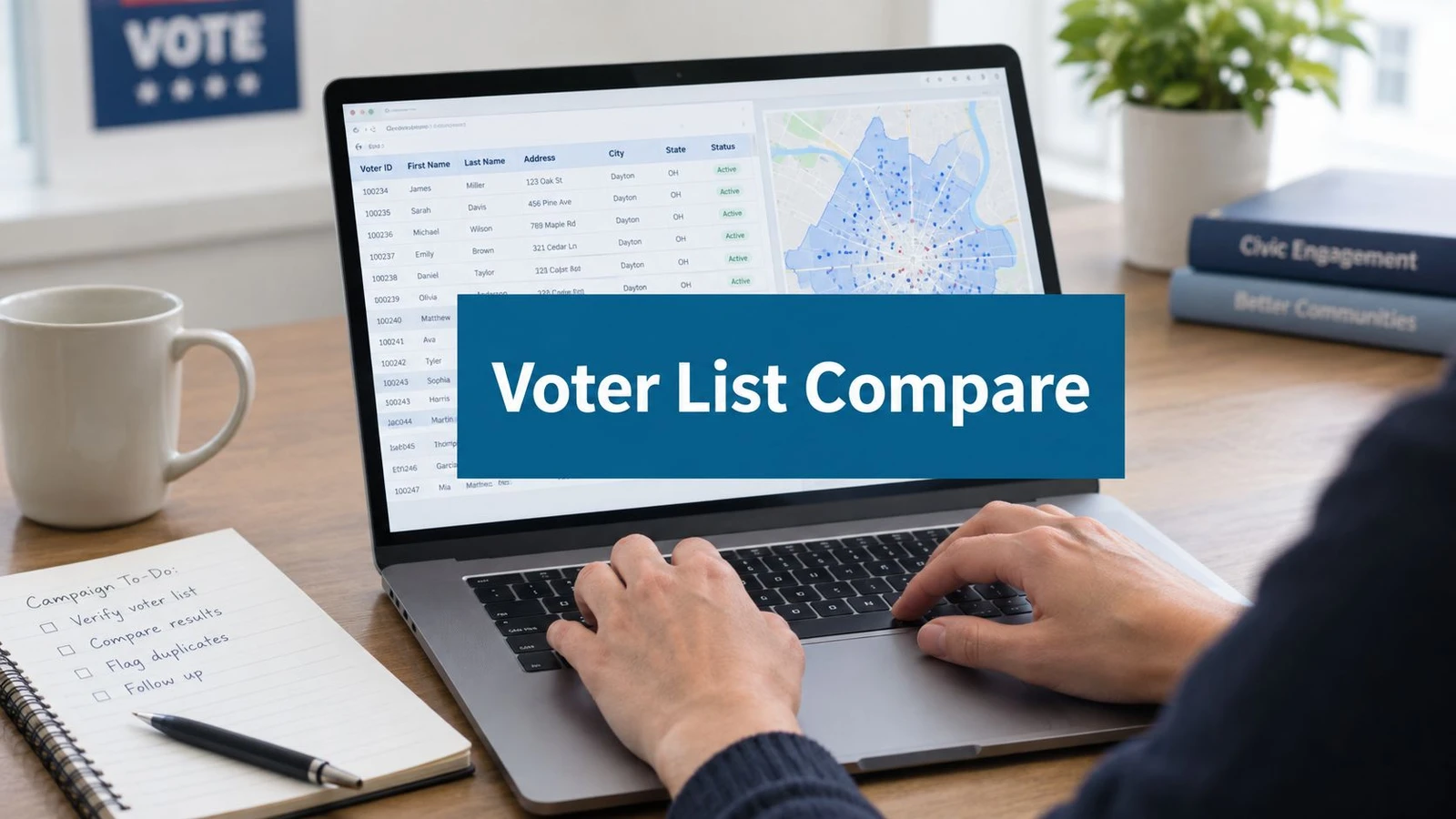
How to buy voter data for campaigns is the most critical technical decision your political operation will make in 2026. Voter data serves as the foundation for every campaign activity — from identifying persuadable voters to building targeted mailing lists that maximize your budget efficiency. This comprehensive guide walks you through the entire voter data acquisition process, from understanding what data exists to selecting vendors, navigating compliance requirements, and implementing the data in your campaign infrastructure.
What Is Voter Data and Why Campaigns Need It
Voter data refers to the comprehensive records maintained by state and local election offices on every registered voter in their jurisdiction. At minimum, voter files contain each registrant’s full name, residential address, mailing address, date of registration, party affiliation (in states with party registration), and complete voting history showing which elections they participated in.
Political campaigns need voter data because it eliminates guesswork from targeting. Instead of blanketing entire neighborhoods with mailers or door-knocking every household, campaigns use voter files to identify exactly which individuals are registered, which party they support, how frequently they vote, and what demographics they represent. A state senate campaign in suburban Pennsylvania, for example, might target registered Democrats over age 50 who voted in the last three midterm elections but skipped the 2024 presidential primary — a highly specific audience impossible to reach without voter file data.
The return on investment is substantial. According to 2026 campaign analytics data, targeted direct mail based on voter file segmentation generates response rates 340% higher than demographic-only targeting. Digital advertising campaigns using voter file matching see cost-per-acquisition improvements of 60-80% compared to broad geographic targeting. These efficiency gains explain why even small local campaigns now treat voter data acquisition as a non-negotiable budget item.
Understanding the Types of Voter Data Available
Voter data comes in two primary forms: base voter files and enhanced voter files. Understanding the distinction determines which vendor you’ll work with and what you’ll pay.
Base Voter File Data
Base voter files contain the information collected and maintained by election officials. This includes:
- Voter identification: Full legal name, voter registration number, date of registration
- Geographic data: Residential address, mailing address, precinct number, congressional district, state legislative districts, county commission district, city council district, school board district
- Political affiliation: Party registration (in states that collect this), party primary voting history
- Participation history: Complete record of elections voted in, method of voting (in-person, absentee, early vote), date of vote
- Demographic basics: Date of birth, gender (in states that collect this)
Base voter files provide everything campaigns need for fundamental targeting. You can identify all registered Republicans in a specific state house district who voted in 2022 and 2024, or all voters aged 65+ who live within a school district boundary. This data alone enables sophisticated segmentation for most campaign purposes.
Enhanced Voter File Data
Commercial voter data vendors enhance base voter files by appending consumer data, demographic modeling, and predictive analytics. Enhanced files add:
- Demographic enhancements: Household income estimates, education level, marital status, presence of children, homeownership status, length of residence
- Consumer behavior data: Magazine subscriptions, charitable donations, vehicle ownership, purchasing patterns
- Predictive scores: Likelihood to vote scores, partisan lean scores (for non-partisan states), issue priority predictions
- Contact information: Cell phone numbers, email addresses, social media handles
- Lifestyle clusters: Psychographic segmentation grouping voters into lifestyle categories
Enhanced data transforms tactical targeting into strategic micro-targeting. A campaign for a school board candidate can identify homeowners with children in specific age ranges who vote consistently in local elections — a precision level impossible with base voter files alone. The tradeoff is cost: enhanced data typically costs 3-10 times more than base voter files.
Where to Buy Voter Data: Your Options in 2026
Campaigns can acquire voter data through three primary channels, each with distinct advantages and limitations.
 Overhead flat-lay of table divided between simple manila folders on left and colorful commercial documents on right.
State and County Election Offices
Every state makes voter registration files available for purchase directly from election offices. This is the most cost-effective option but requires the most technical capability.
Advantages:
- Lowest cost: Most states charge $20-$500 for complete statewide voter files
- Official source: Data comes directly from the authoritative government database
- No middleman markup: You pay only administrative fees
- Complete coverage: Access to every registered voter in the jurisdiction
Disadvantages:
- Technical complexity: Files arrive as raw CSV or fixed-width text files requiring database skills to process
- No enhancements: Only base voter file data included
- Inconsistent formats: Each state uses different field names, date formats, and file structures
- Update frequency: Most states provide snapshots monthly or quarterly, not real-time data
- Limited support: Election offices provide data but no technical assistance
State voter files work best for campaigns with dedicated data staff or consultants who can process raw files. A congressional campaign with a data director can purchase state files, normalize the data structure, and build custom targeting models. A city council campaign without technical resources will struggle with this approach.
To purchase state voter files, contact your state or county election office directly. Most maintain websites with voter file request forms and fee schedules. Processing times range from immediate download to 2-3 weeks for physical media delivery.
National Voter Data Vendors
National vendors aggregate voter files from all 50 states, enhance them with commercial data, and provide sophisticated platforms for filtering and exporting targeted lists.
Major national vendors in 2026 include:
L2 Political: The largest commercial voter file vendor, L2 maintains files on 260+ million registered voters with monthly updates. Their platform includes advanced filtering, predictive modeling, and API access. Pricing starts at $0.08 per record with volume discounts. Annual subscriptions for unlimited access range from $5,000 for local campaigns to $50,000+ for statewide operations.
TargetSmart: Specializes in progressive campaigns with enhanced Democratic voter modeling. Offers voter files plus predictive scores for issue support, turnout likelihood, and persuasion priority. Pricing is project-based, typically $0.10-$0.15 per record for one-time purchases or $15,000-$75,000 for annual access.
Aristotle: Provides voter data plus compliance tools and campaign services. Known for Republican campaign relationships but serves all political affiliations. Pricing ranges from $0.06-$0.12 per record with minimum purchases of $500.
i360: The Koch network’s data platform, focused on conservative campaigns. Combines voter files with consumer data and door-to-door canvassing integration. Subscription-based pricing starting at $10,000 annually.
National vendors excel for multi-state campaigns, organizations needing frequent data updates, or campaigns requiring sophisticated predictive modeling. The premium pricing reflects enhanced data, user-friendly platforms, and ongoing support.
State-Specific Voter Data Platforms
State-specific platforms like MailVotes occupy the middle ground between raw state files and expensive national vendors. These platforms focus on specific states, offering enhanced voter files with accessible pricing and no long-term contracts.
MailVotes provides voter data for Florida, North Carolina, Pennsylvania, Ohio, Oklahoma, and Arkansas with advanced filtering by demographics, voting history, party affiliation, and geography. The platform allows campaigns to build targeted voter lists using an intuitive interface, export precisely filtered data, and pay only for the records they need.
Advantages of state-specific platforms:
- Accessible pricing: $0.03-$0.08 per record with no minimums
- Enhanced data: Demographic overlays and voting history analysis included
- User-friendly interfaces: Filter and export without technical expertise
- No contracts: Pay-as-you-go model for campaigns of any size
- State expertise: Deep knowledge of state-specific data nuances and compliance requirements
Limitations:
- Geographic coverage: Limited to specific states rather than nationwide access
- Feature depth: May lack advanced predictive modeling of premium national vendors
State-specific platforms serve the broadest range of campaigns effectively. A state representative race can purchase 5,000 targeted records for $150-$250, while a gubernatorial campaign can access millions of records with sophisticated filtering at costs 40-60% below national vendors.
How Much Does Voter Data Cost in 2026?
Voter data pricing varies dramatically based on source, data depth, and volume. Understanding the cost structure helps campaigns budget appropriately and evaluate vendor proposals.
State Voter File Costs
Direct state purchases cost $20-$500 for complete statewide voter files containing millions of records. Florida charges $5 for the entire statewide file on DVD. Pennsylvania charges $20. California charges $0.01 per record (approximately $200 for the full state file). These prices include only base voter file data with no enhancements.
The effective per-record cost from state files is negligible — often $0.0001 or less. However, the total cost of ownership includes data processing labor, database infrastructure, and technical expertise that can add thousands of dollars for campaigns without existing data capabilities.
Commercial Vendor Pricing Models
National vendors typically price voter data using one of three models:
Per-Record Pricing: Pay for each voter record you download or access. Rates range from $0.05 to $0.25 per record depending on data enhancements. A campaign purchasing 50,000 records at $0.10 each pays $5,000. This model works well for campaigns with defined target universes who won’t need ongoing data access.
Subscription Pricing: Pay an annual fee for unlimited access to voter files within defined geographic boundaries. A state senate campaign might pay $8,000 annually for unlimited access to all voters in their district. Statewide campaigns pay $25,000-$100,000 for full state access. Subscriptions make sense for campaigns needing frequent data refreshes or multiple target list iterations.
Project-Based Pricing: Vendor quotes a custom price based on campaign scope, data needs, and service requirements. Common for campaigns needing extensive modeling, custom appends, or consulting services alongside data access.
State-Specific Platform Pricing
Platforms like MailVotes use transparent per-record pricing with no minimums or contracts. Typical rates:
- Base voter file records: $0.03-$0.05 per record
- Enhanced records with demographics: $0.05-$0.08 per record
- Premium records with predictive scores: $0.08-$0.12 per record
A local campaign purchasing 10,000 enhanced records pays $500-$800. A county commission race targeting 35,000 voters pays $1,750-$2,800. This pricing model provides cost predictability and scales efficiently for campaigns of any size.
Hidden Costs to Consider
Beyond the base data cost, factor in:
- Setup fees: Some vendors charge $500-$2,000 for account setup and onboarding
- Minimum purchases: National vendors often require $1,000-$5,000 minimum orders
- Data refresh fees: Updated files may cost 50-100% of the original purchase price
- Export fees: Some platforms charge per export or limit export frequency
- Integration costs: API access or CRM integration may require additional fees
- Training and support: Premium support packages can add 20-30% to base costs
Always request all-in pricing that includes these potential add-ons to accurately compare vendor costs.
Evaluating Voter Data Vendors: What to Look For
Not all voter data is equal. Campaigns should evaluate vendors using six critical criteria before making a purchase decision.
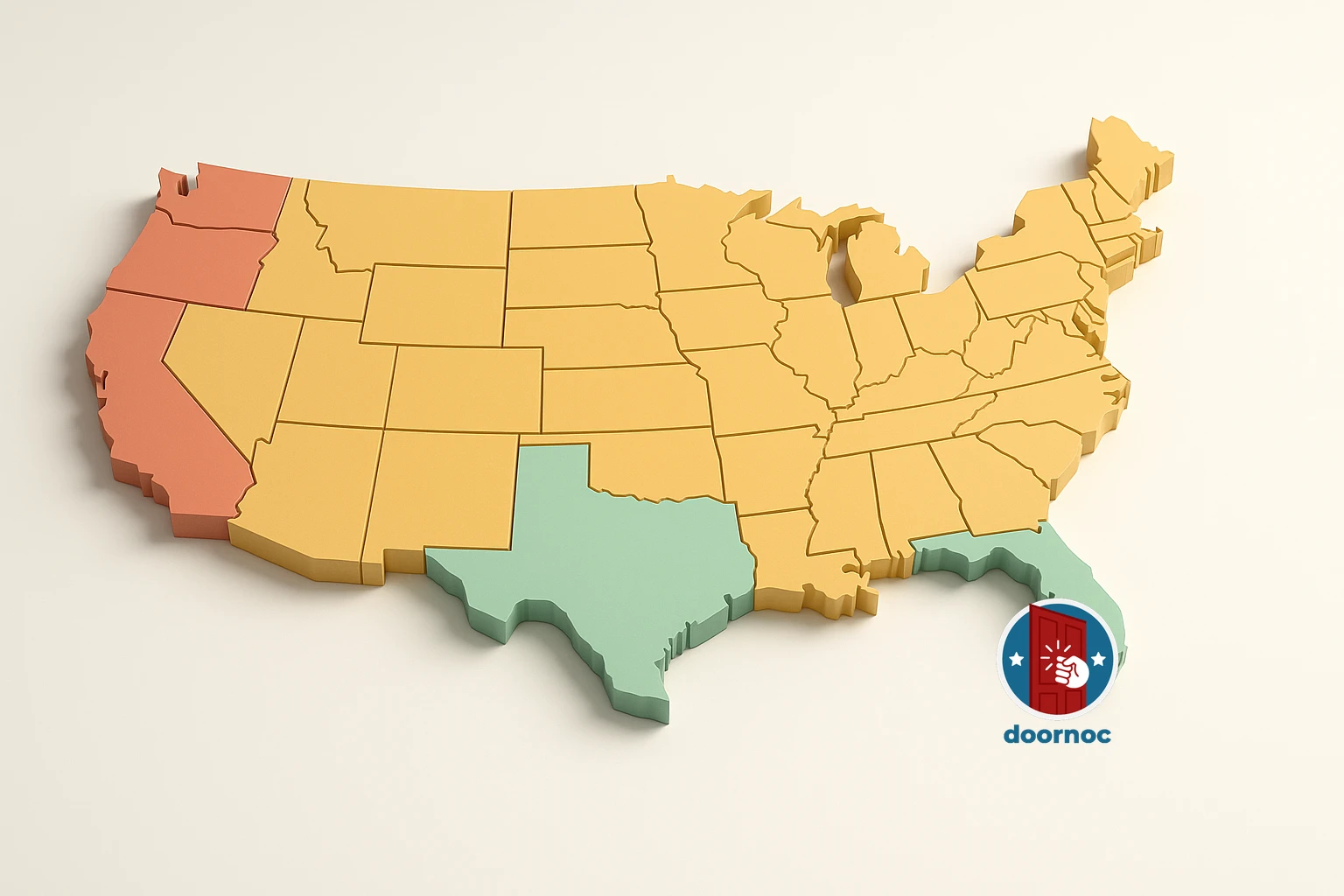 Isometric 3D map of US states color-coded by voter data access restrictions in pastel green, yellow, and red.
Data Freshness and Update Frequency
Voter files become stale quickly. In a typical state, 8-12% of voters change addresses annually, 2-3% die, and new registrations add another 3-5% to the file. Vendors updating monthly provide significantly more accurate data than those updating quarterly.
Ask vendors: When was this data last updated? How frequently do you refresh files? What is your process for incorporating new registrations and address changes? Premium vendors update every 30 days; acceptable vendors update every 60-90 days. Avoid vendors who can’t specify their last update date.
During active registration periods (the 60 days before registration deadlines), data freshness becomes critical. A voter registration drive targeting unregistered adults needs data updated within the last two weeks to avoid wasting resources on individuals who registered through other channels.
Geographic Coverage and Completeness
Verify that vendors provide complete coverage of your target geography. Some vendors exclude certain counties, omit municipal districts, or have gaps in precinct-level data.
For multi-jurisdictional campaigns, confirm the vendor maintains consistent data fields across all geographies. A state senate district spanning three counties needs uniform data structure across all three to enable effective targeting.
Ask for sample files before purchasing. Review the data dictionary to confirm all necessary fields are present and populated. Check for null values or missing data in critical fields like voting history or geographic identifiers.
Filtering and Segmentation Capabilities
The most sophisticated voter data is worthless if you can’t filter it effectively. Evaluate vendor platforms on:
- Field availability: Can you filter on all the criteria your campaign needs?
- Combination logic: Can you build complex queries using AND/OR logic?
- Saved searches: Can you save and reuse filter combinations?
- Export flexibility: Can you export exactly the fields you need in your preferred format?
- Preview functionality: Can you see result counts before purchasing?
Platforms like MailVotes allow campaigns to filter voter data by dozens of criteria simultaneously — age range, party affiliation, voting frequency, specific election participation, geography down to precinct level, and demographic characteristics — then preview exactly how many records match before purchasing.
Pricing Transparency and Flexibility
Beware vendors who won’t provide clear pricing without a sales call. The best vendors publish transparent pricing and allow campaigns to calculate costs before contacting sales.
Evaluate pricing flexibility:
- Can you purchase exactly the number of records you need?
- Are there volume discounts for larger purchases?
- Can you buy data incrementally as your campaign scales?
- Are there penalties for early contract termination?
- Can you upgrade or downgrade service levels mid-campaign?
Rigid pricing structures force campaigns into poor-fit solutions. Flexible pricing lets you match data purchases to actual campaign needs.
Compliance Support and Legal Guidance
Voter data usage is subject to state and federal regulations that vary significantly by jurisdiction. Quality vendors provide compliance support including:
- Clear terms of service explaining permitted uses
- State-specific usage guidelines
- Required disclaimers and attributions
- Data security requirements
- Restrictions on resale or redistribution
- TCPA compliance for phone and text banking
Vendors serving multiple states should provide jurisdiction-specific compliance documentation. A vendor selling data for use in both Florida (minimal restrictions) and California (strict limitations) must clearly explain the different requirements.
Avoid vendors who dismiss compliance questions or provide vague answers. Improper voter data usage can result in fines, legal liability, and campaign damage.
Integration with Campaign Tools
Voter data must integrate with your existing campaign infrastructure to be useful. Confirm vendors provide data in formats compatible with your tools:
- CRM systems: Can you import directly into NGP VAN, Campaign Deputy, or other campaign CRMs?
- Email platforms: Do exports include email addresses formatted for MailChimp, Constant Contact, or other email tools?
- Phone banking: Can you export phone lists in formats compatible with your phone banking platform?
- Direct mail: Do exports include CASS-certified addresses for postal discounts?
- Digital advertising: Can you create matched audiences for Facebook, Google, or programmatic platforms?
Some vendors offer native integrations or APIs for seamless data flow. Others provide CSV exports requiring manual import. Understand the integration workflow before purchasing to avoid technical bottlenecks.
Step-by-Step: How to Purchase Voter Data
Follow this systematic process to acquire voter data efficiently and avoid common pitfalls.
Step 1: Define Your Target Universe
Before contacting vendors, clearly define who you need to reach. Create a written target voter profile including:
- Geographic boundaries: Specific districts, counties, cities, or precincts
- Demographic criteria: Age ranges, gender, party affiliation
- Behavioral criteria: Voting frequency, specific election participation, registration date
- Size requirements: How many voters do you need to reach?
A school board campaign might target: “Registered voters in School District 5 boundaries, age 30-65, who voted in at least 2 of the last 4 local elections.” This specificity helps vendors provide accurate quotes and ensures you purchase only relevant data.
Step 2: Research Vendor Options
Identify 3-5 potential vendors based on your needs:
- Local campaigns (city council, school board, state representative): Start with state-specific platforms like MailVotes or direct state file purchase
- Statewide campaigns (governor, US Senate, statewide ballot measures): Consider national vendors with annual subscriptions
- Multi-state campaigns: National vendors or multiple state-specific platform accounts
- Special targeting needs (specific demographics, predictive modeling): Enhanced data vendors
Request information from each vendor including pricing, data freshness, available fields, and sample data dictionaries.
Step 3: Request Sample Data
Never purchase voter data without reviewing samples. Request sample files containing 100-500 records from your target geography. Evaluate:
- Data completeness: What percentage of records have complete information in critical fields?
- Data accuracy: Spot-check addresses, ages, and voting history against known voters
- Data structure: Are fields clearly labeled and consistently formatted?
- Usability: Can you easily import the sample into your tools?
Sample data reveals quality issues before you commit to a purchase. If a vendor won’t provide samples, eliminate them from consideration.
Step 4: Compare Total Costs
Create a spreadsheet comparing all-in costs across vendors. Include:
- Base per-record cost × number of records needed
- Setup fees
- Minimum purchase requirements
- Data refresh costs (if you’ll need updates)
- Export or access fees
- Support and training costs
Calculate the total cost for your specific use case, not just the advertised per-record price. A vendor charging $0.08 per record with no minimums may cost less than a vendor charging $0.05 per record with a $2,000 minimum purchase.
Step 5: Verify Compliance Requirements
Before purchasing, confirm you understand and can meet all compliance requirements:
- Review the vendor’s terms of service completely
- Verify your intended use is permitted under state law
- Confirm you have necessary data security measures in place
- Understand restrictions on data sharing, retention, and disposal
- Document your compliance procedures for campaign records
If you’re uncertain about compliance, consult with campaign legal counsel before purchasing. Non-compliance can expose your campaign to legal liability.
Step 6: Make Your Purchase
Once you’ve selected a vendor, complete the purchase process:
- Execute any required contracts or terms of service
- Provide payment (most vendors accept credit cards; some require wire transfer or check for large purchases)
- Specify your exact filtering criteria and desired output format
- Confirm delivery timeline (immediate download vs. 24-48 hour processing)
Retain all purchase documentation including invoices, contracts, and data dictionaries for campaign finance reporting and compliance records.
Step 7: Process and Validate Data
When you receive voter data:
- Validate completeness: Confirm record count matches your purchase
- Test imports: Import a subset into your CRM or tools to verify compatibility
- Spot-check accuracy: Manually verify a random sample of records
- Document data source: Note purchase date, vendor, and version for tracking
- Implement security: Store data securely per compliance requirements
Address any issues immediately with the vendor. Most provide a 7-14 day window for reporting data quality problems.
Voter Data Compliance: Legal Requirements by State
Voter file usage is governed by a complex patchwork of state laws, federal regulations, and vendor terms of service. Understanding compliance requirements protects your campaign from legal liability and ensures ethical data usage.
Federal Regulations
Two federal laws govern voter data usage:
National Voter Registration Act (NVRA): Requires states to maintain accurate voter registration lists and make them available for political purposes. Does not restrict how campaigns use voter data once obtained.
Telephone Consumer Protection Act (TCPA): Restricts automated calls and texts to cell phones without prior express consent. Applies when campaigns use voter file phone numbers for robocalls or mass texting. Violations carry penalties of $500-$1,500 per call/text.
Campaigns using voter data for phone or text banking must either obtain consent or use manual dialing (not automated systems) to comply with TCPA.
State-Specific Restrictions
States impose varying restrictions on voter file usage:
Permissive states (Florida, Texas, Ohio, Pennsylvania, North Carolina): Allow broad use of voter files for political, journalistic, or academic purposes with minimal restrictions. Commercial use may be permitted. Resale typically allowed with attribution.
Moderate restriction states (Georgia, Arizona, Michigan, Wisconsin): Permit political use but restrict commercial use. May require specific disclaimers or prohibit certain types of data appending. Resale often restricted.
Strict restriction states (California, New York, Illinois): Limit voter file use to specific political purposes. Prohibit commercial use, require detailed usage reporting, impose strict data security requirements. Resale generally prohibited.
Always verify state-specific requirements before using voter data. MailVotes provides state-specific compliance guidance for each jurisdiction it serves, ensuring campaigns understand their obligations.
Data Security Requirements
Most states require campaigns to implement reasonable data security measures when handling voter files:
- Store data on password-protected systems
- Limit access to authorized campaign staff only
- Use encryption for data transmission
- Implement secure data disposal when no longer needed
- Maintain audit trails of data access
Document your data security procedures and train all campaign staff with voter file access on proper handling protocols.
Permitted Uses
Voter files are generally permitted for:
- Political campaign communications (mail, phone, door-to-door)
- Voter registration drives
- Get-out-the-vote operations
- Political research and analysis
- Journalistic purposes
- Academic research
Prohibited uses typically include:
- Commercial solicitation unrelated to politics
- Harassment or intimidation
- Identity theft or fraud
- Resale for non-political purposes
When in doubt about whether a specific use is permitted, consult the state election office or legal counsel.
Advanced Strategies: Maximizing Voter Data Value
Once you’ve acquired voter data, sophisticated campaigns employ advanced strategies to extract maximum value.
 Close view of computer screen showing data filtering interface with visual funnel narrowing dots from large cluster to small targeted group.
Layering Multiple Data Sources
The most effective targeting combines voter file data with additional data sources:
Consumer data overlays: Append household income, education, occupation, and lifestyle data to identify voters matching your campaign’s issue priorities. A campaign focused on education funding can identify voters with school-age children and above-median income who vote consistently in local elections.
Canvassing data integration: Merge door-to-door canvassing results with voter file records to track persuasion progress and identify supporters for GOTV. Update voter file records with issue positions, yard sign placements, and volunteer recruitment status.
Digital engagement data: Match voter file records to email open rates, website visits, and social media engagement to identify highly engaged voters for volunteer recruitment or high-value persuasion targets.
Donor data matching: Cross-reference voter files with donor databases to identify politically active voters who haven’t yet contributed to your campaign.
Layering multiple data sources creates a comprehensive voter profile that enables precision targeting impossible with voter files alone.
Predictive Modeling and Scoring
Advanced campaigns use voter file data to build predictive models:
Turnout modeling: Predict which voters are most likely to vote in your specific election based on past turnout patterns, demographics, and current engagement. Focus expensive persuasion efforts on high-turnout-probability voters.
Persuasion scoring: Identify voters most likely to be persuaded by your campaign’s message based on past ticket-splitting behavior, demographic profiles, and issue priorities.
Support scoring: Model which voters are likely to support your candidate based on party performance in their precinct, demographic similarities to known supporters, and voting patterns.
Some vendors provide pre-built scores; campaigns with data expertise can build custom models using voter file data as the foundation.
Dynamic List Updating
Voter files are snapshots in time. Sophisticated campaigns implement processes for continuous data updating:
- Purchase monthly data refreshes during active campaign periods
- Update voter file records with canvassing results daily
- Flag voters who have moved based on returned mail
- Add newly registered voters to target universes weekly
- Remove deceased voters identified through obituaries or other sources
Dynamic updating ensures your targeting remains accurate throughout the campaign cycle. A campaign that purchases voter data in January and never updates it will be targeting thousands of voters who have moved, died, or changed party affiliation by November.
Micro-Targeting for Efficiency
Rather than treating all voters equally, use voter file data to create highly specific micro-targeted audiences:
Geographic micro-targeting: Identify specific precincts or neighborhoods with favorable demographics and voting patterns. A campaign might focus exclusively on the 15% of precincts that show ticket-splitting behavior and high turnout.
Behavioral micro-targeting: Target voters based on specific behavioral patterns. “Voters who voted in 2022 and 2024 but skipped 2023” identifies engaged voters who may need extra GOTV attention in off-year elections.
Demographic micro-targeting: Combine multiple demographic criteria to reach niche audiences. “Homeowners age 55-70 with household income above $75,000 who voted in the last school board election” identifies a specific audience for education-focused messaging.
Micro-targeting reduces waste by focusing resources on voters most likely to respond to specific messages or most critical to your electoral coalition.
Common Mistakes When Buying Voter Data
Avoid these frequent errors that waste campaign resources and reduce data effectiveness:
Purchasing too early: Voter files become stale. Buying data six months before you’ll use it means your data will be significantly outdated by campaign time. Purchase data as close to usage as possible, and plan for refresh purchases.
Ignoring data freshness: Accepting data that’s 90+ days old significantly reduces accuracy. Always ask when data was last updated and prioritize vendors with recent refresh dates.
Buying more data than you need: A city council campaign doesn’t need a statewide voter file. Purchase only the records you’ll actually use. Platforms like MailVotes allow precise geographic and demographic filtering so you pay only for relevant records.
Skipping sample data review: Never purchase voter data without reviewing samples first. Sample data reveals quality issues, format problems, and completeness gaps before you commit to a purchase.
Overlooking compliance requirements: Failing to understand state-specific usage restrictions can expose your campaign to legal liability. Always verify compliance requirements before purchasing and using voter data.
Choosing vendors on price alone: The cheapest data is often the worst data. Evaluate total value including data quality, freshness, filtering capabilities, and support — not just per-record cost.
Neglecting data security: Voter files contain sensitive personal information. Implement proper data security measures to protect voter privacy and comply with state requirements.
Failing to integrate with existing tools: Data that can’t integrate with your CRM, email platform, or phone banking system creates manual work and reduces effectiveness. Verify integration compatibility before purchasing.
Making Your Decision: Which Vendor Is Right for Your Campaign?
Your ideal voter data vendor depends on campaign type, budget, technical capabilities, and geographic scope.
 Laptop screen showing before-and-after data visualization: chaotic gray scatter of millions of dots transforming into organized blue cluster of thousands.
For local campaigns (city council, school board, county commission, state representative): State-specific platforms like MailVotes offer the best combination of price, usability, and data quality. Pay-as-you-go pricing with no minimums makes these platforms accessible for campaigns of any size. The ability to browse pre-filtered mailing lists or build custom voter lists with intuitive interfaces eliminates the technical barriers of raw state files without the premium pricing of national vendors.
For statewide campaigns (governor, US Senate, statewide initiatives): National vendors with annual subscriptions provide the best value when you need ongoing access to millions of records. The upfront cost is justified by unlimited access, frequent updates, and advanced modeling capabilities. Consider L2 or TargetSmart for comprehensive statewide data needs.
For multi-state campaigns: National vendors are typically the only practical option for campaigns operating across multiple states. The standardized data structure and unified platform justify the premium pricing.
For campaigns with technical expertise: Direct state file purchases offer maximum cost savings if you have data staff capable of processing raw files. Combine state files with commercial data appends for specific enhancement needs.
For campaigns with limited budgets: State-specific platforms with no minimums allow you to purchase exactly the data you need without unnecessary spending. A campaign with a $500 voter contact budget can purchase 5,000-10,000 precisely targeted records rather than being forced into minimum purchases of 50,000+ records.
The right vendor makes voter data accessible, affordable, and actionable for your specific campaign needs. Take time to evaluate options carefully — your voter data purchase influences every downstream campaign activity from messaging to budgeting to volunteer deployment.
Conclusion: Building Your Voter Data Strategy for 2026
How to buy voter data for campaigns in 2026 requires understanding the vendor landscape, evaluating data quality, navigating compliance requirements, and selecting the right platform for your specific needs. The voter data market has matured significantly, with options ranging from raw state files at minimal cost to sophisticated enhanced databases with predictive modeling.
Successful campaigns treat voter data acquisition as a strategic decision, not a procurement task. The data you purchase determines who you can reach, how efficiently you can target, and ultimately how effectively you can deploy limited campaign resources. A state house campaign that invests $800 in precisely targeted voter data from a platform like MailVotes will outperform a campaign that spends $300 on outdated, poorly filtered data every time.
As you plan your 2026 campaign, prioritize voter data quality over cost savings. The difference between 85% accurate data and 95% accurate data is the difference between wasting 15% of your mail budget versus 5% — a cost differential that quickly exceeds any initial savings from choosing cheaper data. Focus on vendors who provide fresh data (updated within 30 days), transparent pricing, sophisticated filtering capabilities, and strong compliance support.
The campaigns that win in 2026 will be those that leverage voter data not just for basic targeting, but for strategic decision-making across all campaign functions. Your voter data purchase is the foundation of that success. Choose wisely, filter precisely, and deploy strategically to maximize every dollar and every voter contact your campaign makes.
Frequently Asked Questions
How much does voter data cost for political campaigns in 2026?
Voter data costs range from $0.01 to $0.25 per voter record in 2026. State voter files purchased directly cost $20-$500 for entire states, while enhanced data from commercial vendors like L2 or TargetSmart typically costs $0.05-$0.15 per record with additional fees for demographic overlays. Platforms like MailVotes offer targeted lists starting at $0.03 per record with no minimum purchase requirements.
What’s the difference between buying voter data from the state versus a commercial vendor?
State voter files provide basic registration data (name, address, party, voting history) at minimal cost but require technical expertise to process and lack demographic enhancements. Commercial vendors add consumer data, predictive modeling, and user-friendly interfaces but charge premium prices. State files work for large-scale operations with data teams, while vendors serve campaigns needing turnkey targeting solutions.
Is buying voter data legal for political campaigns?
Yes, purchasing voter data is legal for political campaigns in all 50 states, as voter registration records are public information. However, usage restrictions vary — some states limit commercial use or resale, require specific disclaimers, or mandate data security measures. Campaigns must comply with state-specific regulations and federal laws like TCPA when using voter data for communications.
Which voter data vendor is best for small local campaigns in 2026?
Small local campaigns benefit most from state-specific platforms like MailVotes that offer low minimums, pay-as-you-go pricing, and pre-filtered lists for targeted geographies. These platforms provide enterprise-grade data at accessible price points without requiring annual contracts or bulk purchases that national vendors typically demand.
How often is voter data updated by vendors?
Top-tier voter data vendors update their databases every 30-45 days in 2026, incorporating new registrations, address changes, and voting history from state election offices. Premium vendors offer weekly updates during election cycles. State files are updated continuously but typically available for purchase monthly or quarterly, creating a freshness gap that commercial vendors bridge with more frequent refresh cycles.