
A text from someone a voter knew increased the probability of voting by 8.3 percentage points in a randomized midterm experiment, compared with the 0.29-percentage-point lift associated with mass texting by field organizers in the published account of the relational organizing study. That’s a reason to take personal networks seriously, not permission to treat every friend-to-friend program as effective.
Campaign managers need more than a turnout headline. They need a system that turns relationships into completed conversations, assigns follow-up, distinguishes activity from impact, and protects the people whose personal information enters campaign records.
What Relational Organizing Is and Why It Works
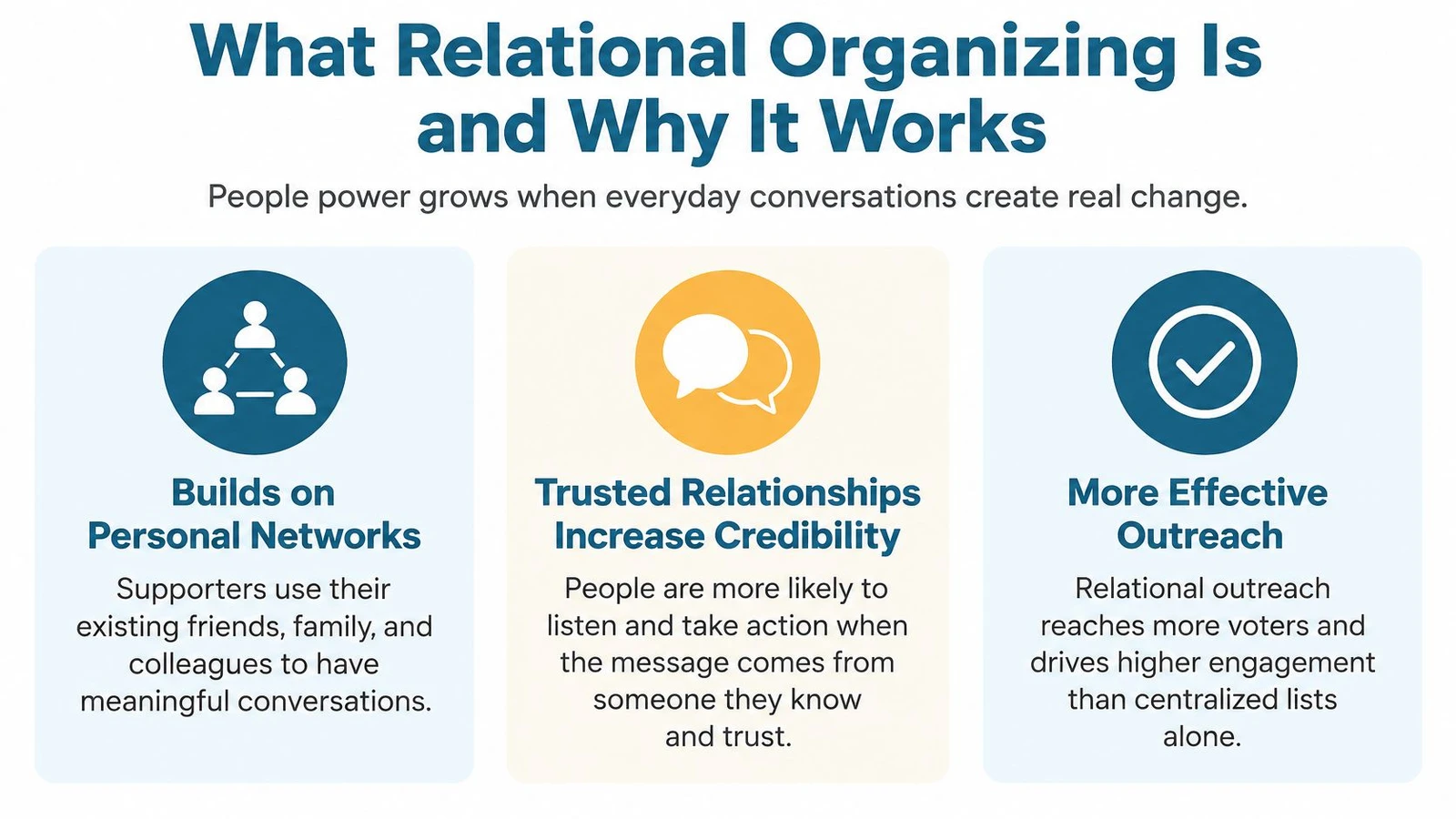
Relational organizing asks supporters to mobilize people they already know rather than relying exclusively on contacts drawn from centralized voter lists. The campaign supplies accurate information, training, and a clear assignment. The supporter supplies an existing relationship.
The opening experiment demonstrates what this approach can achieve under a particular design. But a preregistered trial before the 2022 midterms, conducted in Arizona, Florida, Michigan, and North Carolina, found negligible turnout differences among recruited mobilizers and their pledged friends. Asking participants to remind up to five friends wasn’t enough to produce a meaningful effect.
The relationship is an input, not a result
Those findings aren’t contradictory instructions. They show why campaign managers shouldn’t collapse distinct interventions into a single category called “friends texting friends.”
A campaign should distinguish between recruiting someone who accepts responsibility for outreach and collecting a promise that someone might send a reminder. It should also distinguish a personal conversation from campaign copy forwarded through a familiar account.
The operational question isn’t whether relationships matter in the abstract. It’s whether the program helps supporters use those relationships appropriately and complete a useful action.
- Relationship strength: A familiar name doesn’t necessarily indicate an active, trusted connection.
- Message quality: Volunteers need room to explain the ask naturally rather than reproduce campaign language.
- Participation: A recruitment commitment has little operational value until outreach happens.
- Baseline turnout: Contacting habitual voters can produce impressive-looking results without demonstrating additional participation.
Practical rule: Treat relational organizing as an accountable outreach program, not a shortcut around field management.
The working definition should therefore include responsibility: supporters contact people they know, record a limited outcome, and own any agreed follow-up. Without those elements, the campaign has identified a network but hasn’t necessarily organized it.
How Trusted Messengers Change Voter Behavior
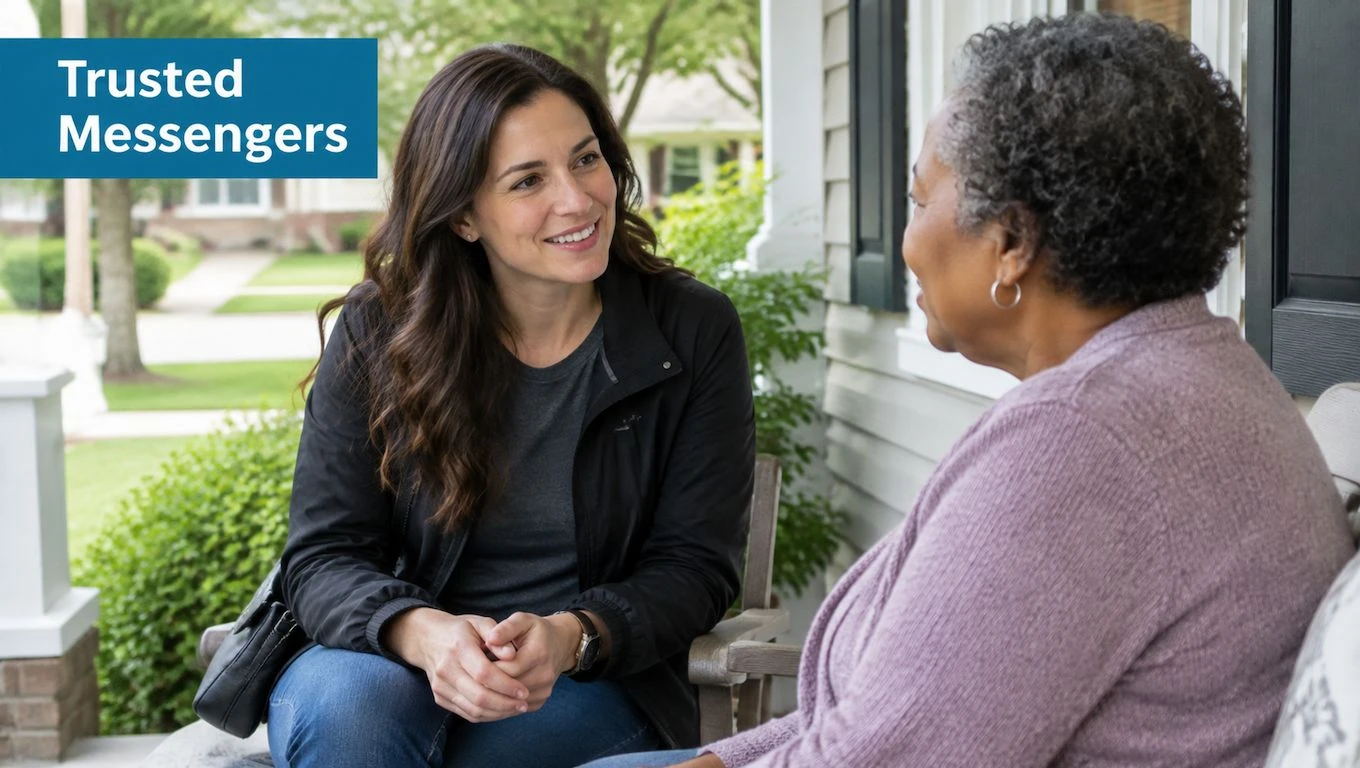
A neighbor can begin a conversation with shared context that an unfamiliar canvasser doesn’t have. That familiarity may make the request credible, but credibility alone doesn’t resolve uncertainty about when, where, or how someone plans to vote.
The proposed mechanism is a sequence: a recognizable person starts a relevant conversation, the recipient identifies an obstacle or intention, and the mobilizer helps establish an appropriate next step. Campaigns should design assignments around that sequence rather than around message volume.
Match the ask to the relationship
Consider a hypothetical volunteer contacting a cousin, a neighbor, and a former coworker. These aren’t interchangeable contacts.
| Relationship | Suitable opening | Useful next step |
|---|---|---|
| Cousin with an active family conversation | Refer to an issue already discussed | Ask whether a voting plan is settled |
| Neighbor encountered regularly | Ask whether election information would be welcome | Offer verified information about voting options |
| Former coworker with infrequent contact | Reestablish contact and ask permission to discuss the election | Continue only if the recipient welcomes the conversation |
The neighbor might need practical information, while the cousin might already have it and want to discuss the candidate. The former coworker might prefer no political conversation at all. A campaign shouldn’t convert familiarity into presumed permission.
Follow-up should remain with the original mobilizer unless the recipient explicitly welcomes contact from someone else. Moving a personal conversation into an unfamiliar campaign queue can remove the reason the recipient engaged.
The record should capture the relationship category, responsible mobilizer, contact outcome, and next agreed action. It shouldn’t become a transcript of private family discussions.
Relational contact also needs its own reporting category. A conversation with a known neighbor and an ordinary door knock might happen on the same porch, but campaign managers need to distinguish them when evaluating the program.
Comparing the Main Relational Organizing Models
The captain model offers the clearest assignment: a mobilizer takes responsibility for a defined group of personal contacts. In the randomized Turnout Nation evaluation, the treatment group voted at a rate 13.2 percentage points higher than the control group. That result supports the evaluated design, not every program that adopts the captain label.
The pledge model asks supporters to identify people they’ll contact and uses reminders to prompt action. It requires less individualized supervision by design, but the flat experiment discussed earlier cautions against treating a pledge as completed organizing.
Relational Organizing Models Compared
| Model | Evidence Strength | Staff Time Required | Contacts per Volunteer | Best Fit |
|---|---|---|---|---|
| Captain | Strong causal evidence for the evaluated program | Higher coaching and follow-up commitment | A bounded group the captain can personally maintain | Local races or larger campaigns with dedicated volunteer leadership |
| Pledge | Cautionary evidence from the reminder-based trial | Lighter onboarding, with verification still necessary | Only contacts the supporter genuinely intends to reach | A limited pilot or supplementary assignment |
| Distributed network | Requires program-specific evaluation | Broad recruitment plus training and data coordination | Volunteer-defined capacity, not an imposed quota | Campaigns with dispersed supporters and supervisory capacity |
Capacity should be demonstrated, not guessed. A volunteer who can sustain several substantive conversations may be more useful than one who submits a long contact list and never follows up.
A school board campaign might use captains with direct coordinator support. A congressional campaign could recruit through a distributed network, then give reliable participants captain-style ownership. The guide to distributed organizing for political campaigns provides a related planning resource for that organizational choice.
For geographically separated captains, a coordinator could use AONMeetings to host a browser-based roundtable focused on unresolved conversations and training needs. The meeting should solve operational problems, not become another attendance requirement.
Combining models makes sense when each serves a defined function. Distributed recruitment can find participants; captain assignments can establish accountability. Neither should excuse a program from checking whether volunteers complete the work.
Recruiting Volunteers and Building Peer Networks
Recruiting only the most politically enthusiastic supporters risks confusing campaign engagement with organizing capacity. A better screening conversation asks whom the supporter can realistically reach, whether those relationships are current, and whether the supporter feels comfortable making a political ask.
Reachable relationships matter more than an impressive contact count. A volunteer should be able to describe the normal communication channel and an appropriate reason to initiate contact.
Turn a network map into assignments
Ask recruits to map relationships by category and channel without immediately uploading an entire address book. Family members, neighbors, former colleagues, and community acquaintances may require different boundaries.
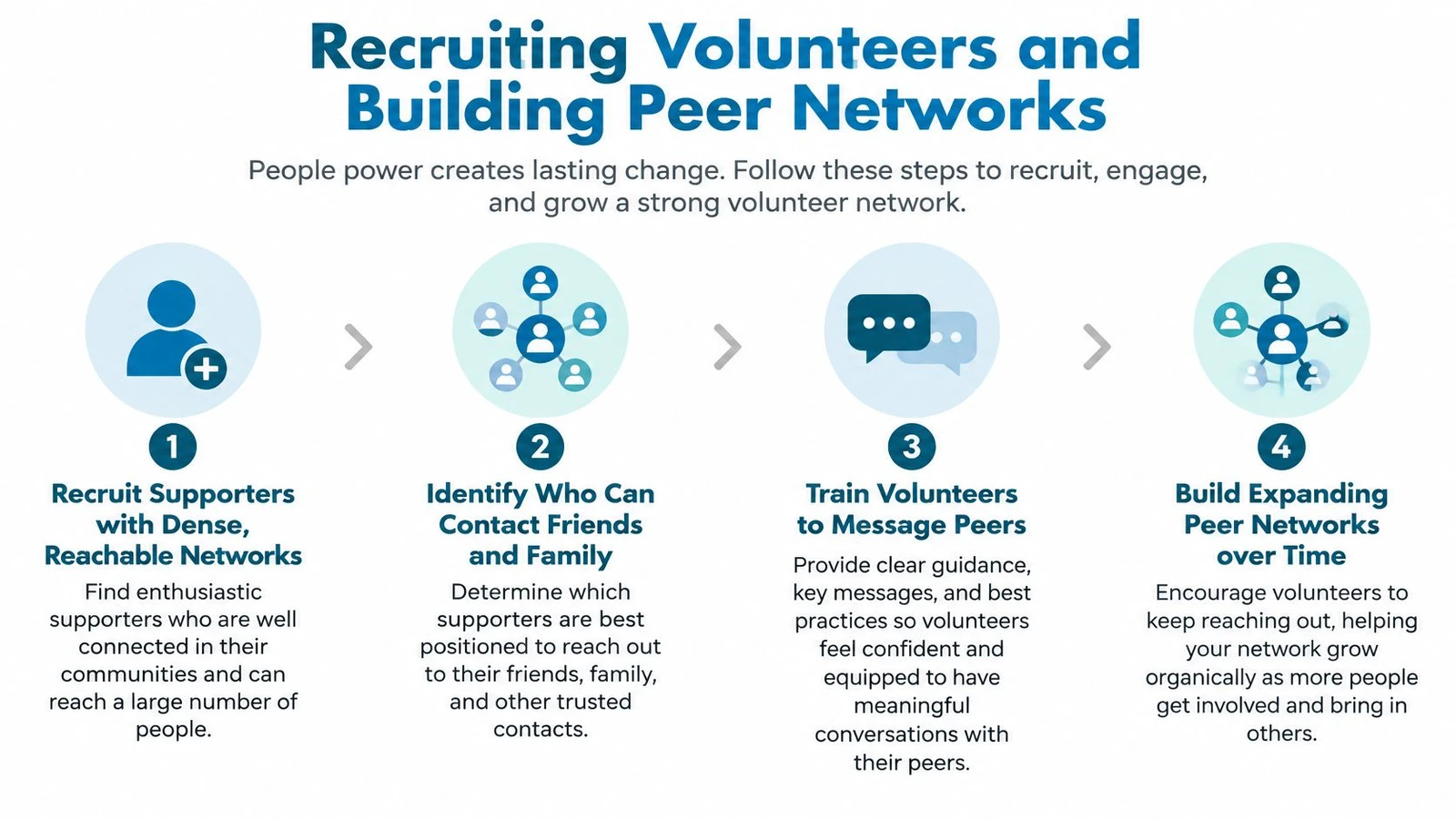
Onboarding should move from explanation to practice. The coordinator demonstrates a conversation, the volunteer rehearses an awkward response, and both agree on a manageable assignment.
- Opening: Name the existing connection and ask whether the conversation is welcome.
- Reason: Give the volunteer accurate campaign information while leaving the personal explanation to them.
- Voting-plan question: Ask what remains undecided about participating, without assuming support.
- Follow-up agreement: Establish whether another message would help and when it would be appropriate.
A relative who disagrees politically doesn’t need an escalating argument. A coworker who declines political discussion at work shouldn’t receive the same pitch through another channel. A friend who never responds shouldn’t become a repeated-contact target.
A volunteer needs permission to end a conversation respectfully, not just training on how to continue it.
Before outreach begins, each mobilizer needs verified election information, an escalation contact, recording instructions, and a clear stop-contact rule. The volunteer canvassing team guide can support the broader training and supervision process.
For coordinators considering ongoing participation, Founder Connects’ resource on ways to grow active founder communities offers a cross-sector prompt for thinking about engagement. Campaign-specific consent and measurement standards still need their own design.
Tracking Metrics That Prove Relational Impact
A contact total answers an activity question. It doesn’t establish whether the campaign changed participation.
High turnout among personally known voters may reflect whom volunteers selected. A program that recruits politically active supporters and reaches their already-engaged friends needs a credible comparison before claiming additional votes.
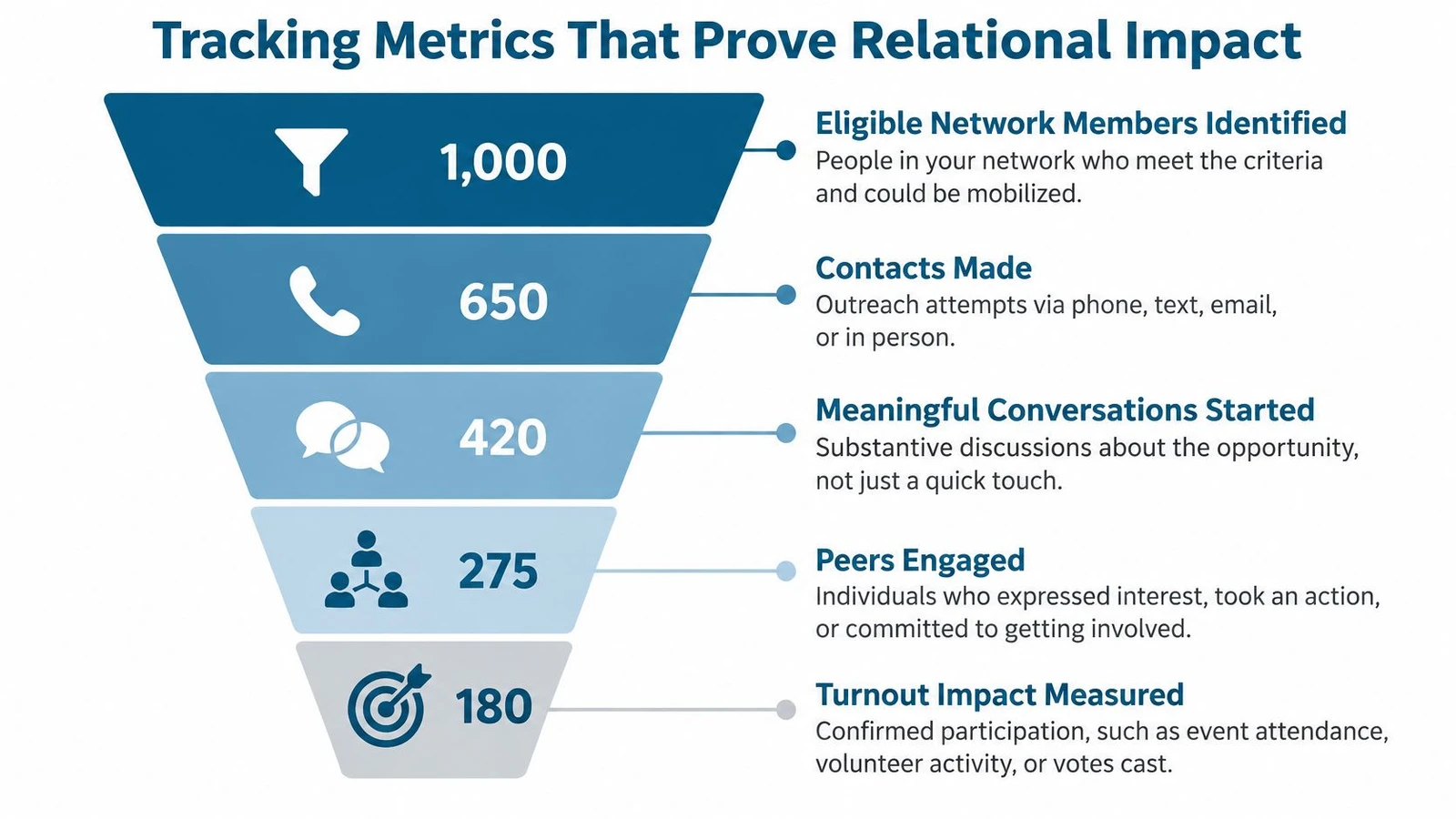
Record the full funnel
Each stage needs a definition that volunteers and analysts interpret consistently.
- Eligible network members identified: Contacts meet the program’s geographic and other eligibility rules.
- Contacts attempted: A mobilizer initiates outreach.
- Conversations completed: The recipient responds substantively, rather than merely receiving a message.
- Voting-plan commitments: The recipient identifies an intended action, recorded without implying verified participation.
- Reminders delivered: An agreed follow-up occurs.
- Verified turnout: Participation is checked through an appropriate authorized source when available.
Where legally and ethically appropriate, analysts should establish a randomized comparison group before outreach begins. They should document assignment rules and analyze participants as assigned, rather than retaining only the volunteers who completed their tasks.
A quasi-randomized comparison may be practical when random assignment isn’t feasible, but the report should explain its limitations. Analysts also need to document overlapping outreach, since a comparison voter may still receive ordinary campaign contact.
Diagnose the failure before increasing volume
Report completion by mobilizer, relationship category, and intervention type. If names accumulate but attempts don’t, the problem is execution; if attempts occur without conversations, the coordinator should inspect channels, relationship quality, and the ask.
The campaign analytics dashboard guide provides a related resource for structuring operational reporting. The CodeWords guide to nonprofit automation can inform administrative workflow planning, but automated reminders shouldn’t be counted as completed personal conversations.
Track staff time and volunteer support alongside contact costs. Compare relational results separately from phone, text, and door-to-door activity, and avoid labeling cost per additional vote unless the evaluation supports an incremental turnout estimate.
Choosing Tools to Scale Relational Programs
Software should fit the campaign’s assignment and reporting workflow. Before choosing a system, specify who owns each contact, what staff need to record, how follow-up is assigned, and who can access records. A tool that captures activity but loses relationship ownership can make a busy program look successful without showing whether its intended outreach happened.
Spreadsheets and shared documents may work for a closely supervised pilot. Coordinators still need to control permissions, resolve duplicates, and keep assignments current without sharing unnecessary personal information. As volume grows, the time required to maintain those controls becomes part of the tool’s cost.
Compare workflows rather than labels
| Approach | Useful role | Main question before adoption |
|---|---|---|
| Spreadsheets and shared documents | Simple assignments and early workflow testing | Can the team maintain ownership, permissions, and version control? |
| Generic canvassing applications | Geographic assignments and interaction capture | Can personal relationships remain distinct from ordinary walk-list contacts? |
| Purpose-built relational platforms | Relationship ownership and follow-up workflows | Can the campaign verify exports, consent handling, and evaluation support? |
Use a live workflow demonstration, not a polished feature tour. Test duplicate contacts, reassignment, opt-outs, incomplete follow-up, and export behavior. Ask whether a relationship assignment stays separate from a door-knocking assignment, and whether reassignment preserves the original mobilizer’s role in follow-up.
The publisher’s platform combines a mobile canvassing application with route planning and voter-data services. Campaigns can assess whether geographic and relational assignments remain distinct within one system, rather than assuming that field activity records capture the relationship behind the contact.
Keep geographic and relational assignments distinct
A route can organize where a volunteer goes; it cannot establish who knows the voter. During a demonstration, ask how the system records the mobilizer, the relationship, the contact outcome, and the next action. Check whether offline entries sync without overwriting relationship ownership, and whether coordinators can distinguish attempted contact from completed conversation.
For voter data and research tools, review how records enter the system, what information appears to volunteers, and whether exports preserve the fields needed for evaluation. Coordinators should train volunteers to use relevant public information carefully, so research does not make a personal conversation feel intrusive.
Compare the staff time needed to maintain each workflow with the reporting it produces. A low-cost setup may require manual reconciliation; a larger system may add configuration and access-control work. Choose based on the campaign’s actual volume, staffing, and data practices, then test the workflow before expanding it.
Keep route completion and relational follow-up separately identifiable, even when they concern the same voter. Otherwise, a dashboard may show field activity while obscuring whether the intended peer outreach took place.
Ethics, Consent, and Sustainable Scaling
A personal connection isn’t permission to create an unrestricted campaign record. Campaign managers need explicit rules for what volunteers may submit, how recipients can decline further contact, and when records should be deleted.
The governance questions become sharper when campaigns introduce AI assistance. The discussion of AI and voter engagement includes a Facebook tagging study with no significant overall treatment effect, despite stronger results among closer and more frequently interacting relationships. Digital distribution shouldn’t be treated as a substitute for a substantive connection.
Establish boundaries before recruitment
Campaign leaders should approve a written policy rather than leave difficult decisions to individual mobilizers.
- Consent and deletion: Explain what enters campaign systems, establish a deletion-request process, and avoid collecting private conversation details.
- Frequency: Set contact limits and honor a recipient’s preference even when a volunteer believes another message might help.
- Power differences: Prohibit pressure tied to employment, family dependence, or access to community support.
- Labor: Clarify compensation or reimbursement arrangements where applicable, and provide supervision without expecting unlimited personal availability.
- Accessibility: Offer participation options for people with limited digital access or smaller networks.
- AI disclosure: Establish when assisted drafting must be disclosed and prohibit automated messages that falsely imply a personally written conversation.
Support shouldn’t depend solely on contact volume. A volunteer who respects a refusal has followed the program correctly, even though the dashboard won’t record another completed conversation.
Governance test: A program should be able to explain its data practices to the person being contacted, not just to the campaign’s staff.
Design for accountability after the election
A credible system needs opt-outs, audit trails, role-based access, and a retention policy. Staff should document who can export records and who handles a complaint involving a volunteer’s personal acquaintance.
Year-round organizing also needs a purpose beyond preserving a list for the next election. Community contact should reflect what participants agreed to receive, with opportunities to renew or withdraw that agreement.
Campaign managers should evaluate the relational program alongside ordinary canvassing rather than exempting it from scrutiny because the messenger is familiar. Trust makes the approach worth testing; it also makes misuse more consequential.
Your First Week Running a Relational Program
Monday should begin with a written decision about the program’s objective. Turnout, volunteer recruitment, and candidate persuasion require different assignments, so the pilot shouldn’t blend them into an undefined request to “talk to people.”
The field director should select a model, name a coordinator, and set a review point before recruiting a large cohort. The starting scope should fit the supervision available, not the size of the campaign’s supporter database.
Sequence the launch around decisions
| Launch stage | Required decision or output |
|---|---|
| Monday planning | Objective, model, responsible coordinator, and eligibility rules |
| Recruitment | Initial mobilizers screened for reachable relationships and availability |
| Onboarding | Rehearsed conversations, boundaries, and escalation procedures |
| Data setup | Defined funnel stages, access permissions, and comparison design |
| Initial outreach | Manageable assignments with clear ownership |
| End-of-week review | Completion barriers, recording errors, and changes to test |
The coordinator should inspect initial records before expanding recruitment. If volunteers interpret “conversation completed” differently, the team needs a clearer definition before it needs additional participants.
Tool selection belongs after the workflow is specified. Staff should test whether the chosen system can represent the assignment accurately, including a refusal, a postponed conversation, and a follow-up owned by the original mobilizer.
Decide in advance what would justify continuing
The evidence already discussed supports disciplined experimentation, not a promised turnout lift. Strong results under a captain design and negligible results under a reminder-based design should push managers to specify what they’re implementing.
An early review can assess execution, but it can’t establish verified election turnout before that information exists. The campaign should label operational indicators as operational indicators and reserve causal claims for an appropriate evaluation.
The practical next step is to write down the single metric that will determine whether the pilot continues at its scheduled review. The field director can then build backward from that metric: define the required record, assign responsibility, establish the comparison where feasible, and identify the decision that follows a disappointing result.
For campaigns connecting personal outreach with door-to-door operations, doornoc offers mobile interaction logging, offline data collection, route planning, and live team monitoring. Campaign managers can visit the platform to assess those workflows against a pilot’s assignment, reporting, and data-handling requirements before expanding outreach.
Looking for a tool to run this? doornoc’s canvassing software bundles voter data, automatic turf cutting, the mobile app, and live reporting in one platform.