What does a movement look like when it’s built less like a broadcast machine and more like a chain of trusted conversations? That question matters because Red Wine & Blue gets described in a lot of shorthand, as a brand, a vibe, or a suburban-women campaign, when the operational story is more specific than that.
At heart, the network is a relational-organizing program. It asks ordinary members to talk with people they already know, then uses those conversations to nudge turnout, track engagement, and keep volunteers active across races that many voters would otherwise ignore.
What People Mean When They Search Red Wine and Blue
Search the phrase Red Wine and Blue, and three different meanings can come up. Some readers mean the literal color pairing, some mean a cultural shorthand for bipartisan or cross-aisle signaling, and some mean the organizing network Red Wine & Blue.
That last meaning is the one most readers are seeking to understand. The organization describes itself as a nonpartisan civic group, not a PAC, not a party, and not a wine brand. Its public identity centers on suburban women, peer-to-peer voter contact, and turnout work in battleground states.
The name is doing symbolic work. It borrows the feel of patriotic imagery, but the mechanism underneath is practical, voter-facing, and built around trusted social ties.
The useful question is not whether the branding is catchy. It is whether the structure behind it can move actual voters.
That’s the lens here. The phrase is ambiguous, but the organization is not, and the article treats the network as the main referent because that’s where the mechanics, the claims, and the evidence live.
How Red Wine & Blue Started After the 2018 Midterms
The organization’s origin story matters because it explains why its work still feels local even when the brand is national. Katie Paris founded Red Wine & Blue in 2019 after the 2018 U.S. midterms, building on the volunteer energy that had already formed around suburban districts and local races (Red Wine & Blue about page).
That timing is important. The 2018 cycle showed that suburban voters, especially women in many places, could be reached through conversation and community more effectively than through generic political messaging. Rather than treating that moment as a one-cycle surge, the founders turned it into an ongoing organizing vehicle.
Why the suburban-women frame stuck
The brand’s emphasis on suburban women is not an accident of marketing. It reflects the original theory of change, that people often respond more readily to a neighbor, friend, or book-club contact than to a stranger on the phone or a mailer in the stack.
That also explains the organization’s recurring social settings. A house gathering, a group chat, a local event, or a repeat volunteer circle all fit the same basic logic, which is to lower the barrier between political information and a known relationship. The network’s identity has stayed close to that origin because the origin is the model.
The result is a campaign style that looks informal on the surface but is actually structured. It relies on hosts, members, and local chapters, not only on paid field staff or one-off outreach bursts.
How the Relational Organizing Model Actually Works
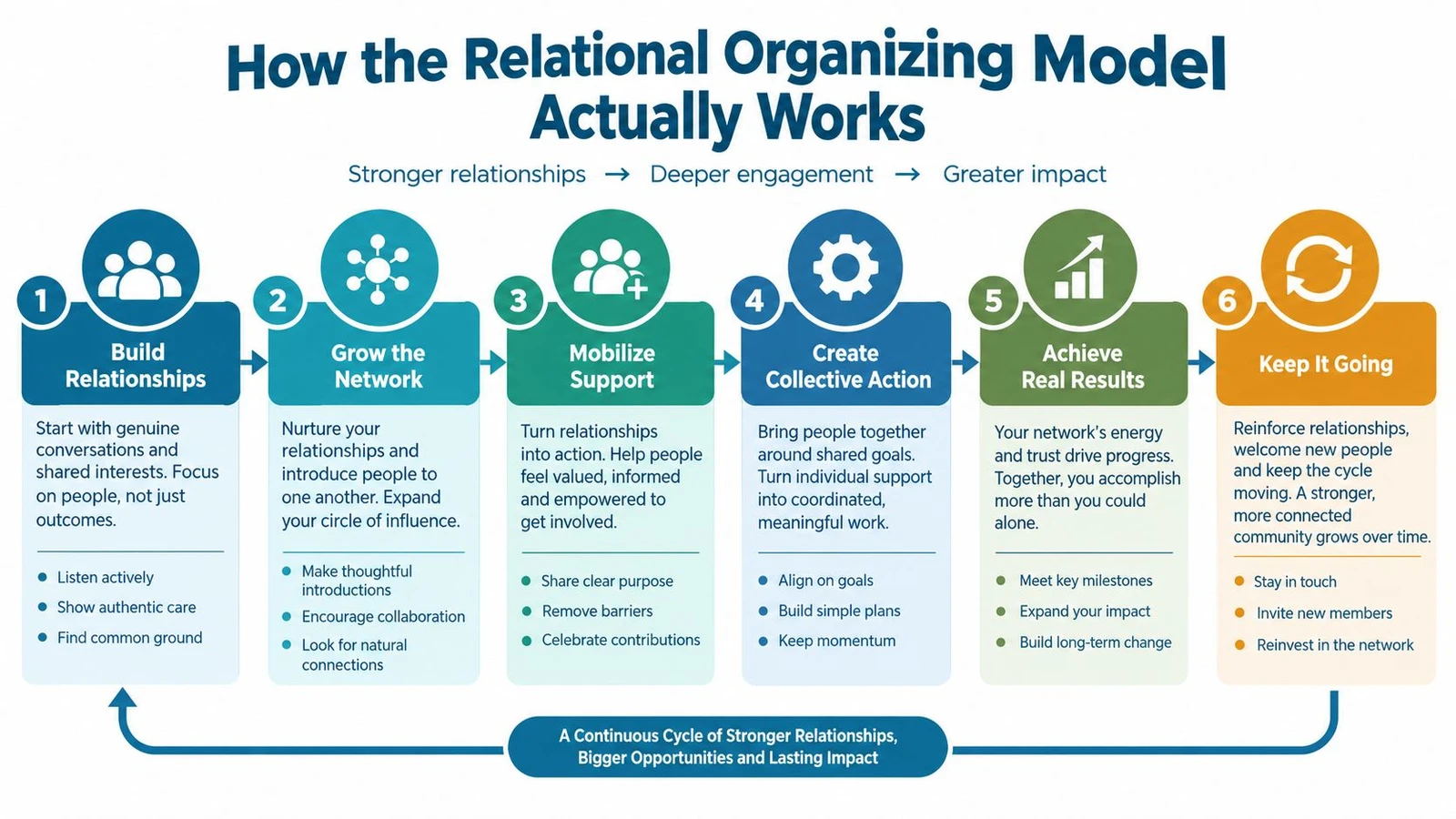
Relational organizing starts with a simple bet, people trust people they know more than they trust campaigns. Red Wine & Blue’s own materials describe a model in which members identify people in their circle, then use those relationships to prompt action, share reminders, and move turnout conversations toward a concrete vote plan (Red Wine & Blue take-action page).
The 20-friends logic
The network’s mechanism is built around a manageable social target. In recent coverage tied to its organizing, members were asked to contact 20 friends each, which is the sort of number that turns a vague appeal into a measurable task. Public descriptions tied to the organization’s footprint also point to 800 groups and local expansion across all 50 states, which is why the model is discussed as a network rather than a single chapter program (Action Network group page).
That structure matters because it changes how persuasion happens. A friend’s message is not the same as a campaign script, and the data trail is different too. Instead of counting only how many doors were knocked, the model can track who was contacted, who responded, and which conversations appeared to move someone closer to voting.
A practical way to think about the workflow is this:
- Find the circle. Members identify people they already know.
- Use a prompt. The network supplies talking points, reminders, and organizing tools.
- Choose the channel. Conversations can happen in person, by text, or through small events.
- Record the response. Organizers can track engagement and follow-up needs.
- Nudge turnout. The final goal is a ballot, not just a reaction.
- Repeat locally. The same pattern can be reused for later races and issue campaigns.
For a broader framework on how that social data can be turned into action, extract consumer insights from social media offers a useful analogy, even though the underlying use case is different. The common thread is that small signals, handled carefully, can guide the next contact.
The distinction that often gets blurred is that Red Wine & Blue is a network, while its ecosystem may include member groups and aligned political activity outside the network itself. The organization does not function like a traditional donor vehicle, which is why its operational question is how many relationships it can activate, not how much it spends on candidate support.
For a deeper mechanics-first view, the logic is close to what’s discussed in relational organizing in 2026, where the emphasis is on converting trusted contacts into measurable outreach instead of treating “community” as a vague slogan.
Practical rule: If the contact came from a friend, the campaign is borrowing trust. If the contact came from a stranger, the campaign has to earn attention from zero.
Red Wine & Blue Compared to Traditional Canvassing
Traditional canvassing still dominates a lot of campaigns because it is concrete. Volunteers knock doors, leave literature, make calls, or send mass messages. Red Wine & Blue’s model is different because the messenger is usually a friend or peer, the contact is more conversational, and the goal is often turnout rather than simple message delivery.
The strongest data point available here comes from the Cleveland reporting. It said turnout among people Red Wine & Blue contacted ran 2.5 to 4 percentage points higher than the comparison group, and 5.5 to 6 points higher among suburban women (Cleveland report). That does not prove every relational program works the same way, but it does show the model can produce measurable lift in at least one setting.
| Dimension | Relational Organizing | Traditional Canvassing |
|---|---|---|
| Messenger | A friend, neighbor, or trusted contact | A volunteer, canvasser, or paid contact worker |
| Tone | Conversational and personal | Scripted or semi-scripted |
| Best use | Turnout nudges, social reinforcement, small-network activation | Broader reach, stranger contact, direct field coverage |
| Scale | Depends on existing relationships and volunteer follow-through | Depends on staffing, turf, and time on the ground |
| Data trail | Tracks social connections and response patterns | Tracks doors, calls, or contacts made |
| Core risk | Shallow reach if the social network is narrow | Low trust if the contact feels impersonal |
The trade-off is plain. Relational work can be cheaper in labor terms and often feels more credible, but it is harder to scale quickly because it depends on social trust that already exists. Traditional canvassing can reach strangers at volume, but the message has to do more work to earn attention.
A useful comparison point for field teams is the mechanics of door work itself. Door-to-door canvassing still matters where direct contact and route discipline are the right tools, especially in races that need broad geographic coverage rather than narrow network activation.
The best reading is not that one approach replaces the other. It is that relational organizing fills a gap, especially where peer influence is stronger than a stranger’s pitch, while traditional canvassing remains the workhorse for coverage and repetition.
What the Reported Impact Numbers Really Show
The cleanest way to read Red Wine & Blue’s public impact claims is to separate activity, reach, and effect. Those are related, but they are not the same thing.
The organization says it grew to 1,050,000 women in its network by 2025, and it reported 4,212 events with 83,443 attendees in its 2025 impact summary (Red Wine & Blue about page). It also said 13,258 members used its platform to talk about voting with 107,321 friends and family, and that 93% of members encouraged friends and family to vote (Red Wine & Blue about page). Those figures show engagement and scale, but they do not automatically prove persuasion.
What the numbers can support
The reported turnout lift is the most meaningful outcome because it is closer to the ballot box. Red Wine & Blue says its relational-contact program raised turnout by 5–7% in target states versus control groups (Red Wine & Blue about page). The Cleveland reporting adds a more specific external check, with turnout among people contacted running 2.5 to 4 percentage points higher overall and 5.5 to 6 points higher among suburban women (Cleveland report).
That still leaves important limits. A turnout lift does not necessarily mean the model persuades opponents, and it does not prove the same effect will hold in every state or cycle. The evidence is strongest where the contact reaches people who were already plausibly movable, not where it tries to convert hardened partisans.
For teams trying to evaluate programs like this, the key is to keep separate the question of how many contacts were made and whether those contacts changed votes. A project can be efficient at generating conversations without being persuasive, and it can be persuasive in a narrow sense without scaling well.
Measuring canvassing ROI and tracking field campaign impact in 2026 is a useful frame for that distinction because the same trap appears across field programs, over-crediting activity and under-testing outcomes.
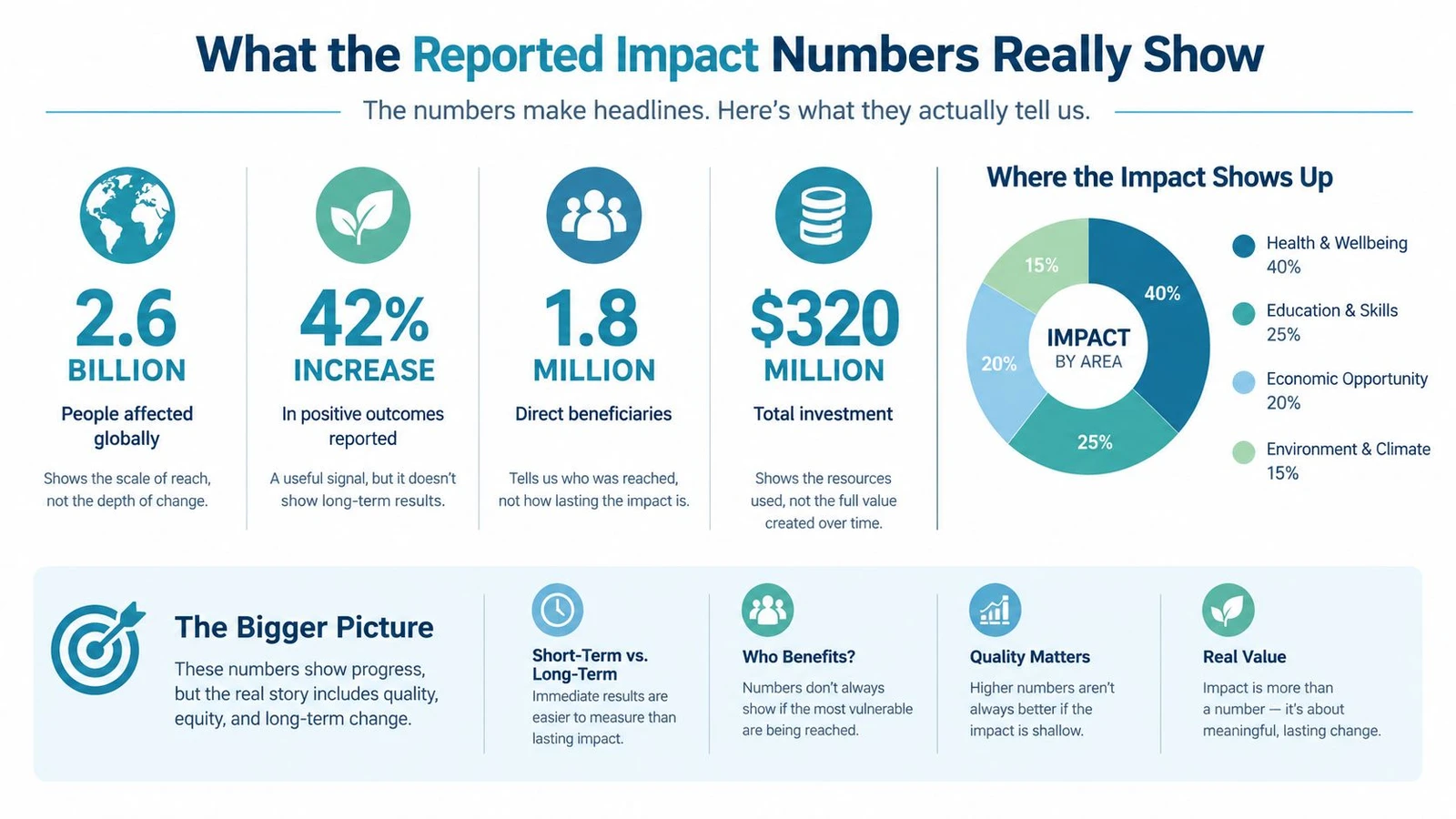
The absence of fully transparent, peer-reviewed validation in the public materials means a careful reader should treat the figures as promising but not final. Self-reported results from an organizer are useful, especially when they’re paired with comparison groups, but they are not the same as a broad academic consensus.
Beyond Suburban Women and Other Open Questions
The suburban-women frame still defines the brand, but it may not fully define the audience anymore. Public materials now point to a much larger and more distributed community, and that raises the question of whether the original archetype is becoming a shorthand for something broader.
Who is joining now
The network says it has expanded across the country and into a large group structure, while recent public descriptions also emphasize digital participation and app-based organizing (Red Wine & Blue take-action page). That makes sense in a cycle where some volunteers join through local gatherings, some through online content, and some through issue-specific mobilization rather than a fixed suburban social club.
That evolution matters because a model built for one demographic can be challenged when it reaches others. Rural participants, younger volunteers, and less politically engaged members may respond to different messages, different channels, and different levels of privacy expectation. The brand can’t assume the same suburban-mom appeal will work everywhere.
The sharper questions are operational, not rhetorical. What happens to the contact data gathered from those 20 friends each volunteer is encouraged to reach? How is it stored, who can use it, and what do those contacts think they’re consenting to when the message arrives through a personal relationship instead of a campaign form?
If the organizing path depends on private relationships, the privacy standard has to be higher, not lower.
There is also a disclosure question. A network that speaks in nonpartisan civic language while operating in a politically charged environment has to be clear about what money funds, what activity it supports, and where the line sits between turnout work and more explicit partisan advocacy.
The final open issue is habit formation. Relational organizing can build durable civic routines, but it can also become a cycle-by-cycle base mobilizer. The difference matters, because one outcome changes long-term participation and the other mainly improves short-term turnout.
What to Take Away About Red Wine and Blue in 2026
Red Wine & Blue is best understood as an organizing mechanism, not a vibe. Its core unit is the friend-to-friend contact model that grew out of the post-2018 suburban organizing environment, and that model still drives how the network asks members to act (Red Wine & Blue about page).
The evidence points to a real turnout effect, but it is not a blank check. The strongest public support comes from the Cleveland turnout comparison and from the organization’s own reported results, which show engagement, conversation volume, and turnout lift, but not a universal proof that every relational program will work the same way in every place.
The third takeaway is that the branding is evolving faster than the underlying questions. The suburban-women framing still matters, but the actual membership picture appears broader, more digital, and more distributed than the brand’s original shorthand suggests. That makes the network interesting to political reporters and campaign professionals for the same reason, because it sits at the intersection of identity, trust, and measurable turnout.
A skeptical reader does not have to choose between dismissing the organization and treating it like a miracle. The more accurate view is that it is a credible turnout infrastructure with a strong narrative, a measurable but bounded evidence base, and a set of privacy and disclosure questions that deserve more attention than the branding usually gets.
If this kind of mechanics-first breakdown is useful, doornoc helps field teams turn voter contact into a clearer system. Campaigns and grassroots groups use doornoc to plan routes, track field activity, and connect voter data to real conversations, which makes it a strong fit for anyone studying how contact programs scale.
Looking for a tool to run this? doornoc’s canvassing software bundles voter data, automatic turf cutting, the mobile app, and live reporting in one platform.