
Activism works best as a coordinated mix of digital outreach, community organizing, direct action, and institutional pressure rather than as a single tactic. Youth participation in marches or protests rose from 5% in 2016 to 27% in 2020, while youth turnout reached 50% in the 2020 presidential election, showing how public action and electoral participation can reinforce each other.
A neighborhood facing a zoning decision knows this problem well. A proposed development threatens a local park, increases pressure on housing, or changes the character of several streets. Residents create a social media page, circulate a petition, and share photographs of the affected area. Yet the city council still needs testimony, undecided residents need persuasion, legal questions need answers, and organized voters need to show up when the decision is made.
A hashtag alone won’t carry that campaign. Neither will one crowded council meeting. The practical challenge is choosing a combination of tactics that matches the desired outcome, available resources, political climate, and level of risk. The major types of activism have different strengths, costs, timelines, and failure points. Effective organizers use them as an integrated toolkit.
Understanding the Real Challenge of Activism
The neighborhood campaign begins with enthusiasm but quickly exposes a tactical gap. One group of residents focuses on online visibility, another schedules public meetings, and a third contacts elected officials. Each group is active, but they aren’t necessarily working toward the same measurable outcome. The petition may attract attention without producing testimony, the meeting may generate strong speeches without changing votes, and the lobbying effort may lack visible public support.
That pattern appears across issue campaigns. Activists often select the tactic that feels most familiar or emotionally satisfying instead of asking which decision-maker must change, what pressure that person can withstand, and how participation will continue after the first burst of attention. A campaign seeking a zoning amendment needs a different sequence from one seeking a corporate policy change, worker recognition, or emergency public relief.
Practical rule: Choose tactics by the behavior they need to change, not by how visible or dramatic they look.
Grassroots organizing creates relationships and local leadership. Digital activism spreads information and lowers the barrier to joining. Lobbying gives decision-makers a clear policy path, while legal activism can challenge the authority behind a decision. Direct action raises the cost of ignoring an issue, and voter contact can turn public concern into electoral accountability. These approaches can support one another, but they shouldn’t be treated as interchangeable.
Residents starting a campaign can use this guide to getting politically involved to identify practical entry points, from contacting representatives to joining local groups. The first operational task is to turn concern into a campaign objective, such as securing a council vote, stopping a permit, protecting a park boundary, or forcing a public review.
Once the outcome is defined, organizers can assign each tactic a job. Digital outreach might identify supporters, door-to-door conversations might reveal neighborhood concerns, and lobbying might secure commitments from council members. The campaign becomes more than a collection of activities. It becomes a system for moving people from awareness to participation and decision-makers from indifference to action.
The Core Categories of Activism
The main types of activism differ in where they apply pressure and what kind of commitment they require. Grassroots organizing builds durable power through relationships, local leadership, meetings, volunteer recruitment, and repeated participation. A neighborhood team might hold listening sessions, train residents to speak at hearings, and create a structure that remains active after the immediate vote.
Digital activism uses online petitions, email, social networks, fundraising, political messaging, and volunteer coordination. Its advantage is speed and reach. Its weakness is that a visible audience isn’t the same as an organized base. A petition becomes more useful when signers are invited to attend a hearing, make a call, donate, or join a local team.
Direct action includes demonstrations, sit-ins, boycotts, strikes, and organized noncooperation. Nonviolent civil resistance can widen participation, lower barriers to entry, and sometimes encourage defections from security forces, civil servants, or economic elites. In the NAVCO research covering major campaigns from 1945 through 2013, approximately 30% of nonviolent campaigns achieved their objectives within three years, compared with 13% of violent campaigns; a broader historical analysis reported success rates of roughly 53% for major nonviolent campaigns versus 26% for violent resistance (Stockholm University’s summary of the research). These figures describe historical campaigns, not a guarantee for any individual action.
Lobbying and policy advocacy work through institutional channels. Organizers meet legislators, submit testimony, provide research, propose language, and build relationships with agency officials. Legal activism uses litigation, administrative challenges, and legal advocacy to contest policies or establish protections. It can create structural change, but legal processes often require specialized expertise, patience, and careful control of public claims.
Labor activism centers workers’ collective power through workplace organizing, bargaining, and strikes. Historical research tracks labor conflict through work stoppages, workers involved, and working days lost. In the United States, 458,900 workers participated in 33 major work stoppages that began and ended in 2023, compared with 120,600 workers in 2022, an increase of more than 280% in the number of workers involved (the long-run research on strike activity).
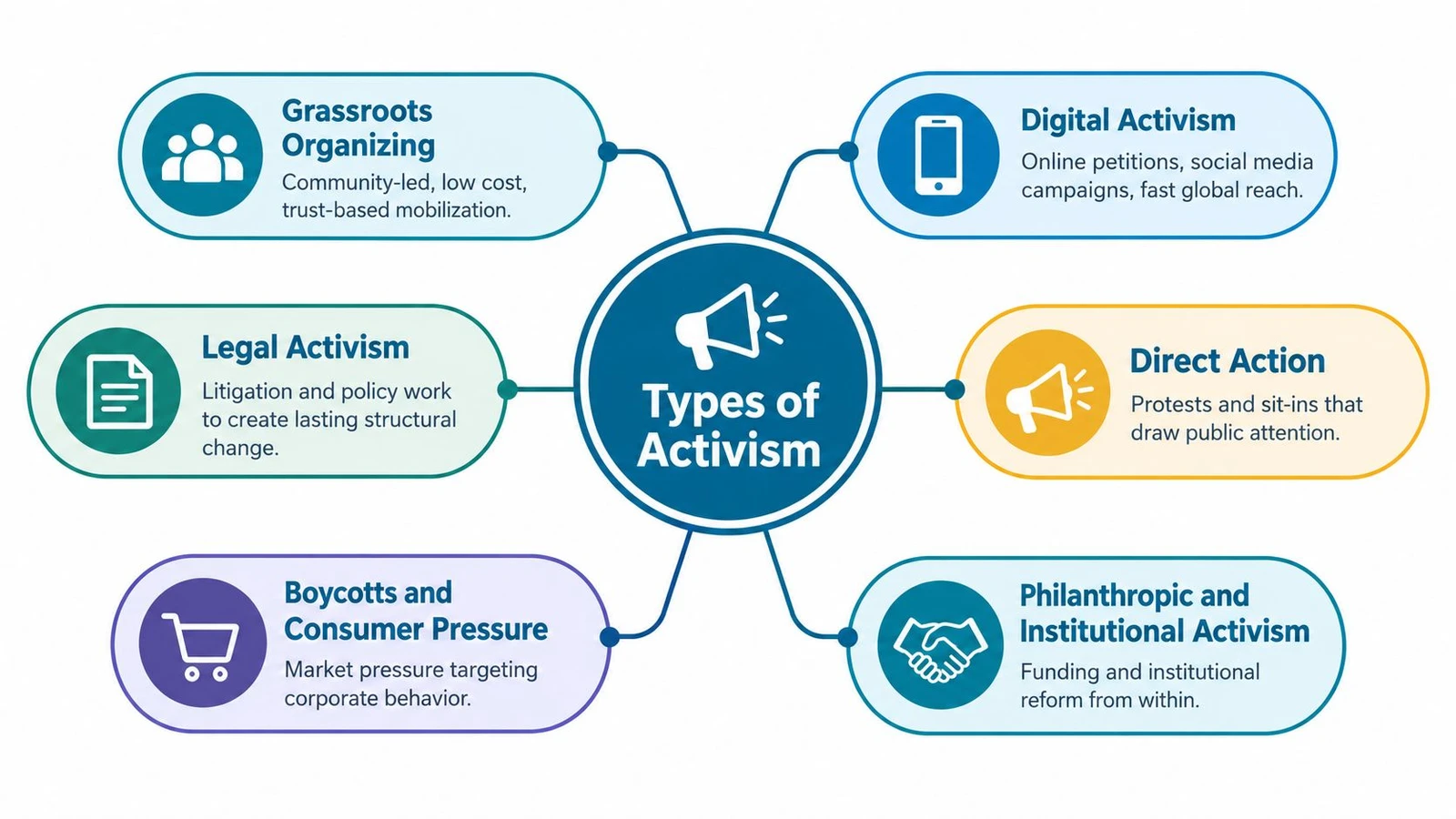
The categories overlap in practice. A worker campaign may use digital storytelling, community meetings, a boycott, and negotiations. A local policy campaign may need legal research, voter contact, and public testimony. The useful distinction isn’t which category is morally superior. It’s what each category can accomplish, what it costs, and what it can’t do alone.
Digital versus Grassroots Activism
Digital and grassroots activism solve different operational problems. Digital channels can distribute a message quickly, recruit people beyond the immediate area, and maintain contact between physical events. Grassroots work develops trust, identifies local leaders, and creates the repeated participation that gives a campaign resilience.
A digital campaign may produce a large number of signatures in a short period. That result can establish public visibility and provide a starting list of interested people. It doesn’t automatically reveal who will attend a meeting, speak publicly, knock on doors, donate, or accept responsibility for a neighborhood team. Organizers need a conversion path, not merely a larger audience.
Grassroots organizing moves more slowly because it depends on conversations and relationships. A volunteer who hears a neighbor’s concern firsthand can adapt the message, identify misinformation, and discover people with influence in the community. The trade-off is real. Face-to-face work requires training, scheduling, supervision, route planning, and follow-up, but it often produces deeper commitment than a one-click action.
What each approach does well
Digital activism is particularly useful when a campaign needs to:
- Create initial awareness: Share clear information about a vote, policy, employer, or public decision.
- Recruit quickly: Invite people to events, volunteer shifts, fundraising, or online briefings.
- Coordinate distributed participants: Give supporters a common message and a clear action.
- Keep attention alive: Send updates between meetings, hearings, demonstrations, and negotiation rounds.
Grassroots activism is stronger when the campaign needs to:
- Build trust: Listen to residents, workers, or voters before asking for public commitment.
- Develop leaders: Give volunteers responsibility for teams, neighborhoods, outreach, or testimony.
- Understand local conditions: Learn which arguments persuade people and which concerns remain unresolved.
- Sustain pressure: Maintain participation after media attention fades.
A systematic review and meta-analysis of 16 studies involving 33,257 participants found that social media’s overall effect on political participation was moderate and highly context-dependent (the review of social media and political participation). The practical implication is straightforward. Online activity should be measured by what it enables next, such as volunteer sign-ups, completed voter contacts, event attendance, donations, or meetings with decision-makers.
For campaigns deciding how to allocate field capacity, the comparison of door knocking and digital voter contact offers a useful way to think about reach, depth, and follow-up. The strongest sequence often uses digital channels to identify and inform people, then uses local organizing to turn interest into responsibility.
A share is not the end of participation. It is a useful result only when the campaign knows what action follows it.
How to Choose the Right Activism Strategy
Choosing among the types of activism starts with a disciplined diagnosis. Campaign teams should resist the temptation to begin with a platform, event format, or familiar tactic. The first question is what must change, who controls that change, and how much time exists before the decision is made.
Five questions before selecting a tactic
-
Define the outcome.
A campaign may seek public awareness, a policy vote, a corporate concession, an election result, a legal ruling, or long-term community power. Awareness favors communication and public education. A policy vote requires direct access to decision-makers, constituent pressure, and credible policy language. Long-term power requires leadership development and a structure that survives the immediate issue. -
Identify the decision-maker. The general public may influence an elected official, but the official, agency, board, employer, or court makes the formal decision. Mapping authority prevents a campaign from spending all its energy persuading people who cannot deliver the requested change.
-
Audit resources.
Teams should list available volunteers, organizers, legal knowledge, money, communications capacity, local relationships, and time. A small group with strong neighborhood ties may start with listening sessions and targeted canvassing. A group with a broad online audience may begin with digital recruitment, then invest in training and local leadership. -
Assess the environment and risk.
Public demonstrations can create visibility, but they may also expose participants to legal, physical, or reputational risk. Digital actions can widen access, yet they may reveal sensitive information or expose participants to surveillance and harassment. Tactics should be evaluated for visibility, reversibility, data exposure, retaliation risk, and accessibility. -
Set measures before launch.
A campaign should define the behavior that signals progress. Useful measures include repeat participation, volunteer recruitment, geographic coverage, completed voter contacts, meetings secured, public commitments, legal milestones, or movement from symbolic protest to sustained noncooperation. Counting attendance alone can hide whether people are becoming more committed.
The framework also clarifies what doesn’t work. A campaign shouldn’t launch a highly visible action without a follow-up route, collect personal data without consent and access controls, or ask volunteers to perform work that the team can’t support. Tactic selection is a resource decision, not a branding exercise.
For teams weighing field contact against phone outreach, this decision framework for when to use canvassing instead of phone banking can help connect audience, geography, timing, and volunteer capacity to the right channel. The choice should follow the campaign’s objective rather than a general preference for online or offline work.
Building Campaigns with Layered Tactics
A layered campaign assigns separate jobs to separate tactics. Consider a climate justice campaign challenging a harmful local policy. The digital team can explain the issue, collect supporter details with consent, and invite people to a briefing. Community organizers can then hold local meetings, recruit neighborhood captains, and learn which concerns require different messages.
The campaign might use voter contact to reach residents who aren’t active online. Volunteers can explain the policy, ask what matters to each household, and record whether people want updates, intend to attend a hearing, or need more information. That data should remain limited to the campaign’s legitimate purpose, with clear opt-out and retention practices.
At the same time, policy advocates can prepare proposed language and meet with officials. Legal specialists can evaluate whether the policy violates existing protections or procedural requirements. A demonstration may create urgency, while a consumer campaign can give a company a reason to negotiate. These tactics work best when the public demand stays consistent and each team understands the others’ timelines.
A practical campaign sequence
- Start with information: Publish an accessible explanation, identify the decision, and correct the most important misunderstandings.
- Build a supporter pathway: Ask for a specific next step, such as attending a local meeting, joining a volunteer team, contacting an official, or contributing resources.
- Develop local ownership: Give residents or workers responsibility for outreach, testimony, recruitment, and follow-up instead of treating them as an audience.
- Apply targeted pressure: Match lobbying, consumer action, direct action, legal advocacy, or voter contact to the institution that can change the outcome.
- Sustain the campaign: Keep participation organized until the decision is implemented, not merely until the issue receives attention.
The sequence isn’t rigid. A sudden eviction threat may require immediate legal support and direct community mobilization before a broader education campaign is ready. A long legislative campaign may begin with research and coalition building, then escalate only when officials ignore constituent demands. The principle is coordination, not a fixed order.
Layering also makes weaknesses visible. Digital recruitment without onboarding creates a list that no one can activate. A march without negotiation demands may generate images but leave the decision-maker’s incentives unchanged. Litigation without public education can win a technical ruling that affected communities don’t understand or defend. Lobbying without public pressure can become a private conversation with no accountability.
The strongest campaigns connect every action to the next decision. A petition should invite a hearing. A hearing should produce commitments. A commitment should be monitored. If the institution refuses, the campaign should already know which pressure will escalate and which participants can carry it out safely.
Challenging the Clicktivism Myth
The criticism of digital activism is partly correct and partly careless. Likes, shares, and signatures can remain symbolic when no one is asked to do anything harder afterward. But dismissing every low-effort action ignores how campaigns use digital behavior to distribute information, find supporters, raise resources, and identify people ready for deeper involvement.
A 2025 review of 72 peer-reviewed studies found that hashtags, videos, and infographics can expand reach and solidarity, particularly when influencers and algorithmic visibility amplify them (the review of digital activism research). The same review identified serious barriers for marginalized communities, including surveillance, censorship, and economic inequality. Reach is therefore an opportunity, not proof of equal participation or political success.
The conversion test
Campaign managers can evaluate digital activity by asking what happens after the first interaction:
- Recruitment: Do supporters join a volunteer team or attend an orientation?
- Field participation: Do they accept canvass shifts, make calls, attend hearings, or host events?
- Resource contribution: Do they donate money, provide meeting space, translate materials, or offer professional skills?
- Political contact: Do they contact officials, submit testimony, or persuade another person to act?
- Retention: Do they return for a second action and take responsibility for helping others?
This approach avoids both extremes. Digital engagement isn’t automatically shallow, and it isn’t automatically organizing. Its value depends on the campaign’s ability to offer a clear next step, reduce friction, provide training, and follow up with people who respond.
The most common failure is an unstructured call to action. “Share this post” may create visibility, but “share this explanation, sign up for the local briefing, and choose a volunteer shift” creates a participation ladder. Each step should match the supporter’s capacity while making deeper involvement possible.
Privacy also matters. Campaigns integrating digital identifiers with canvassing records should use consent, access controls, retention limits, and suppression workflows for opt-outs. A campaign that treats supporters as data points can damage trust even while improving its internal reporting.
Measure movement, not noise. The important question isn’t how many people saw an action. It’s how many people moved from attention to informed participation, and whether that participation helped change a decision.
Digital tools can also support accountability after a campaign wins. Organizers can publish commitments, track implementation, and invite affected communities to report problems. That turns an online audience into an ongoing oversight network, provided the campaign continues to offer meaningful roles rather than just requesting another share.
Designing Resilient Activism Under Pressure
A campaign’s safest and most effective tactic depends on its environment. In 2025, civil society was under severe attack in 122 of 198 countries and territories, while only 7% of the global population lived in countries with free or relatively open civic space, according to CIVICUS global findings on civic space. The same report recorded protester detention in at least 82 countries, and digital components such as shutdowns, social-media blocking, and censorship appeared in more than 10% of documented violations.
Those conditions change the tactical calculation. A public march may be essential in one place and dangerously exposing in another. Online organizing may protect physical attendance while creating records that authorities can monitor. Closed-group coordination may reduce visibility, but it can also limit recruitment and make the campaign harder for new participants to join.
Choosing tactics under unequal risk
Campaign teams should map every proposed action against several questions:
- Visibility: Who will see the action, and does visibility help or endanger participants?
- Reversibility: Can the campaign stop or change course if conditions deteriorate?
- Data exposure: What personal information is collected, stored, or shared?
- Retaliation: Could participants face detention, employment consequences, harassment, or other harm?
- Accessibility: Can people with mobility, work, language, caregiving, or connectivity constraints participate?
- Durability: Does the tactic build relationships and leadership that remain after the public moment?
Resilient campaigns create multiple participation pathways. Public testimony may suit participants who can accept visibility. Community education, mutual aid, legal support, private coordination, and worker organizing may offer roles to people facing higher exposure. The campaign can still project a clear public demand while distributing risk rather than placing it on the same group of visible leaders.
Communication teams should also prepare for misinformation, harassment, sudden platform restrictions, and reputational attacks. For practical guidance on maintaining disciplined communication during disruption, PostSyncer’s crisis response tips provide a useful reference point. Crisis planning should include approved spokespeople, secure contact methods, correction procedures, and a decision rule for pausing actions that create unacceptable danger.
A local zoning campaign illustrates the principle. Residents may begin with public education and neighborhood conversations, then use targeted testimony and legal review while reserving a larger demonstration for a moment when officials refuse to respond. If public exposure becomes unsafe, organizers can shift toward trusted small-group meetings, written submissions, and institutional advocacy without abandoning the campaign’s objective.
Activism is a toolbox, not a single choice. The campaign that combines digital reach, community trust, policy access, legal strategy, and carefully calibrated pressure can adapt when one channel fails. Organizers should choose the combination that moves the right people toward the right decision while protecting the people who make the work possible.
doornoc helps campaigns and grassroots organizations turn voter contact into organized field work through targeted lists, route planning, offline data collection, interaction logging, and real-time progress tracking. Visit doornoc to evaluate whether its canvassing tools fit the campaign’s goals, geography, volunteer capacity, and privacy requirements.
Looking for a tool to run this? doornoc’s canvassing software bundles voter data, automatic turf cutting, the mobile app, and live reporting in one platform.