The week before launch, the question isn’t which platform sounds strongest on a demo call. It’s which system your field team can trust when volunteers are half-trained, phones are spotty, and you need clean walk results back before evening strategy. That’s where NGP VAN vs Aristotle vs Trail Blazer stops being a feature contest and becomes an operating-model decision.
| Platform | Core operating model | Field strength | Compliance strength | Best fit |
|---|---|---|---|---|
| NGP VAN | Shared VAN voter universe and organizing CRM | Strong for tightly linked voter-file workflows, canvassing, and contact logging | Strong, but field-centric first | Democratic and progressive campaigns that need one shared voter record across teams |
| Aristotle | Compliance-heavy political management environment | More limited field depth relative to voter-universe stacks | Strongest fit when reporting and financial controls lead the process | Committees and campaigns that prioritize compliance, fundraising, and reporting |
| Trail Blazer | Bundled all-in-one campaign management and fundraising suite | Practical mobile canvassing, mapping, turf cutting, and phone banking | More of a general campaign system than a compliance-first stack | Budget-conscious campaigns that want bundled tools and simpler administration |
A lot of buyers start with the wrong question. They ask which platform has the longest checklist, then discover after launch that their real problem is offline data capture, route balance, duplicate records, or getting field contacts into the next day’s universe without a messy export. If you’re feeling that pressure right now, this comparison is built around the same constraints your organizers feel at the door, not around vendor marketing language.
Introduction Why This Three Way Comparison Matters Now
A field director I trust once described contract week as the moment when every good intention gets tested by the ground. Volunteers need walk packets, the finance team wants clean reporting, and data staff are trying to make sure the same voter doesn’t show up twice under two different records. That’s the point where a platform choice can either reduce friction or create it.
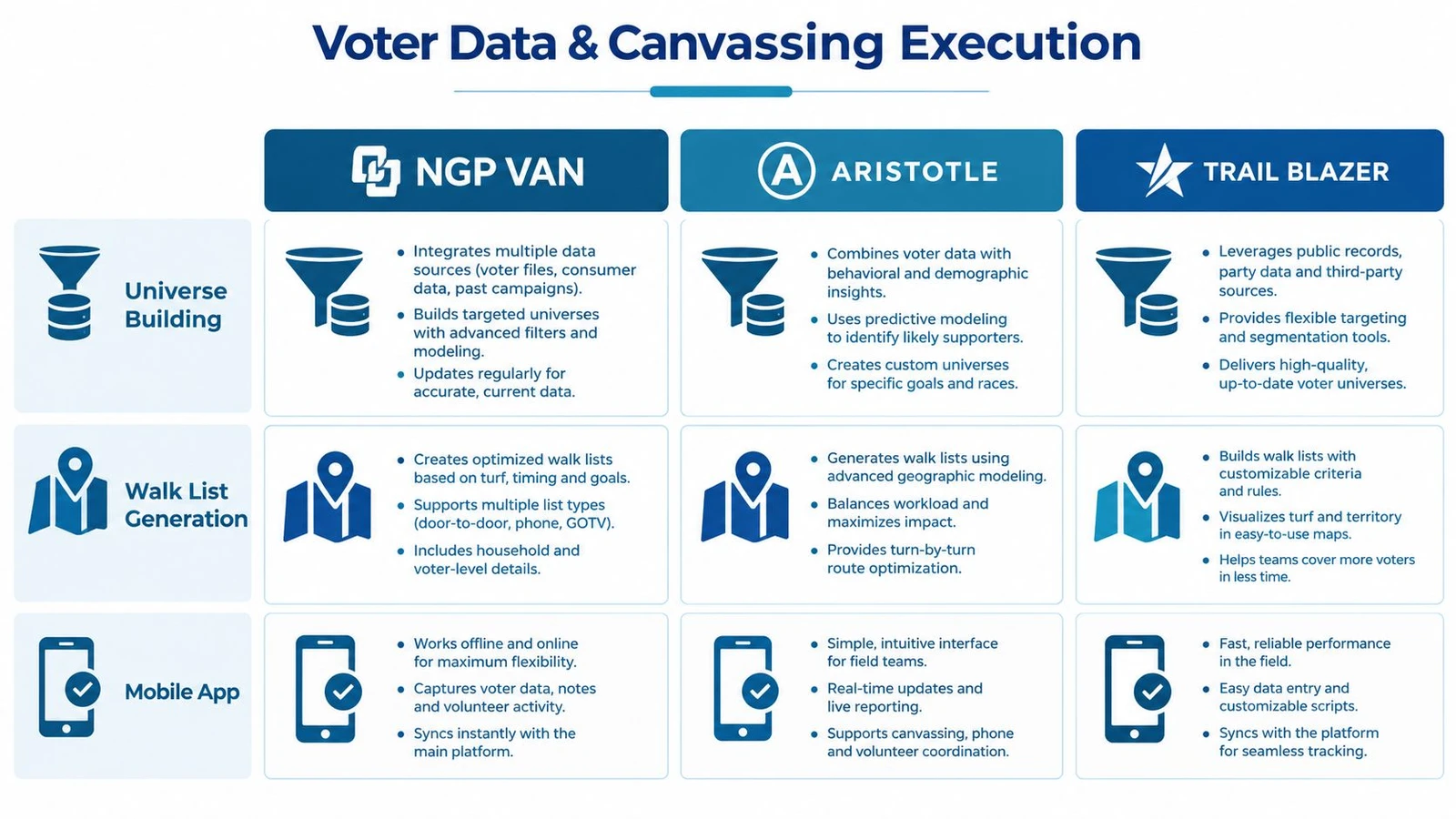
NGP VAN, Aristotle, and Trail Blazer get compared together because they all sit inside political campaign operations. They’re not interchangeable, though, and the difference matters most when the campaign starts moving data from targeting to turf cutting to logging results. NGP VAN is positioned around a shared VAN voter universe and tightly coupled organizing workflows, Aristotle leans toward compliance-heavy political management, and Trail Blazer bundles canvassing, mapping, voter data, and fundraising into a more SMB-oriented system.
Practical rule: pick the system that matches your operating model first, then judge features inside that lane.
A checklist comparison misses the buying question. A campaign with a coordinated Democratic voter file, field volunteers, and downstream tools needs a different core system than a committee that lives or dies on reporting discipline. A local race that wants straightforward canvassing plus fundraising has another set of trade-offs again, especially if the team cares more about ease of administration than deep ecosystem fit.
One reason this matters now is that campaign software is moving toward cloud deployment, mobile canvassing, and integration-heavy workflows. Recent market research says cloud deployment accounts for 64%–68% of installations, mobile canvassing usage has reached 71%, and AI-assisted voter segmentation is already adopted by 68% of campaigns (market and field workflow trends). That doesn’t make every platform equal. It just means the best choice is the one that handles your field reality without forcing the team into extra manual cleanup.
If you’re also mapping your canvassing layer, the practical question is whether your core system can support clean handoffs to tools like doornoc’s voter-contact workflow guide without turning every shift into a CSV exercise.
What Each Platform Is Built to Do
NGP VAN’s center of gravity is the voter universe
NGP VAN was formed in November 2010 through the merger of NGP Software, founded in 1997 by Nathaniel Pearlman, and Voter Activation Network, founded in 2001 by Mark Sullivan (NGP VAN history). That history still shows in the product’s posture. It’s built for Democratic and progressive campaigns that want a shared universe for field, fundraising, and compliance work, not a loose collection of separate modules.
The key design choice is the central voter database. Once a campaign works from that shared record, precinct targeting, walk-list generation, canvassing, phone bank activity, and contact tracking can sit in one flow. The practical value is less about a shiny interface and more about reducing re-keying, record drift, and duplicate updates between teams.
Aristotle is built around control, reporting, and compliance
Aristotle’s positioning is different. It’s framed more as a compliance-heavy political management environment than a field-first canvassing stack. That usually attracts teams that care about reporting structure, donor oversight, and the discipline of campaign administration more than they care about a shared voter-universe workflow.
For buyer purposes, that means Aristotle tends to answer a different question. It’s a better fit when your operational center is compliance and financial visibility, and field operations are expected to plug into that system rather than define it.
Trail Blazer aims for bundled practicality
Trail Blazer is consistently described as an all-in-one campaign management and fundraising system with mobile canvassing, mapping, turf cutting, voter data access, phone banking, and constituent management (campaign software comparison). Its market feel is more SMB- and cost-oriented than NGP VAN’s enterprise organizing stack, which is why it often lands with teams that want an integrated package and simpler administration.
Trail Blazer usually makes sense when the campaign wants enough field tooling to run a race, but doesn’t need the depth of a VAN-aligned universe.
That doesn’t make it weaker. It makes it different. Trail Blazer is often the practical middle ground for campaigns that want canvassing, fundraising, and voter data in one place without adopting a fully integrated Democratic ecosystem.
Voter Data Canvassing and Mobile Field Execution Compared
The field difference shows up in the handoff, not the brochure
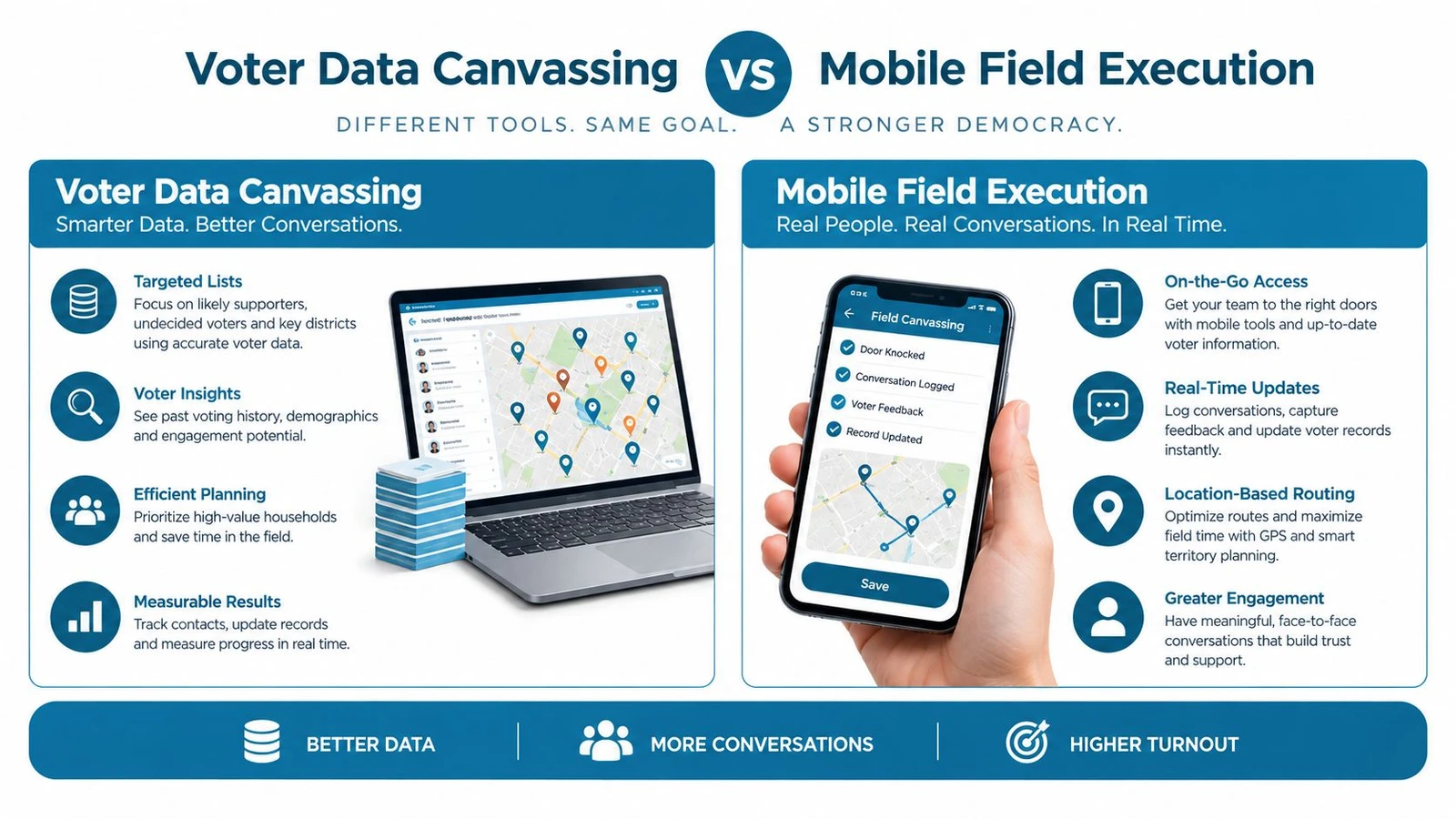
On paper, all three platforms can sound similar because they touch voter data and outreach. In practice, the difference is whether the platform starts with a shared voter universe, a compliance workflow, or a bundled campaign suite. NGP VAN is strongest when the campaign already lives inside VAN-aligned records and needs the universe, precinct list, and contact log to stay synchronized across teams (political CRM workflow positioning).
Trail Blazer is the more self-contained option. Its strength is that field tools, mapping, turf cutting, and phone banking sit inside one package, which simplifies life for smaller teams that don’t want to stitch together multiple systems. Aristotle, by contrast, is less about field depth and more about keeping the campaign’s reporting and administrative side under control.
Mobile execution is where the trade-offs become obvious
A canvassing manager cares about the basics that nobody talks about in sales sheets. Can volunteers load routes quickly? Does the app still work when the signal drops? Do conversation results come back cleanly enough to be trusted the same night? Those questions matter because a field team doesn’t have time to re-enter notes after a shift.
If the platform can’t preserve door results under weak connectivity, it’s not a field platform, it’s a database with a map.
That’s why campaigns that expect to run offline canvassing, route corrections, and same-day progress tracking often pair a core system with a dedicated mobile canvassing layer. The operational win is not just convenience. It’s the ability to keep route updates and contact logs moving without asking field staff to become data clerks.
What each one is actually good at on doors
- NGP VAN: strongest when the walk list is part of a broader voter-universe workflow and teams need the contact history to land back in one shared record.
- Aristotle: better when the campaign’s main burden is administrative control, so field work is secondary to reporting discipline.
- Trail Blazer: useful when the team wants a bundled canvassing and fundraising environment with less ecosystem complexity.
For a deeper look at mobile field tooling, this canvassing technology guide for campaign managers is the right companion read if your main concern is how doors, routes, and offline capture behave in real use.
Integrations Data Portability and How Each Works With Canvassing Tools
Integration depth is the hidden buying criterion
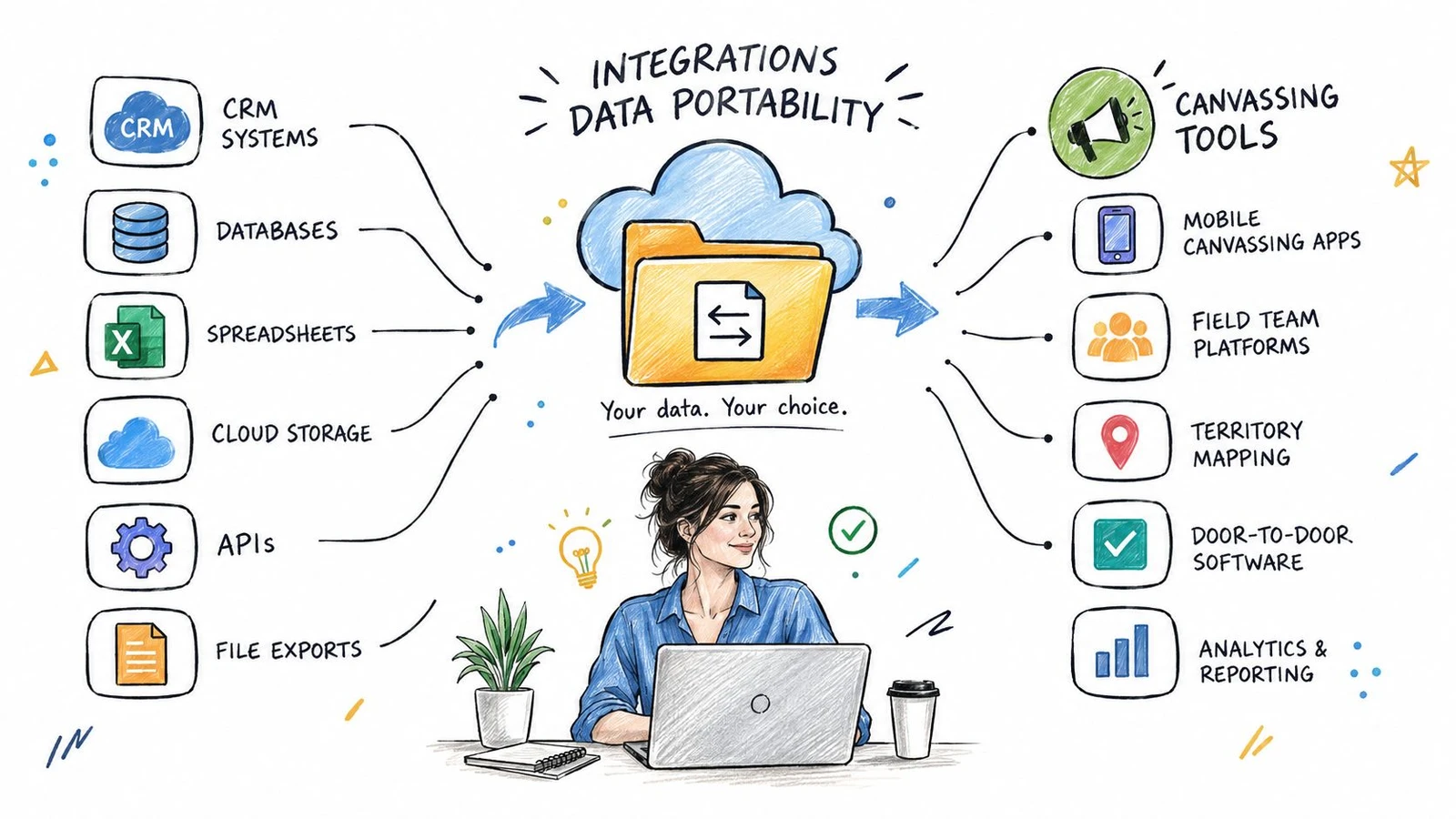
This is the part most comparison posts flatten into a generic “supports integrations” line. That misses the actual operational problem. Modern campaign software is increasingly judged on APIs, third-party data-source integration, secure syncing, and the campaign’s ability to keep field, fundraising, and compliance views aligned without duplicate records or manual cleanup. Market research says third-party data-source integration expanded by 56%, cybersecurity investment rose 47%, and compliance automation now handles 85% of reporting workflows (market and governance trends).
Those numbers matter because they explain why ecosystem lock-in is such a big deal. When a campaign changes systems, it isn’t just moving a login and a spreadsheet. It’s preserving voter history, reducing duplicate contacts, and making sure field teams can still work under low-connectivity conditions without breaking the data chain.
The real test is whether your field stack can move without friction
NGP VAN’s strength is that its whole model assumes the shared voter universe is the anchor. That makes it powerful, but it also means the campaign gets the most value when other tools are aligned to that structure. Aristotle is more likely to sit at the compliance and reporting center, so the integration question becomes how cleanly it exchanges data with donor and administrative workflows. Trail Blazer is more self-contained, which can reduce setup complexity, but it also means you need to pay closer attention to portability if the campaign expects to grow into more specialized systems later.
Operational takeaway: the best integration story is the one that keeps voter history intact when the field team changes tools mid-cycle.
That’s also where data pipelines to canvassing software matter. A platform that can send or receive structured records without repeated CSV exports saves time and lowers error risk. In practical terms, that’s what lets a campaign hand off targeted lists to a mobile canvassing tool, sync back results, and keep the next walk list current without a manual merge step.
If you’re comparing your data stack against a canvassing workflow, this vendor comparison for voter data tools is useful for thinking about how the upstream file choice affects the downstream field run.
Pricing Contracts and Scalability for Different Campaign Sizes
Starting price is only the first line item
Independent comparison pages report starting prices of about $45/month for NGP VAN and about $100/month for Trail Blazer (campaign pricing comparison). Aristotle is described with a starting price of $250/month for local races in the research brief. Those figures help, but they don’t answer the bigger budget question, which is how much operational friction the team buys with each license.
A lower monthly price can still be expensive if it creates more onboarding work, more manual exports, or more duplicate cleanup. A more expensive system can be the cheaper option if it saves staff time during canvass-heavy weeks or keeps reporting and finance teams from spending their nights reconciling records.
Scale changes what “cheap” means
Trail Blazer’s user-review summaries point to a system that’s easier to administer and do business with, which matters for campaigns that don’t have a large technical bench. That kind of simplicity can be a real advantage for smaller campaigns or local races where the campaign manager is also acting as field coordinator and operations lead. NGP VAN is built for a broader organizing stack, so its value rises as the campaign needs deeper coordination across field, compliance, and voter-file work. Aristotle fits campaigns where reporting and financial control are the pressure point, not field complexity.
- Local races: simpler bundled systems can be enough if staff need fast setup, predictable administration, and basic canvassing support.
- Regional or coordinated campaigns: deeper voter-universe workflows usually matter more because multiple teams need the same source of truth.
- Compliance-sensitive committees: a reporting-first environment is often the more rational choice than a field-heavy suite.
The cheapest license is not the cheapest operating model if the team loses time every day to handoffs and cleanup.
That’s why scalability should include team onboarding, support burden, and data portability. A platform that looks inexpensive in the contract can become hard to change later if the campaign’s records, field history, or reporting workflow are tightly trapped inside one ecosystem.
Which Platform Fits Your Campaign Use Cases and Tactics
The right choice depends on what the campaign is optimizing for
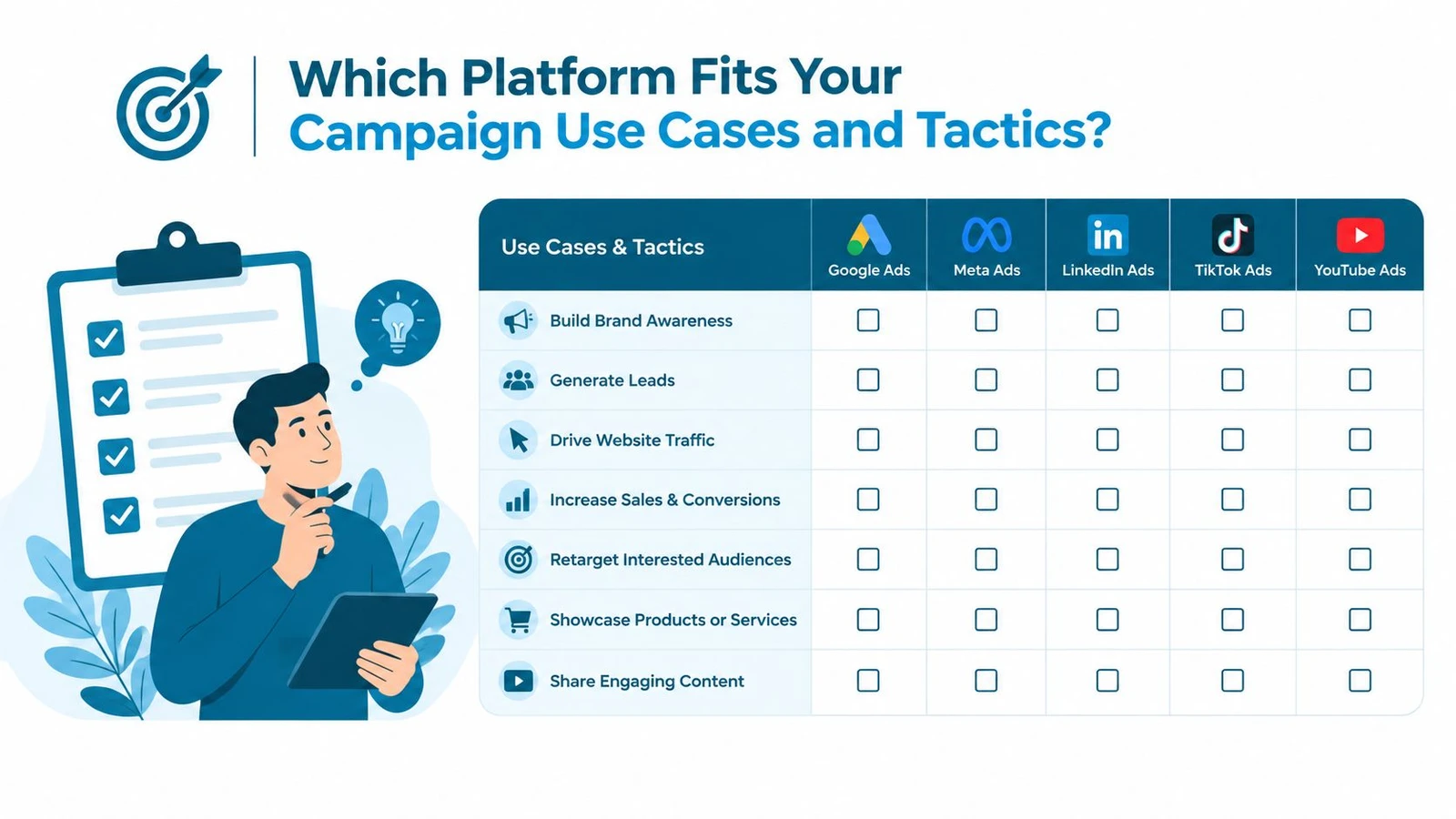
The cleanest way to choose is to start with the campaign’s dominant operating model. If your team already runs on Democratic or progressive voter records and needs a shared universe for canvassing, phone, and contact logging, NGP VAN is the natural fit. If the campaign’s center of gravity is compliance, fundraising discipline, and reporting oversight, Aristotle is the more coherent choice. If the team wants a bundled suite with mobile canvassing, mapping, turf cutting, and simpler administration, Trail Blazer is the more practical lane.
That makes the decision less ideological than operational. A campaign can love a platform’s interface and still make the wrong choice if the underlying workflow doesn’t match how staff work on doors.
A compact decision matrix
| If your campaign needs this | Lean toward |
|---|---|
| Shared voter universe across field and compliance | NGP VAN |
| Reporting and administrative control first | Aristotle |
| Bundled canvassing, mapping, and fundraising in one place | Trail Blazer |
| Simpler administration for a smaller team | Trail Blazer |
| Tight ecosystem alignment for Democratic organizing | NGP VAN |
For teams that want a dedicated canvassing layer, a tool like doornoc can sit alongside the chosen core system as the field execution layer. Its mobile app supports offline capture and automatic sync, and its route tools are built for campaign field work, which makes that kind of pairing useful when the core system is strongest on records but not on route intelligence.
Tactics should drive the stack, not the other way around
If your campaign is running live route changes during a weekend push, you want the field layer to handle that cleanly. If your data team is worried about duplicates and history loss, you want the core CRM to preserve the universe. If your compliance team owns the bottleneck, you want the platform that keeps filings and accounting tidy enough that field work doesn’t force a separate spreadsheet shadow system.
Final Recommendation and Next Steps Before You Choose
The best way to de-risk NGP VAN vs Aristotle vs Trail Blazer is to test the workflow, not the pitch deck. Start by checking whether your voter file matches the platform’s record structure, then run a small offline canvass in a low-connectivity area and see whether the app preserves every contact cleanly when it reconnects. After that, validate the API path or data handoff into your canvassing layer, then generate a real walk list and inspect route balance, usability, and duplicate handling before anyone signs a contract.
Three questions should decide the final choice. Can the system preserve voter history without manual cleanup? Can field staff work offline and sync back reliably? Can your team move data between targeting, canvassing, and reporting without exporting everything by hand? If any one of those answers is weak, the platform may still be a fit, but only if you’re honest about the extra process it creates.
A short field trial usually tells the truth faster than a procurement meeting. Give the team a real turf, a real shift, and real volunteers, then watch where they get stuck. The best platform is the one that keeps your organizers moving, your data clean, and your next walk list ready before the field captain has to ask twice.
If you’re trying to connect voter data, routing, offline canvassing, and live field visibility in one campaign workflow, doornoc gives you a mobile knocking app, auto turf generation, and data services that fit the same operational problem discussed here. Visit doornoc to see how it can support your canvass stack alongside the system you choose.
Weighing it against something lighter? doornoc vs NGP VAN and VoteBuilder covers cost, access and what each one does at the door.