You’re staring at a phone in a bad-signal neighborhood, a volunteer is waiting at the next door, and the app that worked fine at headquarters is suddenly the wrong tool. That’s the core political-app problem in 2026, not whether a platform has another shiny feature, but whether it can survive the walk, the workflow, and the size of the race.
The best political apps are the ones that match the campaign’s operating reality. A lean volunteer drive needs something simple enough to train fast. A funded field program needs route generation, data discipline, offline capture, and reporting that don’t fall apart when turnout pressure rises.
| Political Apps Field Operations Comparison | Canvassing | Voter Lookup | Volunteer Mgmt | Offline Sync | Best Fit |
|---|---|---|---|---|---|
| NGP VAN / MinVAN | Strong | Strong | Strong | Strong | Large coordinated campaigns |
| MobilizeAmerica | Moderate to strong | Moderate | Strong | Moderate | Volunteer-led event and turnout programs |
| Ecanvasser | Strong | Moderate | Moderate | Strong | Mid-size independent races |
| Reach | Light | Limited | Limited | Strong | Distributed texting and quick outreach |
| Hustle | Limited | Limited | Limited | Moderate | Peer-to-peer SMS programs |
| VoteBuilder-adjacent tools | Strong | Strong | Moderate | Strong | Party-aligned field operations |
A Field Director’s Guide to Choosing the Best Political Apps
A field director in a low-signal neighborhood doesn’t need a brochure, they need a decision. If the app can’t handle route cuts, offline collection, and quick volunteer handoffs, it doesn’t matter how polished the interface looks at headquarters.
The first filter is race size. Lightweight volunteer tools are fine when the universe is small and the staff is thin. Once the campaign starts pushing beyond a few thousand doors or hiring paid field staff, the app has to do more than collect contacts, it has to organize a real operation.
Practical rule: if a team can train a volunteer in under half an hour and still trust the data at the end of the day, the app is doing its job.
The second filter is data maturity. Some campaigns have a clean voter file, stable precinct IDs, and someone who knows how to audit exports. Others are still working out who owns the turf and how the sync behaves after a long walk. The right app reflects that reality instead of pretending every race has the same field muscle.
The third filter is integration depth. If the campaign lives inside a broader CRM and needs centralized reporting, the app should plug into that system cleanly. If the operation is still proving basic field discipline, simplicity wins. The wrong choice is usually buying too much infrastructure too early, then forcing volunteers to absorb the complexity.
How Political Apps Became Campaign Infrastructure
A field team starts with a simple app request, then keeps piling on duties until the app becomes part of the operation itself. That shift showed up in October 2008, when the Obama campaign released the free Obama08 iPhone app, which organized supporter contacts for outreach and bundled donation tools, news feeds, event listings, and issue positions into one mobile product MediaShift.
That changed the job. A political app was no longer just a place to read updates. It became a working tool for calls, fundraising, and participation, and once campaigns saw mobile could coordinate action, the category stopped being decorative.
Later field programs made that shift obvious. By late September 2018, the mobile canvassing app MiniVAN had logged 218,189 users, up from 153,513 users recorded during all of 2016, with more than six weeks still left before Election Day, according to MediaShift. That growth shows field teams were not testing a nice-to-have. They were making it part of daily turnout work.
Three forces pushed the category into its current form. Smartphones got cheap enough that every volunteer could carry a field device. Campaign systems matured around structured voter files and workflow handoffs. After 2016, teams wanted self-service tools that volunteers could use without a two-hour briefing.
That is why today’s shortlist looks different from the one a field director would have used in 2018. Proprietary campaign CRMs still matter, but third-party canvassing apps now sit on top of them as the front line for walk lists, contact logging, and real-time field reporting.
The divide isn’t “app or no app.” It’s whether the app only collects data, or helps a team move actual voters.
Comparing the Best Political Apps for Field Operations
See the comparison table above for the full feature breakdown. The question is simpler: which app matches the size of the campaign, the staffing model, and the amount of cleanup your team can tolerate?
Large coordinated campaigns need a field system that holds together under pressure. That means centralized turf management, staff coordination, and clean handoffs between field work, compliance, and analytics. The price of that control is complexity. These systems assume a team that already knows how to work inside process and can keep the workflow disciplined.
Volunteer-driven turnout programs need a different shape. They live on events, signups, and fast activation. A lighter app works well here because it lets organizers move people quickly without forcing every task through a heavy field stack. The drawback is just as clear, these tools are not built for a campaign that wants to run a highly customized walk program every day.
Mid-size independent races sit in the middle, and that is where many campaigns make the wrong call. They either stay too small for too long and end up re-cutting turf by hand, or they buy more system than they can use. The right choice is a canvassing platform that gives structure without burying the team in setup and admin. If the app adds more coordination work than it removes, it is the wrong fit.
Text-first outreach plays by different rules. Distributed contact work and peer-to-peer SMS belong to campaigns that care more about conversation volume than street-level turf management. These tools are useful when the operation needs fast touchpoints and quick follow-up, but they should not be treated as a substitute for a real field operation.
Party-centered campaigns need consistency across counties, offices, and staff layers. They also need a voter universe that connects field work to the broader operation. That setup favors tools that fit inside a larger party workflow, not standalone apps that isolate data or create another reporting layer to manage.
The breakpoint is easy to spot. Once volunteers, turf, and follow-up are too messy to run in a spreadsheet, lightweight tools stop scaling. At that point, an integrated canvassing platform takes over because it gives the campaign one place to manage work, track contact, and keep the field program moving.
Matching Political Apps to Real Campaign Scenarios
A local race can make a simple app look brilliant, then expose its limits the moment the field budget grows. The same is true in the other direction. A big operation can bury itself in software before the first door is knocked if the stack is too heavy.
Small race, small universe
A city council campaign with under 20 volunteers and a tight budget should stay light. A simple canvassing app plus a spreadsheet-based turf workflow is enough if the campaign is still figuring out message discipline and volunteer retention. The breakpoint arrives when the team starts re-cutting turf by hand because the list is no longer small enough to manage casually.
Mid-size independent campaign
A nonpartisan down-ballot race in the middle budget range needs more structure. That campaign has enough doors, enough shifts, and enough volunteer turnover that a real canvassing platform starts paying for itself in fewer mistakes and cleaner follow-up. The app should reduce admin work, not create it.
Volunteer-led ballot measure
A ballot measure powered by volunteers should favor relational outreach and low-friction coordination. Text-first programs and lightweight contact tools work because the goal is rapid activation, not deep voter file architecture. The campaign should keep legal and data exposure under control by avoiding unnecessary complexity.
Advocacy program for younger voters
An 18-25 outreach program needs conversational contact, not a traditional door-heavy field plan. Peer-to-peer texting and distributed contact workflows work better than trying to force a walk program into a group that’s harder to reach at the door. The winning stack is the one that matches behavior, not the one that looks most complete on paper.
| Best Political Apps by Campaign Scenario | Budget Range | Canvassers | Recommended Apps | Breakpoint Reason |
|---|---|---|---|---|
| City council race | Tight | Under 20 volunteers | Simple canvassing app plus spreadsheet workflow | The universe is still small enough to manage manually |
| Competitive congressional district | High | 80+ canvassers | Full integrated field stack | Central route generation and oversight become non-optional |
| Volunteer-led ballot measure | Lean to moderate | Mostly volunteers | Text-first outreach tools | Relational contact beats complex walk management |
| Advocacy non-voter program | Variable | Distributed contacts | Peer-to-peer SMS tools | Door-to-door is the wrong default for this audience |
One useful exception belongs here. doornoc is a political canvassing platform with a mobile door-knocking app, route planning, offline collection, real-time tracking, and voter data services, so it fits naturally in conversations about field stacks for campaigns that still need active walk programs.
Implementing Canvassing Apps Without Losing Your Week
The rollout fails in the first week, not on election day. That’s when bad turf, weak onboarding, and broken exports show up. The app choice matters, but the implementation sequence matters more.
Start with route generation
Route generation comes first because bad turf wastes real human time. A platform should turn a clean voter file into walkable routes that staff can trust. If precinct IDs are wrong or the file hasn’t been QC’d, the canvass will be full of dead ends, vacant lots, and bad handoffs.
Treat offline sync as non-negotiable
Canvassing happens where cell service is patchy. If the app can’t hold data locally and sync later, the campaign loses information every time the signal drops. A team should test that behavior before the first shift, not after volunteers have spent an afternoon collecting contacts that never made it back.
For a practical checklist on that exact problem, the field team can use essential offline canvassing app features for 2026 elections.
Train for retention, not theater
Volunteer onboarding should be short and repeatable. A long live session feels thorough, but it usually burns attention before the team reaches the doors. Script prompts, clean task flows, and a simple first-use experience matter more than making the trainer sound polished.
Export testing should happen on day one. If the file doesn’t round-trip cleanly through the app and back into the campaign’s system, the problem is already real.
The export pipeline needs to be checked before GOTV. A campaign should verify that cut files move in and out without column drift, missing fields, or naming mismatches. That single habit saves more late-night cleanup than almost any feature on the vendor deck.
Privacy, Data Handling, and Trust in Political Apps
The privacy question is usually asked backward. The wrong question is which app looks safest on a sales page. The right question is which platform minimizes exposure while still supporting field intelligence.
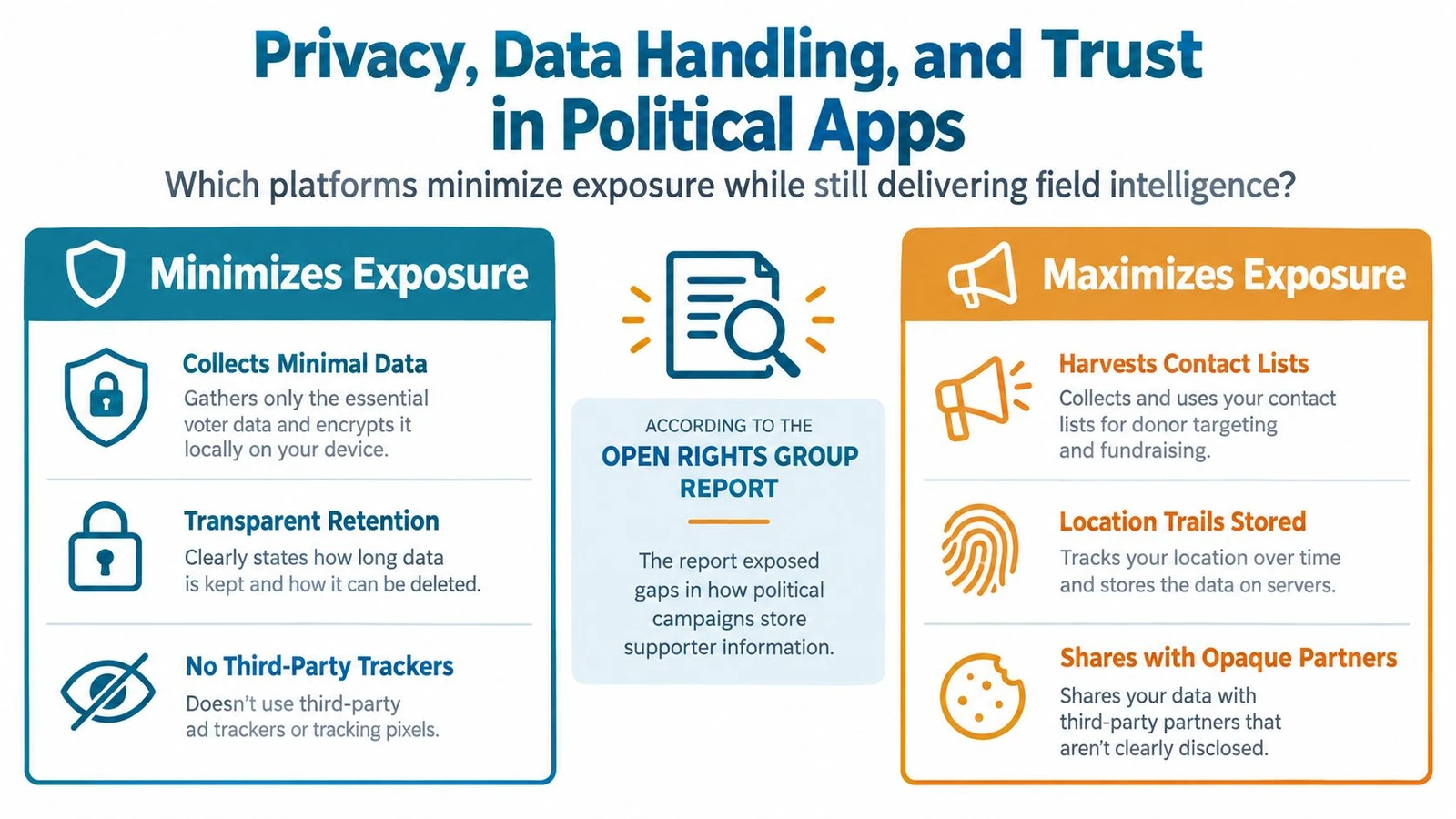
The Open Rights Group’s 2025 report on election-canvassing apps points to a basic tension, canvassing tools can store highly detailed outreach and engagement records, and that data can widen the exposure surface if campaigns don’t control where it lives Open Rights Group. The report’s value is that it shifts the conversation away from marketing language and toward data handling.
Minimize what volunteers carry
A campaign should prefer tools that keep only the data volunteers need for the task in front of them. Local-only mode, shorter retention windows, and limited device exposure are all better than letting every handset become a miniature archive. The safest setup is usually the one where the volunteer sees less, not more.
The data handling question is closely tied to trust. If a campaign hands out full voter files to every device in the field, the risk isn’t just technical, it’s operational. The better model is to centralize what the campaign owns and reduce what each volunteer can expose.
For a more detailed look at that trade-off, the privacy guide at campaign data privacy and canvassing app controls is a useful reference point.
Watch for centralization without oversight
Large field stacks make life easier, but they also move more data into systems the campaign can’t fully inspect. That’s the trade. Central storage can improve coordination, yet it also means the campaign has to trust the vendor’s controls and retention policies.
A resource for teams that want to manage app privacy settings can help staff tighten access before the field rollout begins. That kind of control won’t fix a sloppy process, but it does reduce unnecessary exposure.
The simplest rule is this. If the campaign can get the field job done while storing less, sharing less, and retaining less, that’s the better setup. Data discipline is not a nice-to-have in political apps, it’s part of the operating model.
Which Political App Should Your Campaign Actually Buy
The recommendation should be blunt. Small, volunteer-led campaigns need tools that stay out of the way. Bigger field operations need infrastructure that can absorb pressure without turning every shift into a manual cleanup exercise.
Clear picks by campaign size
| Best Political App Picks by Campaign Size | Campaign Type | Budget Range | Recommended App | Why It Wins | Upgrade Trigger |
|---|---|---|---|---|---|
| Volunteer-led ballot measure | Ballot or advocacy program | Under $25K | Spoke-style lightweight canvassing setup | Fast volunteer training and low friction | When shift volume starts stressing manual follow-up |
| Nonpartisan down-ballot race | Local or mid-size race | $25K to $150K | Ecanvasser-style field platform | Better structure without enterprise overhead | When turf cuts and reporting become daily bottlenecks |
| Statewide or congressional operation | Large coordinated campaign | Above $150K | MobilizeAmerica plus NGP VAN | Centralized volunteer and field coordination | When the campaign needs integrated field oversight |
| Distributed texting program | Advocacy or turnout support | Variable | Reach-style messaging stack | Strong for contact-heavy outreach | When the campaign needs full canvassing logistics |
The breakpoint is not theoretical. Once a campaign starts pushing beyond roughly 150 volunteer shifts per week or 40,000 doors, lightweight tools stop scaling cleanly and an integrated platform becomes non-optional. At that point, the campaign needs route logic, field oversight, and data consistency more than it needs simplicity.
That’s why smaller campaigns should not buy for a future they haven’t earned yet, and larger campaigns should stop pretending a lean tool can carry a heavy field program. A campaign director should choose the simplest app that can still survive the busiest week on the calendar.
For teams comparing software layers before procurement, the field guide at best field management software for political campaigns in 2026 is worth using as a second screen.
The decision rule is simple. If the campaign can’t trust the turf, the sync, and the export on the busiest day, it hasn’t picked the right app.
If a campaign needs cleaner turf cuts, offline field capture, and a route system that doesn’t waste volunteer time, doornoc is built for that job. It’s a practical fit for teams that want canvassing, voter data, and reporting in one field workflow. Visit doornoc to review the platform and see whether it matches the race size and operating style at hand.
Looking for a tool to run this? doornoc’s canvassing software bundles voter data, automatic turf cutting, the mobile app, and live reporting in one platform.