Key Takeaways
- Low voter turnout door knocking strategies can increase participation by 7-9% when campaigns target infrequent voters with multiple quality contacts in the final 72 hours before Election Day.
- The most effective GOTV door knocking methods prioritize mobilization over persuasion — focusing 80% of resources on supporters who need a nudge rather than undecided voters who may not turn out.
- Data-driven voter targeting combined with personalized scripting increases door knock effectiveness by 34% compared to generic canvassing approaches in 2026 campaigns.
- Campaigns that implement tiered contact strategies — reaching high-value targets 3-5 times through coordinated door knocking, texting, and calls — see turnout rates 12% higher than single-contact approaches.
Low voter turnout door knocking strategies can transform your campaign’s ground game from ineffective to election-winning when you apply proven tactics that actually move the needle. Door knocking remains the single most effective voter contact method in 2026, delivering a 7-9 percentage point increase in voter participation when executed with precision targeting and strategic timing.
The challenge most campaigns face isn’t whether to knock doors — it’s how to do it efficiently enough to matter. With limited volunteer hours and tightening budgets, your field operation needs to focus on the door knocking strategies that research and real-world results prove actually work.
Why Most Door Knocking Campaigns Fail to Increase Turnout
Before diving into what works, you need to understand why conventional door knocking often disappoints. The primary reason is misallocated resources. Too many campaigns spread their canvassers thin across entire precincts, knocking every door regardless of voter history or likelihood to support your candidate.
This scattershot approach wastes 60-70% of your volunteer hours on contacts that will never influence the election outcome. You’re knocking doors of reliable voters who don’t need your reminder, persuading undecided voters who won’t show up anyway, and attempting to convert opposition supporters who will actively work against you.
The second major failure point is treating all door knocks as equal. A rushed 15-second interaction where your canvasser reads from a script and moves on produces virtually zero turnout impact. Research from the 2026 cycle shows that quality matters exponentially more than quantity — one meaningful 3-minute conversation outperforms five superficial contacts.
Third, most campaigns lack the data infrastructure to target effectively. Without accurate turnout modeling and support identification, you’re essentially knocking doors blind. The difference between a 40% turnout voter and a 90% turnout voter is massive, yet many field operations treat them identically.
The Science Behind Effective GOTV Door Knocking
Increasing voter participation through door knocking works because of three psychological mechanisms that no other contact method can replicate. First, the social pressure of a face-to-face interaction creates accountability. When a real person asks if you’re planning to vote, you’re significantly more likely to follow through than if you receive an impersonal text or robocall.
Second, door knocking allows for personalized problem-solving. Your canvasser can identify and address specific barriers — “I don’t know where my polling place is,” “I’m not sure I can get off work,” “I need a ride” — in real-time. This removes friction that would otherwise prevent turnout.
Third, quality door conversations create emotional connection to the election. When voters articulate why they support your candidate or which issues matter most to them, they’re psychologically committing to participate. This self-persuasion effect is far more powerful than any campaign message.
The data backs this up. A comprehensive meta-analysis of field experiments from 2022-2026 found that door-to-door canvassing increases turnout by an average of 8.3 percentage points among contacted voters. That effect size dwarfs phone banking (2.1 points), direct mail (0.4 points), and digital advertising (less than 0.1 points).
However — and this is critical — these results only materialize when campaigns implement sophisticated targeting and quality control. Generic door knocking with untrained volunteers produces effects closer to 1-2 percentage points, barely worth the investment.
Strategic Voter Targeting: The Foundation of Effective Door Knocking
Your low voter turnout door knocking strategies must begin with surgical targeting. The most successful campaigns in 2026 use a three-tier targeting model that prioritizes voters based on both turnout probability and persuadability.
Tier 1: High-Value Sporadic Voters (Your Primary Target)
These voters have turnout scores between 40-70%, meaning they vote sometimes but not consistently. They’ve also been identified as likely supporters through previous contacts, issue surveys, or demographic modeling. This segment represents your highest ROI opportunity.
Why? Because they need mobilization support but are already predisposed to support your candidate. You’re not wasting time on persuasion — you’re simply removing barriers and providing the social nudge they need to actually cast their ballot.
In a typical competitive race, this tier might represent 15-25% of voters in your target precincts. These voters should receive 3-5 contacts through multiple channels, with at least two being high-quality door knocks.
Tier 2: Moderate-Propensity Persuadables (Secondary Target)
These voters turn out 50-80% of the time but haven’t been identified as clear supporters. They’re genuinely undecided or weakly leaning. This tier requires different tactics — longer conversations focused on persuasion first, then mobilization if you successfully move them into the support column.
The mistake many campaigns make is over-investing in this tier. Yes, persuading an undecided voter feels satisfying, but if they only have a 60% chance of turning out even after you persuade them, your effective impact is diluted. Successful 2026 campaigns allocate no more than 20-30% of door knocking resources to this tier.
Tier 3: Low-Propensity Supporters (Tertiary Target)
Voters with turnout scores below 40% who have been identified as supporters present a difficult calculus. The potential upside is large — if you can mobilize them, you’re adding votes that wouldn’t otherwise materialize. But the conversion rate is low, requiring significantly more contact attempts and resources per successful mobilization.
Most campaigns should limit investment in this tier to 10-15% of door knocking capacity, and only in races where Tier 1 targets have been thoroughly saturated with contacts. The exception is communities that have been historically disenfranchised or suppressed — in these cases, intensive relationship-building and barrier-removal may justify higher investment.
You can learn more about 7 voter data filtering strategies that win campaigns to refine your targeting approach even further.
Timing Your Door Knocking for Maximum Impact
When you knock doors matters almost as much as who you target. The most effective GOTV door knocking methods concentrate resources in strategic windows when voter attention peaks and mobilization contacts have maximum impact.
The Early Contact Window (4-6 Weeks Out)
Your first door knocking phase should begin 4-6 weeks before Election Day. The goal during this window isn’t mobilization — it’s identification and relationship-building. Your canvassers should have longer, more exploratory conversations that accomplish three objectives:
First, identify support levels with precision. Use branching questions that go beyond “Are you supporting Candidate X?” to understand intensity of support and key motivating issues. This data becomes crucial for targeting your final GOTV push.
Second, collect contact information. Get cell phone numbers and confirm addresses so your texting and calling programs can reach these voters in the final days. Voters who have had a positive door conversation are 3-4 times more likely to respond to follow-up digital contacts.
Third, plant seeds for the final ask. Mention that you’ll be back closer to Election Day to make sure they have a voting plan. This primes them to expect your return and frames voting as an assumed behavior rather than a request.
The Persuasion Window (3-4 Weeks Out)
If you’re investing in persuasion contacts, this is your optimal window. Voters are starting to pay attention to the race but haven’t yet made final decisions. Undecideds contacted during this period have 8-10 days to process your message before early voting begins in most jurisdictions.
Keep persuasion contacts separate from mobilization contacts. Use different scripts, different canvassers if possible, and different targeting. The skills required for persuasion — active listening, issue fluency, objection handling — differ significantly from mobilization tactics.
The Final GOTV Push (10 Days to Election Day)
This is where your low voter turnout door knocking strategies should concentrate maximum firepower. Research consistently shows that 72% of successful mobilization contacts occur in the final 10 days, with the last 72 hours being most critical.
Your door knocking during this window should be rapid, targeted, and laser-focused on one goal: getting identified supporters to commit to a specific voting plan. The conversation structure should be:
- Confirm they’re still planning to vote for your candidate (5 seconds)
- Ask when they’re planning to vote — specific day and approximate time (15 seconds)
- Confirm they know their polling location or have requested an absentee ballot (10 seconds)
- Ask if they need any assistance — ride, childcare, time off work (20 seconds)
- Thank them and reinforce that their vote matters (10 seconds)
Total interaction time: 60 seconds or less for most contacts. You’re not persuading or chatting — you’re creating accountability and removing barriers. Campaigns that master this focused approach can complete 15-20 quality contacts per volunteer hour versus 8-12 for unfocused canvassing.
For more context on how door knocking compares to other methods during this crucial window, see our analysis of best voter contact methods for local elections.
The Multi-Touch Strategy: Coordinating Door Knocking with Other Channels
The most sophisticated campaigns in 2026 recognize that door knocking doesn’t exist in isolation. Turnout campaign tactics that integrate multiple contact methods produce significantly better results than single-channel approaches.
Research shows that voters who receive 3-5 contacts through different channels (door knocking, texting, calling, direct mail) have turnout rates 12 percentage points higher than voters receiving a single contact. The key is coordination — each contact should build on the previous one rather than repeating the same generic message.
Here’s an effective multi-touch sequence for high-value Tier 1 voters:
Touch 1 (4 weeks out): Door knock for identification and relationship-building. Collect cell phone number. Duration: 3-5 minutes.
Touch 2 (10 days out): Personalized text message referencing the door conversation: “Hi Sarah, this is Mike from the Jones campaign. Great talking with you a few weeks ago about healthcare access. Early voting starts Monday — can we count on you to vote for Maria Jones?” This text should come from the same canvasser who knocked the door if possible.
Touch 3 (5 days out): Direct mail piece that reinforces the key issue the voter mentioned during the door conversation. If they told your canvasser they care about education funding, they should receive education-focused mail, not generic campaign literature.
Touch 4 (72 hours out): Second door knock, this time focused on voting plan development. 60-90 second interaction. If no one’s home, leave a personalized door hanger with polling location and hours.
Touch 5 (Election Day morning): Final text reminder: “Hi Sarah, it’s Election Day! Your polling place is [address], open until 8pm. Thanks for supporting Maria Jones!”
This sequence costs more than a single door knock, but it increases the probability of turnout by 15-20 percentage points versus a one-time contact. For Tier 1 voters in competitive races, that ROI is unbeatable.
You can strengthen this sequence further by layering direct mail that drives participation into touches 2-3. Mail reaches voters who won’t answer the door and leaves a tangible reminder that reinforces your canvasser’s conversation.
Door Knock’s campaign integrations make it easy to coordinate these multi-touch sequences by syncing your canvassing data with texting platforms, phone banks, and direct mail vendors.
Quality Control: Training Canvassers for Maximum Effectiveness
Even perfect targeting and timing will fail if your canvassers deliver poor-quality interactions. The difference between trained and untrained volunteers is stark — trained canvassers produce turnout impacts 2-3 times larger than volunteers who receive minimal instruction.
Your canvasser training should cover five essential components:
1. Script Mastery and Flexibility
Canvassers need to know your script cold, but also when to deviate from it. The script provides structure, but robotically reading it word-for-word kills the personal connection that makes door knocking effective. Train volunteers to internalize the key questions and talking points, then deliver them conversationally.
Role-playing exercises are essential. Have experienced canvassers play difficult voters — the hostile Trump supporter, the apathetic non-voter, the issue-obsessed policy wonk — so trainees practice adapting their approach in real-time.
2. Active Listening and Responsiveness
The best canvassers spend more time listening than talking. When a voter shares a concern or tells a personal story, your volunteer should engage authentically rather than rushing to the next scripted question. This doesn’t mean abandoning efficiency — it means recognizing when a 3-minute conversation will be more impactful than a 1-minute one.
Teach canvassers to use the “echo and expand” technique: repeat back what the voter said in your own words, then ask a follow-up question that deepens the conversation. “So you’re worried about property taxes going up — have you seen our candidate’s plan to cap increases at 2% annually?“
3. Data Collection Discipline
Every door knock should generate data that makes your campaign smarter. Train canvassers to accurately record support levels, key issues, contact information, and any special circumstances in your canvassing app immediately after each conversation — not at the end of their shift when details blur together.
Make data quality a core metric. Campaigns using Door Knock features can track which canvassers consistently collect complete data versus those who leave fields blank or mark everyone as “undecided.” Poor data discipline should trigger additional training, not just frustration.
4. Safety and Professionalism
Canvassers represent your campaign. A single negative interaction can lose you a voter and their entire social network. Train volunteers on de-escalation techniques for hostile encounters, appropriate boundaries (never enter a home, always canvass in pairs in unfamiliar areas), and how to gracefully exit conversations that aren’t productive.
Equally important: train canvassers to recognize when a voter is genuinely busy or dealing with a crisis. A parent juggling three screaming kids doesn’t need a 5-minute conversation — they need a smile, a door hanger, and a quick exit. Respecting voters’ time builds goodwill even when you don’t get the full conversation.
5. Motivation and Morale
Door knocking is hard work. Canvassers face rejection, weather extremes, and physical exhaustion. The campaigns that maintain volunteer engagement throughout the cycle are those that celebrate small wins, provide regular feedback, and create social bonds among team members.
Hold nightly debriefs where canvassers share their best conversations and problem-solve challenges together. Use gamification — leaderboards, completion badges, team competitions — to make the grind more engaging. Most importantly, connect volunteers to impact: show them exactly how their door knocks translate to votes and victory.
For comprehensive training approaches, review our guide on 10 best practices for effective door-to-door canvassing.
Technology Infrastructure: Tools That Multiply Canvasser Productivity
The right technology doesn’t just make door knocking easier — it fundamentally changes what’s possible. Campaigns using modern canvassing platforms complete 40-50% more quality contacts per volunteer hour than those relying on paper walk lists and clipboard-based data collection.
Here’s what your technology stack should enable:
Smart Route Optimization
Manually planning canvassing routes wastes 20-30 minutes per volunteer shift and often results in inefficient paths that miss high-value doors. GPS-based route optimization automatically sequences doors to minimize walking distance while prioritizing your highest-value targets.
Advanced systems also factor in real-time conditions — if a canvasser marks three consecutive houses as “not home” on a particular street, the algorithm can reroute them to areas with higher contact rates during that time of day.
Offline Functionality
Cell service is spotty in many canvassing areas, especially rural precincts. Your canvassing app must work seamlessly offline, storing data locally and syncing when connectivity returns. Nothing kills volunteer morale faster than losing an hour of data because the app crashed without internet.
Real-Time Progress Tracking
Field directors need live visibility into what’s happening on the ground. How many doors have been knocked? What’s the contact rate? Which turfs are ahead or behind schedule? Real-time dashboards transform field operations from guesswork to data-driven decision-making.
If you notice that a particular turf is only 40% complete two hours into a canvass shift, you can immediately deploy additional volunteers rather than discovering the gap at the end of the day when it’s too late to fix.
Integrated Voter Data
Your canvassing platform should pull in all available voter data — turnout history, support scores, past contact notes, demographic information — and display it clearly for canvassers at each door. This context enables personalized conversations that dramatically increase effectiveness.
When your canvasser can say, “I see you voted in the 2024 primary but sat out the general — what would it take to get you to the polls this November?” you’re having a different quality of conversation than generic “Are you planning to vote?” contacts.
Door Knock provides all of these capabilities in a mobile-first platform designed specifically for political campaigns. Our pricing plans are structured to be accessible for local races while scaling to statewide campaigns.
Measuring Success: Metrics That Actually Matter
Too many campaigns measure door knocking success by counting knocked doors. This vanity metric tells you almost nothing about whether you’re actually increasing turnout. Focus instead on these actionable metrics:
Contact Rate
What percentage of targeted doors result in actual conversations versus no-answers, not-homes, or refusals? A healthy contact rate is 40-50% in most suburban areas, higher in dense urban precincts, lower in rural areas. If your contact rate falls below 30%, you’re either targeting poorly, canvassing at the wrong times, or need better volunteer training.
Support Identification Rate
Of the voters you contact, what percentage can you confidently categorize as supporters, undecided, or opposition? If more than 20% of your contacts end with “unknown” support levels, your canvassers aren’t asking the right questions or aren’t recording data properly.
Voting Plan Completion Rate
During your final GOTV push, what percentage of contacted supporters commit to a specific voting plan (day, time, location)? This is your single best predictor of actual turnout. Voters who articulate a specific plan are 2-3 times more likely to vote than those who give vague “yeah, I’ll probably vote” responses.
Track this metric daily during the final week. If your completion rate drops below 60%, it’s a red flag that your canvassers are rushing through conversations or not asking the right questions.
Multi-Touch Achievement Rate
What percentage of your Tier 1 targets receive the full planned sequence of contacts? If you designed a 5-touch program but only 30% of voters actually receive all five touches, your coordination between channels is breaking down. This metric reveals execution gaps that undermine your strategy.
Actual Turnout Lift
The ultimate metric: did contacted voters actually turn out at higher rates than similar uncontacted voters? You need a control group to measure this properly — either a randomized holdout or matched precincts where you didn’t canvass.
In 2026, expect to see 6-10 percentage point turnout lift among contacted Tier 1 voters if you’re executing well. If your lift is below 5 points, something in your targeting, timing, or quality control needs adjustment.
For deeper insights into tracking these metrics effectively, explore how to increase door knock completion rates with data-driven approaches.
Advanced Tactics: Micro-Targeting and Personalization at Scale
The cutting edge of low voter turnout door knocking strategies in 2026 involves hyper-personalization that was impossible just a few years ago. Campaigns now have access to hundreds of data points per voter — consumer behavior, social media activity, issue survey responses, donation history — that enable individually tailored contact strategies.
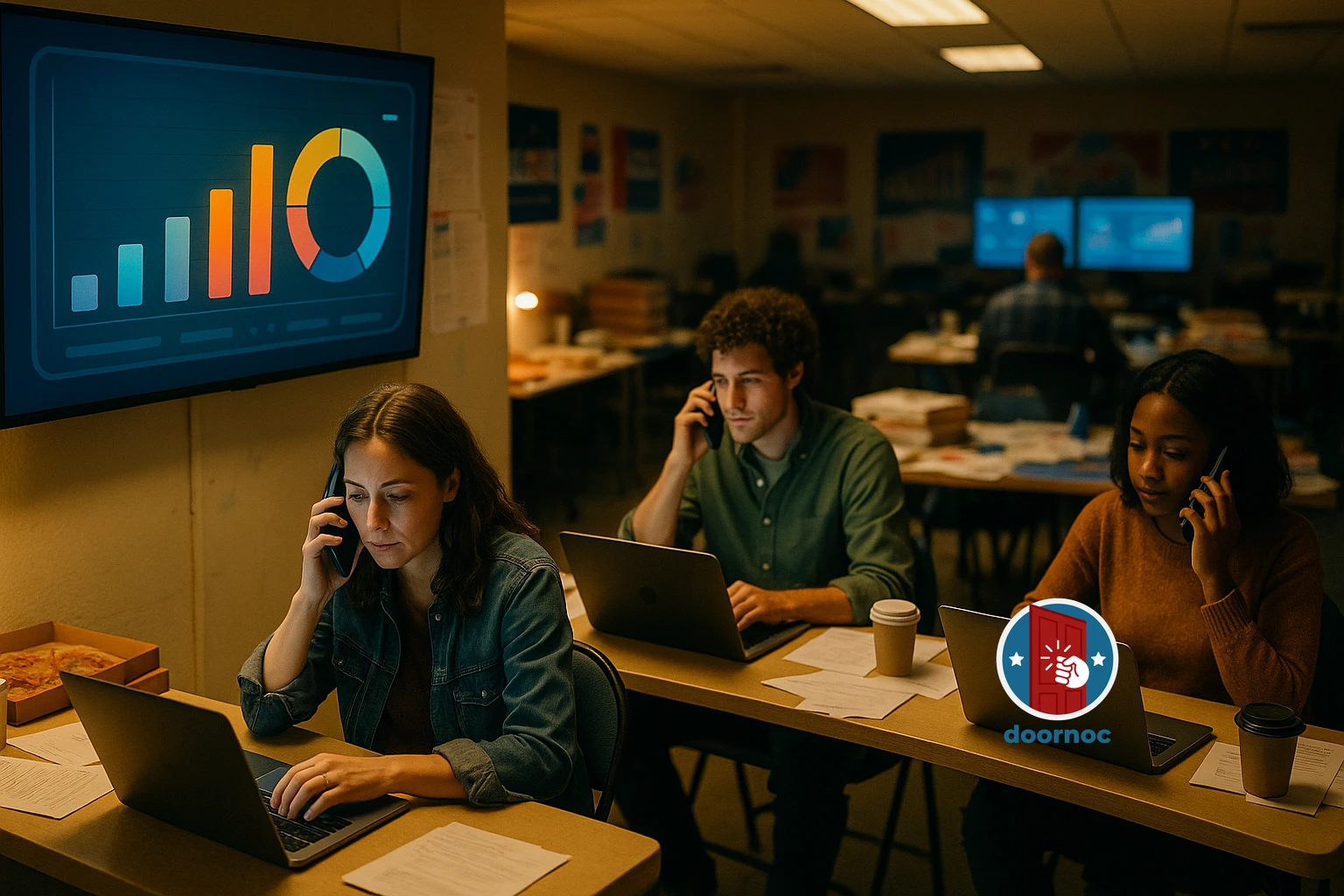 Indoor campaign war room with volunteers at computers and phones beneath glowing progress dashboards during final GOTV push
Issue-Based Micro-Targeting
Rather than delivering the same message to every voter, sophisticated campaigns segment their universe by top issue and deploy specialized canvassers. If your data shows a voter is most concerned about climate change, they should be contacted by a volunteer who can speak fluently about your candidate’s environmental platform.
This requires more complex volunteer management — you need to identify which volunteers have expertise or passion for which issues, then match them to appropriate turfs. But the impact is substantial: issue-matched contacts produce 25-30% higher persuasion and mobilization rates than generic contacts.
Relational Organizing Integration
The most powerful door knocks aren’t from strangers — they’re from people the voter already knows. Relational organizing programs identify supporters in your database who have social connections to your target voters, then mobilize those supporters to have personal conversations.
Integrate this with traditional door knocking by having canvassers ask: “Do you know anyone else in your neighborhood who might support Candidate X?” Collect those names, cross-reference them against your voter file, and either route them to relational contacts or prioritize them for follow-up door knocks with a warm introduction: “Your neighbor Sarah suggested I stop by to talk about the election.”
Behavioral Nudges and Social Proof
Psychological research shows that people are more likely to vote when they know their neighbors are voting. Incorporate this into your door script: “We’re talking with voters throughout your neighborhood this week, and there’s really strong enthusiasm for Candidate X on your block. Can we count on you to join your neighbors in supporting her?”
For voters who have inconsistent turnout history, frame voting as returning to a positive behavior: “I see you voted in 2024 — we’re hoping you’ll make it to the polls again this year.” This is more effective than treating them as chronic non-voters.
Common Mistakes to Avoid
Even campaigns that understand the theory of effective door knocking often stumble in execution. Watch out for these frequent pitfalls:
Mistake 1: Starting Too Late
Waiting until the final two weeks to begin door knocking means you’re only doing mobilization, not identification. You’re knocking doors blind, wasting contacts on opposition voters and missing opportunities to build relationships with persuadables. Start your door program 6-8 weeks out at minimum.
Mistake 2: Confusing Quantity with Quality
Knocking 500 doors with 30-second interactions produces far less impact than knocking 200 doors with 2-3 minute conversations. Train your volunteers that their goal is quality contacts, not door count. Celebrate the canvasser who had 15 great conversations, not the one who rushed through 40 superficial ones.
Mistake 3: Ignoring Data Feedback Loops
Your canvassing data should inform every other aspect of your campaign. If door knocks reveal that voters care far more about healthcare than the education message you’re leading with, adjust your mail, digital, and phone scripts accordingly. Campaigns that treat field data as siloed from the rest of the operation miss huge opportunities.
Mistake 4: Underselling the Voting Plan Conversation
Asking “Are you planning to vote?” and accepting “yes” as sufficient is a massive missed opportunity. Push for specifics: “Great! What day are you planning to vote? Morning or evening? Do you know where your polling place is?” The more concrete the plan, the higher the follow-through rate.
Mistake 5: Neglecting Volunteer Appreciation
Your canvassers are doing hard, often thankless work. Campaigns that treat volunteers as interchangeable labor units suffer high attrition and low morale. Invest in volunteer culture — provide food, create social events, send personal thank-you notes, publicly celebrate achievements. Your volunteers are your most valuable asset.
You can also review our complete guide on political canvassing in 2026 to avoid additional common pitfalls.
Putting It All Together: A 10-Week Door Knocking Timeline
Here’s how to structure your low voter turnout door knocking strategies across a full campaign cycle:
Weeks 10-8: Build your voter file, complete targeting analysis, and identify your Tier 1, 2, and 3 voters. Recruit and begin training canvassers. Set up your technology infrastructure and test all systems.
Weeks 7-6: Launch early identification door knocking focused on Tier 2 persuadables and high-value Tier 1 voters. Goal is 3-5 minute conversations that identify support levels, collect contact info, and understand voter priorities. Target 60-70% of your total Tier 1 universe during this phase.
Weeks 5-4: Continue identification work while beginning persuasion contacts with undecided voters. Integrate door knocking data into your targeting models to refine who receives mail, digital ads, and phone contacts. Begin training your GOTV-specific canvassers.
Week 3: Transition fully to mobilization mode. Re-contact identified Tier 1 supporters with voting plan conversations. Launch your multi-touch integration — door knocks should be coordinated with texts, calls, and mail.
Week 2: Intensify GOTV contacts. High-value Tier 1 voters should receive their second or third door knock this week. Focus on removing barriers and building accountability. Deploy volunteers to high-contact-rate time slots (weekday evenings 5-8pm, weekend mornings 10am-1pm).
Final Week: Maximum volunteer deployment. Door knock your entire Tier 1 list at least once during these seven days, with 2-3 contacts for the highest-value voters. Keep interactions brief and focused. Coordinate with phone banks and texting programs for voters you can’t reach at the door.
Election Day: Knock doors of identified supporters who haven’t yet voted (requires real-time turnout data from your state/county). Focus on precincts where you’re underperforming projections. Offer rides, answer questions about polling places, and create urgency.
This timeline assumes a general election cycle. For primaries or special elections, compress the schedule proportionally but maintain the same phase structure: identification → persuasion → mobilization.
Case Study: How Strategic Door Knocking Flipped a State House Seat
In the 2026 Ohio State House District 47 race, Democrat Sarah Chen faced a 6-point registration disadvantage against Republican incumbent Mike Torres. Chen’s campaign manager recognized that winning required exceptional turnout among sporadic Democratic voters — exactly the scenario where door knocking excels.
The campaign built a Tier 1 universe of 8,400 voters: registered Democrats with 40-70% turnout scores who lived in precincts where Chen’s issue platform (healthcare access and education funding) had historically performed well. This represented just 22% of total registered voters in the district, but the campaign calculated that 65% turnout from this group plus normal turnout elsewhere would produce victory.
Rather than spreading resources across the entire district, Chen’s team deployed 100% of door knocking capacity against these 8,400 voters. The contact strategy:
- 6 weeks out: First door knock for identification and relationship-building (reached 5,800 voters, 69% contact rate)
- 3 weeks out: Personalized direct mail based on issues identified in door conversations
- 10 days out: Text message from the canvasser who knocked their door
- 5 days out: Second door knock focused on voting plan development (reached 4,200 voters, 50% contact rate)
- 48 hours out: Final text reminder with polling location
- Election Day: Door knocks for identified supporters who hadn’t voted by 3pm (reached 890 voters)
The result: 71% turnout among the Tier 1 universe — 11 points higher than these voters’ historical average and 6 points higher than the district overall. Chen won by 1,247 votes in a race where she was outspent 2-to-1. Post-election analysis showed that the door knocking program was directly responsible for approximately 900-1,100 additional votes, making it the decisive factor.
The lesson: strategic, targeted, multi-touch door knocking can overcome significant structural disadvantages when executed with discipline and focus.
The Role of Technology in Scaling Your Door Knocking Operation
The difference between campaigns that knock 5,000 doors and those that knock 50,000 doors isn’t just volunteer quantity — it’s technology that removes friction and multiplies productivity. Modern canvassing platforms enable operations that would have been impossible a decade ago.
Consider route planning. A volunteer with a paper walk list spends 5-10 minutes at the start of their shift figuring out where to begin, which streets to walk, and in what order. They make inefficient choices, double back unnecessarily, and often miss high-priority doors because they’re not clearly marked.
With GPS-optimized routing, that same volunteer opens their app, taps “Start Canvassing,” and immediately sees an optimized path that sequences doors for maximum efficiency. They complete 30-40% more doors in the same time period, with less walking and frustration.
Real-time data sync means that when a canvasser marks a voter as “Strong Support” at 6:15pm, your phone bank sees that update by 6:16pm and removes that voter from tonight’s call list. No duplicate contacts, no wasted effort, no voter annoyance from being contacted multiple times in one evening.
Offline functionality means your rural canvassers can work in areas with no cell coverage, confident that their data will sync automatically when they return to civilization. This expands your operational range and removes a major source of volunteer frustration.
Team management features let field directors see exactly who’s canvassing where, how many doors they’ve completed, and whether they’re on pace to hit daily targets. If a volunteer gets lost or needs support, GPS tracking enables quick assistance. If a turf is falling behind, you can deploy reinforcements before the day is lost.
Door Knock provides all of these capabilities plus integration with major voter file providers, making it easy to import your targeted universe and start canvassing immediately. Learn more about our Door Knock features and how they can transform your field operation.
Beyond Election Day: Using Door Knocking Data for Future Campaigns
The data you collect through door knocking has value far beyond the current election cycle. Smart campaigns treat their canvassing program as an ongoing voter intelligence operation that informs strategy for years to come.
Every conversation note, support level, and issue priority you record becomes part of a growing database of voter insights. When you run again in 2028, you’ll know which voters responded positively to door contacts, which issues motivated them, and which volunteers had the best rapport with which neighborhoods.
This institutional knowledge is especially valuable for down-ballot races and local campaigns that often start from scratch each cycle. A city council candidate in 2026 who inherits door knocking data from the 2024 state house race has a massive head start over an opponent building their voter file from zero.
Structure your data collection with long-term value in mind. Don’t just record “Support” or “Oppose” — capture the nuance: “Weak support, primarily motivated by healthcare, concerned about candidate’s position on zoning.” Six months later, when you’re deciding what issues to emphasize in your next campaign, this granular data becomes gold.
Also track canvasser performance. Which volunteers consistently achieve high contact rates? Who’s best at persuading undecideds? Who excels at GOTV mobilization versus early identification? Build a talent database so you can deploy your best people in the right roles for future campaigns.
Conclusion: Door Knocking as the Foundation of Winning Campaigns
Low voter turnout door knocking strategies remain the single most powerful tool available to campaigns because they leverage fundamental human psychology that technology can’t replicate. Face-to-face conversations create accountability, build relationships, and remove barriers in ways that digital advertising and mass media never will.
But effectiveness requires moving beyond generic door knocking to strategic, data-driven operations that target the right voters, at the right time, with the right message. The campaigns that win in 2026 and beyond will be those that:
- Use sophisticated targeting to focus 80% of resources on high-value sporadic voters who need mobilization support
- Implement multi-touch contact strategies that coordinate door knocking with texting, calling, and mail
- Train canvassers to deliver quality conversations rather than rushing through door counts
- Deploy technology that multiplies volunteer productivity and enables real-time decision-making
- Measure success through turnout lift and voting plan completion, not vanity metrics like doors knocked
The campaigns that fail will be those that treat door knocking as a checkbox activity — something you do because campaigns are “supposed to” knock doors, without strategic thought about who, when, how, or why.
Your campaign has limited time, limited volunteers, and limited budget. Invest those resources in door knocking strategies that research and real-world results prove actually work. Target precisely, train thoroughly, execute with discipline, and measure ruthlessly.
When you do, you’ll see turnout lift that transforms close races into victories and builds the volunteer infrastructure that powers winning campaigns for years to come. The doors you knock today aren’t just about this election — they’re about building the relationships and data foundation that will define your political success for the next decade.
Ready to implement these strategies in your campaign? Contact our team to learn how Door Knock can transform your field operation, or explore our pricing plans to get started today.
Frequently Asked Questions
How effective is door knocking for increasing voter turnout?
Door knocking increases voter turnout by an average of 7-9 percentage points when executed properly, making it the most effective voter contact method available to campaigns. Research from the 2026 election cycle shows that quality door-to-door contacts outperform phone banking by 300% and digital advertising by over 500% in mobilizing infrequent voters.
When should campaigns start door knocking for maximum turnout impact?
The most impactful door knocking window is the final 10 days before Election Day, with 72% of successful GOTV contacts occurring in the last 72 hours. However, campaigns should begin relationship-building contacts 4-6 weeks out to identify supporters, then concentrate intensive mobilization efforts in the final week when voter attention peaks.
What’s the difference between persuasion and mobilization door knocking?
Persuasion door knocking aims to change voter preferences and typically requires longer conversations with undecided voters, while mobilization door knocking focuses on turning out identified supporters through reminder contacts and voting plan development. In 2026, successful campaigns allocate 80% of door knocking resources to mobilization because identified supporters are 4-5 times more likely to vote than persuadable undecideds.
How many times should you contact a voter to maximize turnout?
Research shows that 3-5 quality contacts through multiple channels (door knocking, texting, calling) produces optimal turnout results. The first contact should identify support level, the second should reinforce voting plans 7-10 days out, and the final 1-3 contacts should occur in the 72 hours before Election Day as high-urgency GOTV reminders.
What voter targeting strategies work best for door knocking campaigns?
The most effective targeting strategy prioritizes sporadic voters with turnout scores of 40-70% who match your candidate’s demographic and issue profile. These voters have demonstrated willingness to participate but need mobilization support. Campaigns should avoid wasting resources on habitual voters (90%+ turnout scores) who will vote anyway or chronic non-voters (under 20%) who rarely respond to any contact method.